
Step 1: Understand what you're trading
One big mistake beginners make is jumping into trading without knowing what they're actually going to trade.
And I completely understand why. Most influencers shout from the rooftops that trading is an easy way to get rich...
It isn't.
That's why I'll start with a quick explanation of financial markets and the instruments you'll be trading.
Financial markets
Financial markets are where buyers and sellers meet to exchange financial products.
Each market and each financial product has its own characteristics, which will affect how you trade.
There are several markets:
- Interest rates: mortgages, savings accounts
- Currencies: currency pairs, such as EUR/USD
- Stocks: Tesla shares, Google shares
- Commodities: gold, oil
- Cryptocurrencies: Bitcoin, Ethereum
Exchange-traded and over-the-counter markets
An organised market is an exchange where transactions follow standardised rules and are regulated.
Products are listed there, and trading is transparent.
Major markets such as the CAC 40, NYSE and Nasdaq are examples of organised markets.
The over-the-counter (OTC) market, on the other hand, is decentralised. Transactions take place directly between the parties, without going through an official exchange.
OTC products aren't standardised, and trading terms can vary.
You can read this article to learn more.
Financial instruments
Now that you know the different financial markets, let's look at the main instruments you'll use to trade:
Futures are agreements to buy or sell an asset, such as a commodity or a financial instrument, at an agreed price on a future date.
CFDs (contracts for difference) are derivatives that let investors speculate on an asset's price movements without owning the underlying asset. They're traded over the counter.
ETFs (exchange-traded funds) are investment funds that track an index, a commodity or a basket of assets. They trade on an exchange like shares.
Step 2: Learn the basics of trading
What is trading?
Trading means buying and selling underlying assets.
A trader's main aim is to make a profit by buying an asset at a low price and selling it at a higher one, or doing the reverse.
The underlying asset is what a financial product is based on.
Take a Société Générale share:
- The financial product is the share.
- The underlying asset is Société Générale.
Now take a Bitcoin ETF:
- The financial product is the ETF.
- The underlying asset is Bitcoin.
Going long and going short
If you've watched trading content online, you've probably heard the terms long and short.
What do they mean?
Going long means buying an asset because you expect its price to rise.
For example, if you think Bitcoin will go up, you buy Bitcoin.
If the price rises, you can sell it for more and make a profit.
- You buy 1 Bitcoin at €65,500.
- If the price rises to €65,580, you sell it.
- Your profit is €80.
Going short, or short selling, means selling an asset you don't own because you expect its price to fall. You buy it back later at a lower price to make a profit.
For example, if you think Bitcoin will fall, you can sell Bitcoin you don't yet own.
If the price drops, you buy it back for less and keep the difference.
- You borrow 1 Bitcoin at €65,500 and immediately sell it.
- If the price falls to €65,420, you buy it back at that price and return it.
- Your profit is €80.
Usually, the broker takes care of the technical side. With CFDs, opening a short position is as easy as opening a long one.
Leverage in trading
Leverage lets traders increase their market exposure by borrowing additional funds on top of their starting capital.
Sounds like a cheat code, doesn't it? It isn't quite that simple.
Here's why.
Imagine you have €1,000 to trade with.
With 10:1 leverage, it's as if you had €10,000. Think of it as borrowing €9,000 from the broker.
You buy €10,000 worth of Bitcoin using that leverage.
First scenario:
- If Bitcoin rises by 5%, your total position is now worth €10,500.
- You return the €9,000 to the broker and have €1,500 left.
- Thanks to leverage, you've made €500 on your initial €1,000.
Second scenario:
- If Bitcoin falls by 5%, your total position is now worth €9,500.
- You return the €9,000 to the broker and have €500 left.
- Because of leverage, you've lost €500 of your initial €1,000.
Yes, you read that right. You only have €500 left.
You've lost 50% of your starting capital in a single trade.
Which raises another question:
What would happen to my capital if the loss were 10%?
You'd lose all of it and your trade would be closed automatically. That's called liquidation.
Remember, you still have to repay the €9,000 you "borrowed" through leverage.
Think of leverage as an amplifier. It can produce big gains, but it can also produce big losses.
And remember that losses hurt much more than gains feel good.
There's another point I want to clear up: using leverage doesn't necessarily mean taking more risk.
Paired with proper risk management, leverage can still be a useful tool.
Reading a price chart
Now we've covered the basics, let's move on to something practical: reading a price chart.
You can use several types of charts to analyse markets.
The main two are:
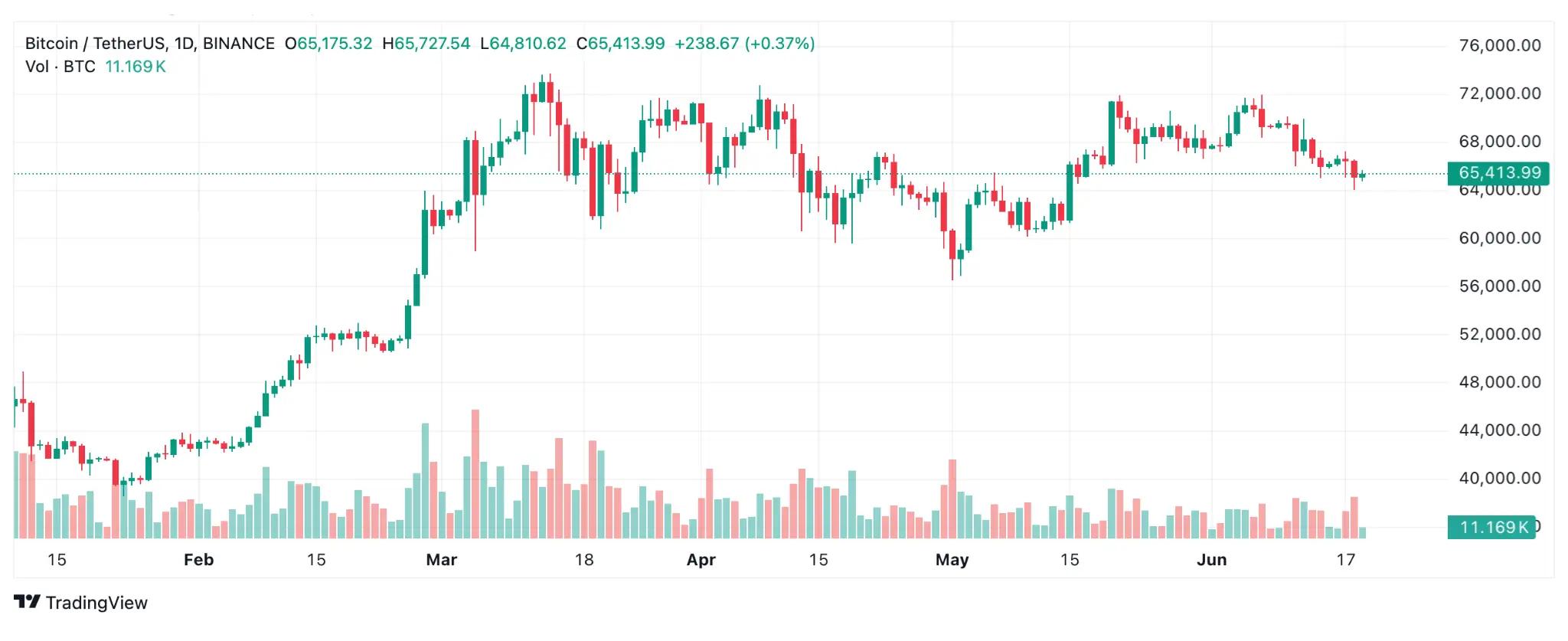
- Line charts. A line connects closing prices over a given period. Great for getting an overview.
- Candlestick charts. Each candle shows the opening price, closing price, high and low. Its colour tells you whether the price went up or down, usually green or red.
Fundamental and technical analysis
Once they're looking at a chart, traders can approach their analysis in different ways:
- Fundamental analysis: looking at information that isn't directly related to price. That could be a country's economy, inflation, wars or a company's financial health.
- Technical analysis: focusing on price and volume to anticipate future price movements.
- Random analysis, otherwise known as gambling: the best way to lose money and end up in that famous AMF statistic.
These approaches can be used on their own or combined.
Different types of traders
Traders don't just use different strategies. They also trade in different ways:
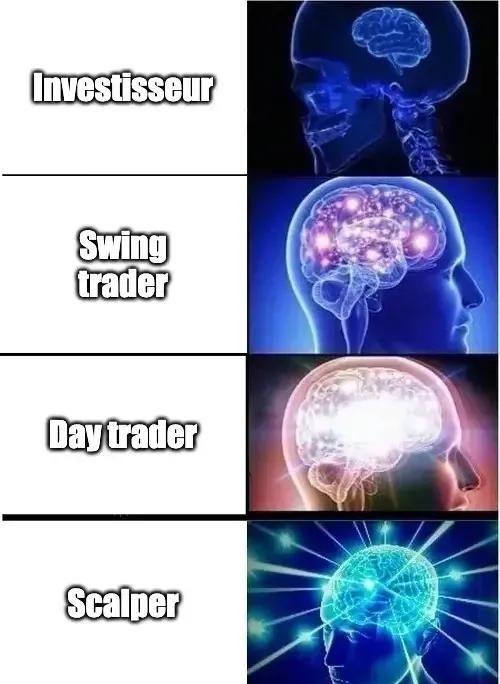
- Swing traders hold positions for several days or weeks to capture price movements.
- Investors take a long-term approach based on their analysis of trends.
- Day traders buy and sell assets within the same day.
- Scalpers take lots of small trades lasting seconds or minutes.
These trading styles differ in their time horizons, risk levels and goals.
You can wear more than one trading hat. I'm a scalper, a day trader and an investor, for example.
Different roles for different situations.
You'll also need to adapt your trading style to what you're trying to achieve. Don't worry, that comes with experience.
How do you choose your trading style?
You can use my quiz to find a trading style that suits your situation and personality.
As for the criteria:
The main thing to consider is how much time you can spend trading.
If you only have 30 minutes a day, I wouldn't recommend scalping.
You won't have enough time to analyse the market and trade.
Scalping opportunities appear very quickly. You need to spend several hours at your charts to spot them.
I'd suggest swing trading or investing instead.
The second criterion is the results you get when you try different styles.
Some will feel more comfortable than others.
You might be more profitable swing trading than day trading, for example.
That's a sign that swing trading could be the right fit.
Can trading make you rich?

The favourite question of anyone thinking about getting into trading.
First, I want you to answer these questions:
- Why are you learning to trade?
- How much time can you spend on it each week?
- How much money are you prepared to put in at the start?
- How much of that starting capital are you prepared to lose?
Your answers will tell you whether your plans and ambitions line up with reality.
You can't expect to become a millionaire through trading with €100 and 15 minutes a day.
So yes, trading can make you rich. But that possibility depends on several things:
- Your starting capital
- Your appetite for risk
- Your ability to trade
- The time you have available
- Your luck
I've written an article debunking trading myths. You might find it useful.
Step 3: Learn a trading approach
Why do you need to learn a trading approach?
An established approach gives you solid foundations to work from.
You can trade in full YOLO mode, and it can work. But the statistics show it's far from the best way to go about it.
A trading approach helps you understand when to enter and exit, identify trends and avoid common traps.
Without one, you're more likely to trade impulsively, which can lead to heavy losses.
That's something you really want to avoid...
Which approach should you learn?
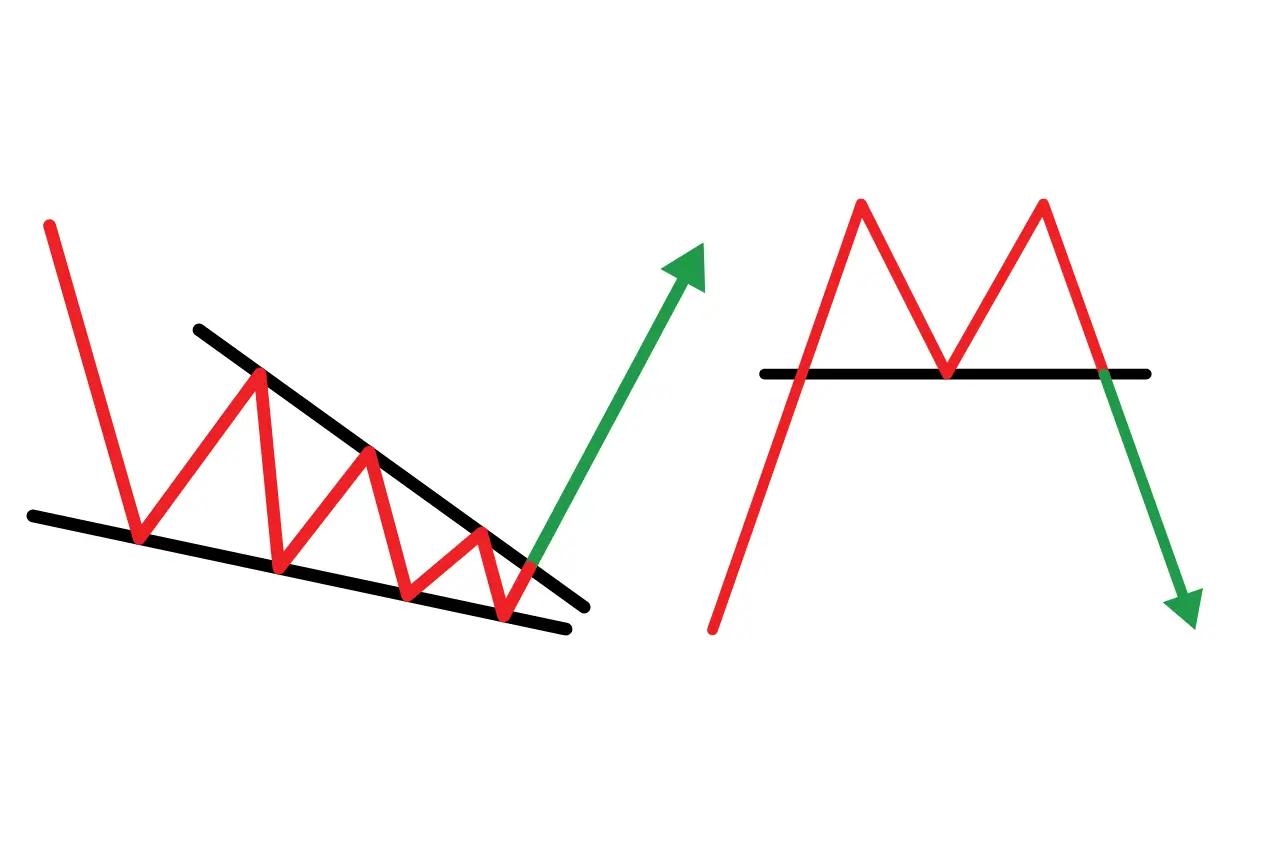
There's no shortage of trading approaches. There are more than a dozen, some simple and others more complex:
- Chart patterns
- Order flow
- ICT/SMC
- Elliott Wave
Chart pattern trading is the approach most commonly used by beginners.
It involves analysing charts to anticipate market movements.
By spotting chart patterns and confirming them with technical indicators, you can anticipate trend reversals and decide how to take a trade.
Just remember: no strategy or approach wins 100% of the time.
Step 4: Practise on a demo account
Now it's time to trade and put what you've learned into practice. But you're not going to throw yourself to the wolves straight away...
Trading comes with real financial and psychological risks.
That's why I recommend practising the approach you've just learned on a demo account.
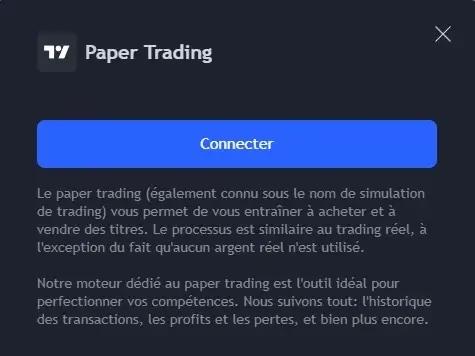
A demo account is a virtual trading account that simulates real market conditions without putting real money at risk.
It lets you apply what you've learned, try different strategies and develop a feel for the market.
Which demo platform should you use?
Several trading platforms and brokers offer demo accounts, each with its own advantages.
Here are two options to consider:
- TradingView
- MetaTrader 5 (MT5)
Moving to live trading
A demo account is necessary when you're starting out, but I wouldn't stay at this stage forever.
Once you've got the hang of things, which can take a few months of practice, you'll need to move to a live account. Psychology plays a huge role in trading.
Live trading brings in psychological factors that don't exist in a risk-free environment.
You can only work on that side of your trading when your own money is on the line.
But being profitable on demo doesn't mean you'll be profitable live.
Step 5: Trade with real money
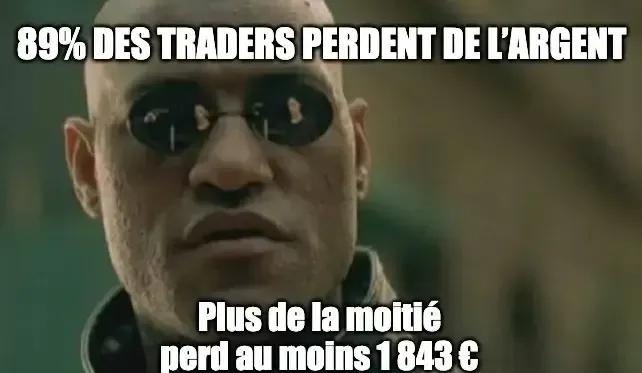
Before we start this section, a reminder of the AMF's statistics:
- 89% of traders lose money.
- The median loss is €1,843.
In other words, more than half of traders lose at least €1,843.
Surprising for something that's supposed to be easy, isn't it?
I don't want you to become part of that statistic. But going through a period of losing money is the best way to learn to trade.
As I mentioned earlier, the psychology of losing money has a major influence on the way you trade.
Which broker should you choose?
As a beginner, I'd recommend a regulated broker with competitive transaction fees and an intuitive trading platform.
Here are some options to consider:
Do your research and read reviews to find the one that suits you best.
How much money should you put in?
Only put money into your trading account that you're prepared to lose, but that would still hurt to lose.
To me, that's the most sensible approach. It brings psychology into play while protecting your capital.
If you're prepared to lose €100, start with €100.
If you're prepared to lose €50,000, start with €50,000.
Because yes, I've seen people put in all their savings and cry after losing everything.
For more on this, read how much money you need to start trading.
Understanding and managing your emotions
The main emotions you'll face are fear, greed, stress and sometimes euphoria.
Each one can harm your trading decisions if you don't manage it properly.
Stress makes you take irrational decisions. I explain how to manage it in this article.
Fear can leave you frozen, unable to make important decisions. Or it can push you to close a position too early because you're afraid of losing more.
Greed can make you take excessive risks in pursuit of quick gains. You might hold a winning position for too long, hoping for even more profit, only to lose it all when the market turns.
Euphoria can make you feel invincible. You take reckless decisions because you think you can't be wrong.
Here are a few ways to stay calmer and keep your emotions in check when you trade:
- Exercise. Do I really need to explain why?
- Build a daily routine.
- Meditate or practise deep breathing. I really like Wim Hof's guided breathing exercises.
Understanding your psychology
Live trading turns up the volume on your emotions.
You'll catch yourself acting or reacting in completely irrational ways.
That's why I recommend learning to identify your emotions, as well as keeping a trading journal.
Writing down your reactions, emotions and the reasons behind each decision helps you spot recurring patterns.
Those patterns can make or break a trader.
Most come from cognitive biases. They happen automatically, without you even noticing.
That's why a trading journal matters.
How should you structure your trading journal?
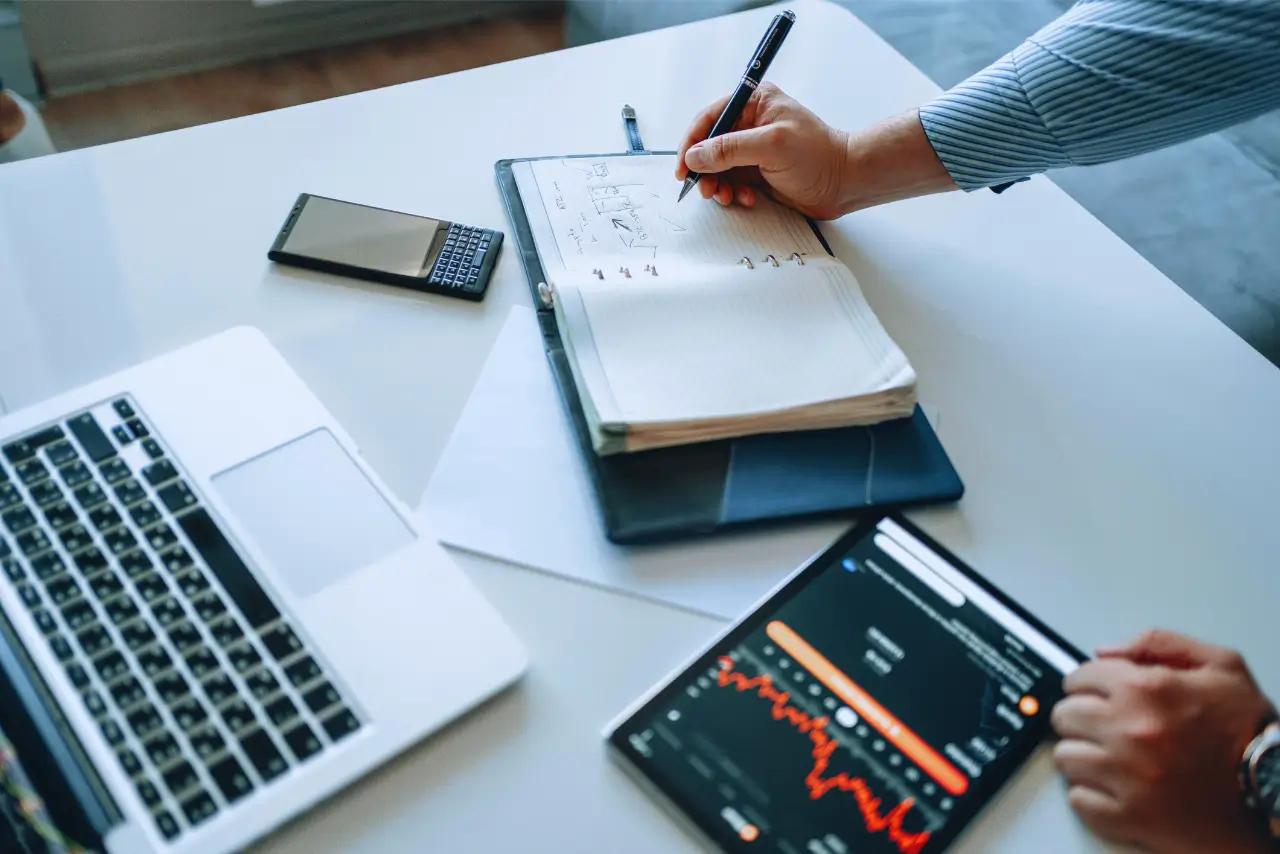
A trading journal isn't just a list of profits and losses. It helps you pinpoint what's working in your trading.
Lots of traders keep one. Few really know how to use it.
Writing "winning trade +€50" or "losing trade -€30" isn't enough.
I've written a full guide on keeping and analysing a trading journal. Read it to learn more.
Step 6: Take a prop firm challenge
I think taking a prop firm challenge and trying to keep the account is one of the most valuable learning experiences a beginner can have.
A prop firm is a company that funds traders, giving them capital to trade in return for a share of their profits.
It gives traders access to more capital without risking their own trading funds.
But to get that capital, you first need to pass a paid challenge.
You didn't think someone would just hand you money with nothing in return, did you?
And if you want to keep the account, your risk management needs to be spot on.
Because the prop firm's rules and conditions are set up so it can take the capital back and show you the door:
- Your strategy isn't profitable? You're out.
- You can't manage your emotions? You're out.
- You lose more than 3% of your capital on one trade? You're out.
There's simply no room for mistakes.
It's tough. That's exactly what makes it such a good learning experience.
