

Inflation is a broad, sustained rise in prices across an economy.
It directly affects your purchasing power, monetary policy and financial markets.
How is inflation measured in France?
The Consumer Price Index (CPI) is the main tool for tracking changes in the overall price level.
It covers major categories such as food, energy, tobacco, services and manufactured goods.
Each category is weighted according to its share of the average household budget.
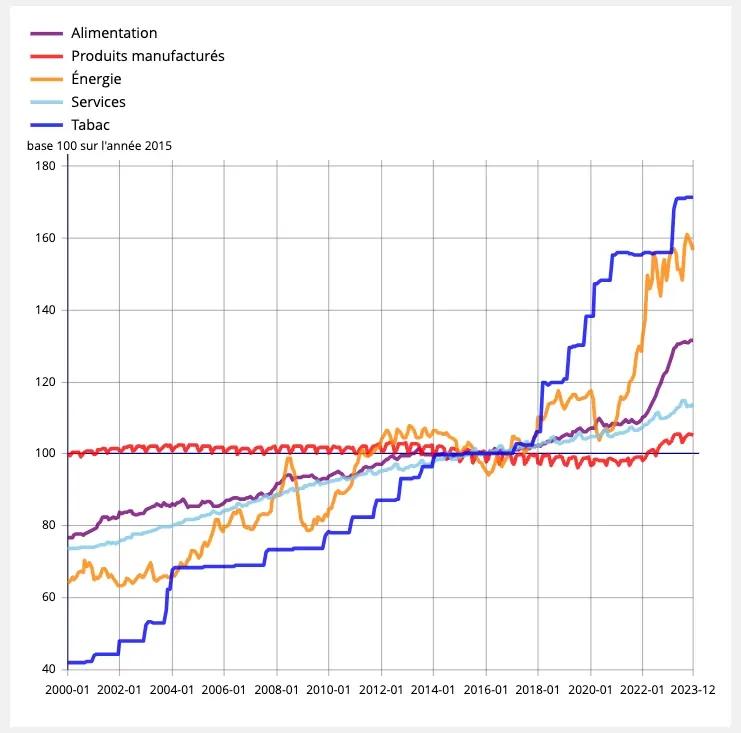
Source: Insee
Look at the chart and you’ll see tobacco prices rising in regular steps, while energy prices jump sharply all at once.
The reasons are straightforward:
- Tobacco prices rise in regular steps because of government taxes
- Energy prices rise because of pressure on global markets and geopolitical crises
Even though they rise for different reasons, both categories count towards the overall inflation figure.
Why do we talk about adjusted CPI?
Some prices move a lot from one month to the next.
A sharp rise in a single category can push up the overall index even if other prices stay stable.
Energy, for example, can get more expensive very quickly when international tensions rise.
To get a clearer picture of the underlying trend, we also use a core price index, or adjusted CPI.
It excludes the most volatile items, such as energy and fresh food.
How inflation affects you, and the markets
When inflation rises, your purchasing power falls. €100 no longer buys as much as it used to.
But there’s a macroeconomic impact too:
Central banks such as the ECB and the Fed adjust their interest rates in response to inflation.
They aim to keep prices stable by targeting inflation of around 2%:
- If prices rise too quickly, they raise interest rates to slow the economy and curb price growth
- If prices stagnate or fall too much, they cut rates to stimulate activity
Those decisions directly influence investors and financial markets.
I discussed this in my newsletter on the FOMC and interest rates.
Inflation, disinflation and deflation: know the difference
If a can of Red Bull goes from €1.50 to €1.80, that’s inflation.
Prices are rising over time.
If it then goes to €1.90, followed by €1.92, that’s disinflation.
Prices are still rising, but more slowly.
If that same can then falls to €1.40 and then €1.30, that’s deflation.
Prices are falling over time.
But an example like this isn’t enough to establish inflation across a whole country.
We look at changes in a range of goods and services across all sectors.
That’s what CPI measures: a broad, sustained rise in prices across the economy.
I’ve simplified complex ideas to make them accessible. Some deserve a fuller explanation.