Compare the best prop firms in 2026
Compare prop firms by type, platforms, assets and reviews to find the right fit for you.
What is a prop firm?
A prop firm (proprietary trading firm) is a company that provides individual traders with capital to trade financial markets.
In return, it takes a share of any profits you make, often between 10% and 30%.
What is a funded account?
A funded account is an account a prop firm makes available to you with a defined capital allocation, so you can trade without putting up your own trading capital.
A trader who obtains one is known as a funded trader.
How does a prop firm work?
Before giving you a funded account, a prop firm wants to check that you can trade responsibly within strict rules.
That's why it asks you to pass an evaluation challenge.
The process usually follows these steps:
- Choose a challenge. Choose the account size you want to try: 25K, 50K, 100K, 200K or more. Prices vary between prop firms, so it pays to compare offers and use promo codes.
- Pass the evaluation challenge. You need to reach a profit target, often between 6% and 10%, without breaking the firm's rules: maximum drawdown, daily loss limit, consistency rule, minimum trading days and so on.
- Activate the funded account. If you pass, some prop firms charge an activation fee before giving you access to the funded account. This fee may sometimes be refunded with your first payout.
- Trade with the prop firm's capital. Once your account is activated, you can trade with the capital available to you. The rules can change after the challenge, depending on the firm and account type, but you still have specific rules to follow. Break them and you can lose the account.
- Request a payout. If you make enough profit and stay within the account's rules, you can request a payout. The waiting times and withdrawal conditions vary between prop firms.
Different ways to get a funded account
Passing a challenge is the traditional route, but it is not the only option prop firms offer.
Some use a single evaluation, others have multiple stages or offer direct access.
- One-off challenge: you pay once to attempt the challenge. Pass and you receive a funded account. Fail and you lose the entry fee.
- Multiple stages: the challenge has several phases, for example an initial 8% profit target followed by a 5% target. Each stage may be more manageable, but the overall process takes longer.
- No challenge, or instant funding: you receive a funded account directly, without a traditional evaluation. In return, the entry fee is usually higher and the rules remain strict. I explain this in more detail in my article on instant funding prop firms.
Futures or CFDs: the two main types of prop firms
Prop firms mainly fall into two categories: those offering futures, and those offering CFDs.
This choice directly affects the instruments you can trade, available platforms, challenge prices and position management rules.
- Futures prop firms (such as Apex Trader Funding) give you access to futures markets. Challenges are often cheaper, reducing the cost of a failed attempt. However, most require you to close positions before the daily session ends, making swing trading difficult or impossible.
- CFD prop firms (such as FundedNext) offer access to forex and crypto, often through MetaTrader or TradingView. They give you more flexibility over holding periods, since positions can stay open for several days. However, challenges are generally more expensive and often have two stages.
I explain the differences between these models in a dedicated article: Futures or CFD prop firms.
Which prop firm should you choose for forex?
To trade forex pairs such as EUR/USD, GBP/USD or USD/JPY, you need a CFDs prop firm. Futures firms also offer currency exposure, but through futures contracts rather than spot forex.
Use the Forex asset filter in the comparison table to show only firms that offer it.
Demo funded or live funded
A prop firm may let you trade on a simulated account or on an account connected to the real market.
- Demo funded: you trade on a simulated account managed by the firm. Your orders do not go directly to the live market, but you can still receive payouts if you follow the rules and make profits. This is the model most prop firms use today.
- Live funded: you trade in real markets using the firm's capital. Orders are executed through its broker, exposing the firm to real risk. This model is less common. Even when a firm calls something a "live account", check what that actually means: it can sometimes be a demo account monitored or copied internally.
What is the best prop firm to trade with in 2026?
There is no single best prop firm for everyone.
A firm can be a great fit for one trader and much less suitable for another.
So don't look for the perfect prop firm. Look for the one that suits you best.
How do I choose the right prop firm?
The right choice mainly depends on your trading style, experience, target account size and risk tolerance.
Step 1: start with your trading style
In practice, the choice mainly depends on how you trade.
- If you regularly hold positions for several days: CFD prop firms are more suitable.
- If you mainly trade crypto with longer holding periods: CFD prop firms are also more suitable.
- For other styles, including day trading and scalping: Futures prop firms are often more attractive on cost.
Step 2: match your choice to your experience
The aim is not just to pass a challenge, but also to keep the account long enough to request a payout.
- Beginner: focus first on keeping the cost of each attempt down. Check the challenge price, any activation fees, the drawdown type and the trading platform.
- Intermediate: if you pass challenges but struggle to reach your first payout, price may no longer be the main criterion. Look at payout conditions instead: minimum trading days, profit target, loss limits and profit split.
- Experienced: if you already receive regular payouts, the ability to scale becomes more important. Some firms let you increase account size after several payouts or manage multiple accounts at once.
- Scalper: account prices and how well trailing drawdown suits your strategy may matter more. Because you hold positions briefly, this rule can be less restrictive than it is for swing traders.
Step 3: check the firm's reputation
A well-known, transparent firm used by many traders inspires more confidence than a new platform with no payout history.
Remember that conditions can change over time. Check them before buying an account.
My recommendations by trader profile
| Profile | Type | Recommendation | Key criterion |
|---|---|---|---|
| Beginner | Futures | Apex, Bulenox | Low cost per failed attempt, EOD drawdown, TradingView compatibility |
| Intermediate | Futures | Apex, Bulenox | Flexible payout conditions: minimum days, profit target and profit split |
| Experienced | Futures, CFDs | Apex, FTMO | Conditions that support scaling |
| Scalper | Futures | Apex | Competitive prices, trailing drawdown suited to scalping |
| Forex, swing and crypto trader | CFDs | FTMO, FundedNext | Some allow overnight positions |
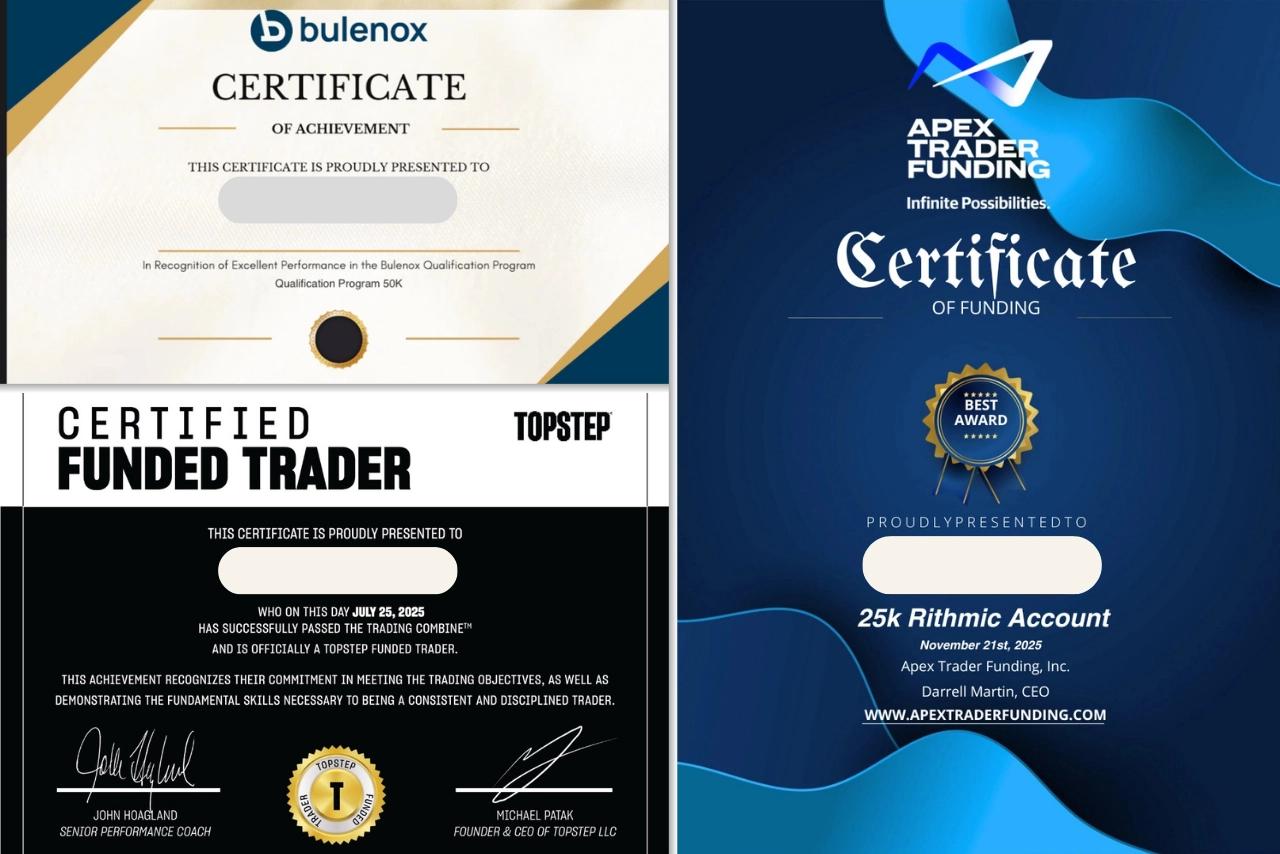
The benefits and limitations of prop firms
The main appeal of a prop firm is being able to trade with more capital than you would put up on your own.
But that benefit comes with constraints you should understand before starting.
Benefits
- You can trade with capital you might not have been able to put together yourself, such as 50K, 100K or more, while spending much less upfront.
- The rules can help you become more disciplined, particularly with risk management, daily losses and following a trading plan.
- Even a modest return can become meaningful. For example, 2% on a €200,000 account with an 80% profit split amounts to €3,200.
For more detail, I explain how to make a living from prop firms in a dedicated article.
Limitations
- The rules are strict. One mistake can be enough to lose the account, even if your strategy is profitable overall.
- You lose the challenge fee if you fail, and passing on your first attempt is never guaranteed.
- The account isn't yours. The prop firm can change its rules, ban certain practices or close down. You can then lose access to the account, your unpaid gains and your performance history.
I discuss this in more detail in my article: prop firms: scam or opportunity?
Frequently asked questions
Are prop firms regulated?
Most prop firms are not regulated in the same way as brokers. They generally operate through contracts between the firm and the trader.
For tax purposes, income earned through a prop firm must be declared.
In many cases, this income is treated as payment for a service rather than a capital gain. The exact treatment depends on your status, country of residence and the firm's contractual framework.
I explain the legal and tax framework in my article on prop firm taxes.
Are there any French prop firms?
Very few. The French firms that do exist are still little known and aren't widely used by the community.
All prop firms listed in this comparison accept traders resident in France.
Can I use several prop firms at once?
Yes. Some traders use this approach to diversify their sources of capital.
But be careful to follow each firm's own rules, including evaluation deadlines and maximum drawdown.
Which criteria does this comparison use?
Prop firms are compared using practical criteria such as:
- Challenge entry fees
- Available platforms: cTrader, MT5, R Trader and others
- Available assets: indices, crypto, currencies and others
- Challenge conditions
- Trustpilot reviews
- How long the firm has been operating
The table also shows the payment methods each firm lists for payouts, making it easy to see whether it supports bank transfers, crypto or other methods.
Is the comparison updated regularly?
Yes, the data is reviewed and updated regularly.
More reliable prop firms will be added as I analyse and research them.
Some may be removed if their conditions change or their reliability becomes questionable.
Explore prop firms
Find comparisons by criterion and detailed reviews of each prop firm.

I'm a former financial engineer with seven years of experience on trading floors and at a hedge fund. I use prop firms regularly and built this tool to compare the best offers quickly.
Disclaimer: This comparison is for information only and does not constitute professional financial advice. Conditions can change, so always check the prop firm's official website before buying a challenge. Some links are affiliate links.