
Drawdown is the main reason you fail a prop firm challenge, far more than your trading strategy.
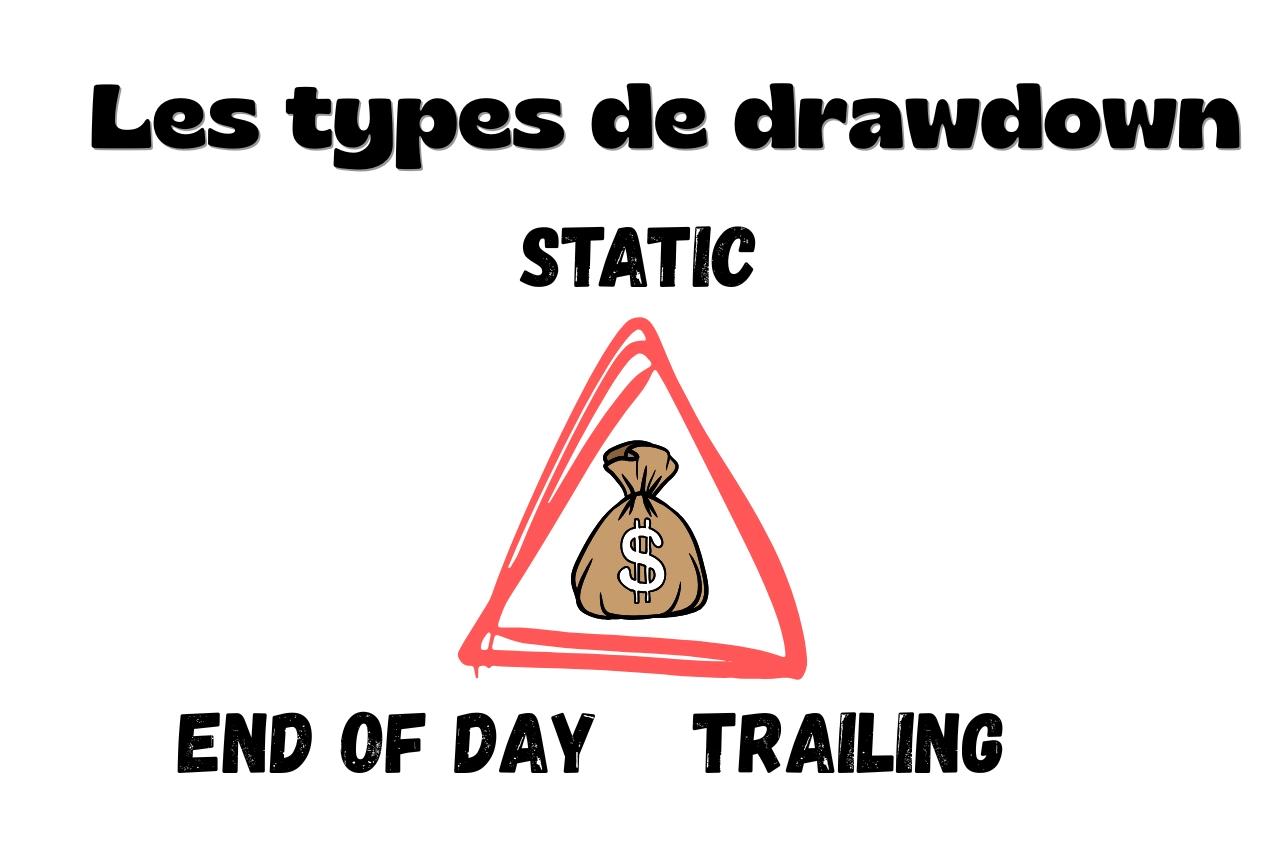
There are several types of drawdown, including static, trailing and end of day. Each completely changes how difficult your challenge is.
Understanding how they work tells you where your loss limit sits before you choose a challenge.
What is drawdown?
Drawdown is the maximum decline in your account's value over a given period.
It measures the fall from a peak to a subsequent low before the account recovers.
Drawdown is a standard trading term for a decline from an account's previous high. It can be expressed as an amount or a percentage.
Let's say you start with $10,000.
Your account rises to $10,500, then falls to $9,500.
The drawdown is $1,000, or roughly 9.5%.
Other examples:
- On a $50,000 account, a 5% drawdown allowance represents $2,500
- On a $100,000 account, 10% represents $10,000
Drawdown at a prop firm
At a prop firm, the drawdown limit is the maximum loss you can incur before failing the challenge or losing your funded account.
The limit serves several purposes:
- Preventing excessive risk and losses on a live account, if the firm allocates real capital
- Assessing a trader's ability to manage risk
- And, let's be honest, making you fail more challenges, which is part of the prop firm business model
Some firms calculate drawdown using account equity, including open positions.
Others use only the balance after positions close.
These differences produce the various drawdown models.
The different drawdown types
Static drawdown
The loss threshold is fixed. It does not move, even if you make profits along the way.
This is the easiest drawdown type to understand and manage.
It has less influence on how you trade because the threshold stays unchanged.
For example, on a $25,000 account with a 2% static drawdown allowance, your account must stay above the $24,500 loss threshold.
Even if the account rises to $25,300, the threshold remains $24,500.
View challenges with static drawdown.
Trailing drawdown
The loss threshold follows your account higher as you make profits. The more the account rises, the higher the threshold moves.
For example, you start with $50,000 and a drawdown allowance of 5%, or $2,500.
If the account rises to $52,000, the threshold moves to $49,500.
If the account then falls below that $49,500 threshold, you fail.
This is the most demanding type of drawdown. You need precise risk management, and it can quickly catch you out if you're not disciplined.
At some prop firms, the loss threshold adjusts in real time, even while a position remains open.
View challenges with trailing drawdown.
End-of-day drawdown
The permitted loss is calculated using the highest account balance recorded at the end of a trading day.
You'll often see this shortened to EOD.
But that doesn't mean the limit resets every day.
Consider a $100,000 funded account with a 6% end-of-day drawdown:
- Day 1: the account rises to $102,000
- Day 2: it rises to $103,000. The threshold is set at $96,820, which is 6% below $103,000
- Day 3: the account falls to $102,000. The threshold still uses the highest end-of-day balance, $103,000
This sits between static and trailing drawdown.
It gives you more room than intraday trailing drawdown, but you still need to manage your end-of-day balance carefully.
View challenges with end-of-day drawdown.
Intraday and balance-based drawdown
Some firms use names such as "intraday" or "balance-based".
- Intraday drawdown is similar to trailing drawdown
- Balance-based drawdown sits between end-of-day and trailing approaches
There can be important differences between firms, so always check the exact rules.
Drawdown affects challenge price and difficulty
Each prop firm chooses the drawdown model for its accounts.
Static drawdown accounts generally cost more because they are less restrictive and offer more flexibility.
Trailing drawdown accounts are often cheaper but much harder to pass.
Two $100,000 challenges can look identical, but the drawdown type changes everything.
A firm may compensate for a tougher model, such as trailing drawdown, by allowing a higher drawdown percentage, or do the opposite.
Before choosing, compare this rule both across accounts at the same firm and between firms.
You can use my challenge comparison tool to help choose.
Are there prop firms with no drawdown limit?
No. Drawdown limits are an integral part of the prop firm business model.
They help firms make money and limit potential losses on live funded accounts.
Personally, I'm very wary of prop firms that advertise a very large drawdown allowance.
Most of the time, it means they're not really interested in your risk management and probably don't intend to let you trade with real money.
