The5ers is a CFD prop firm operating since 2016. It has paid more than $43 million to its funded traders.
It has recently started offering Futures accounts.
I'll explain how the firm's own systems work, compare the accounts, go through the main pros and cons, and give you my opinion.
1) Account types
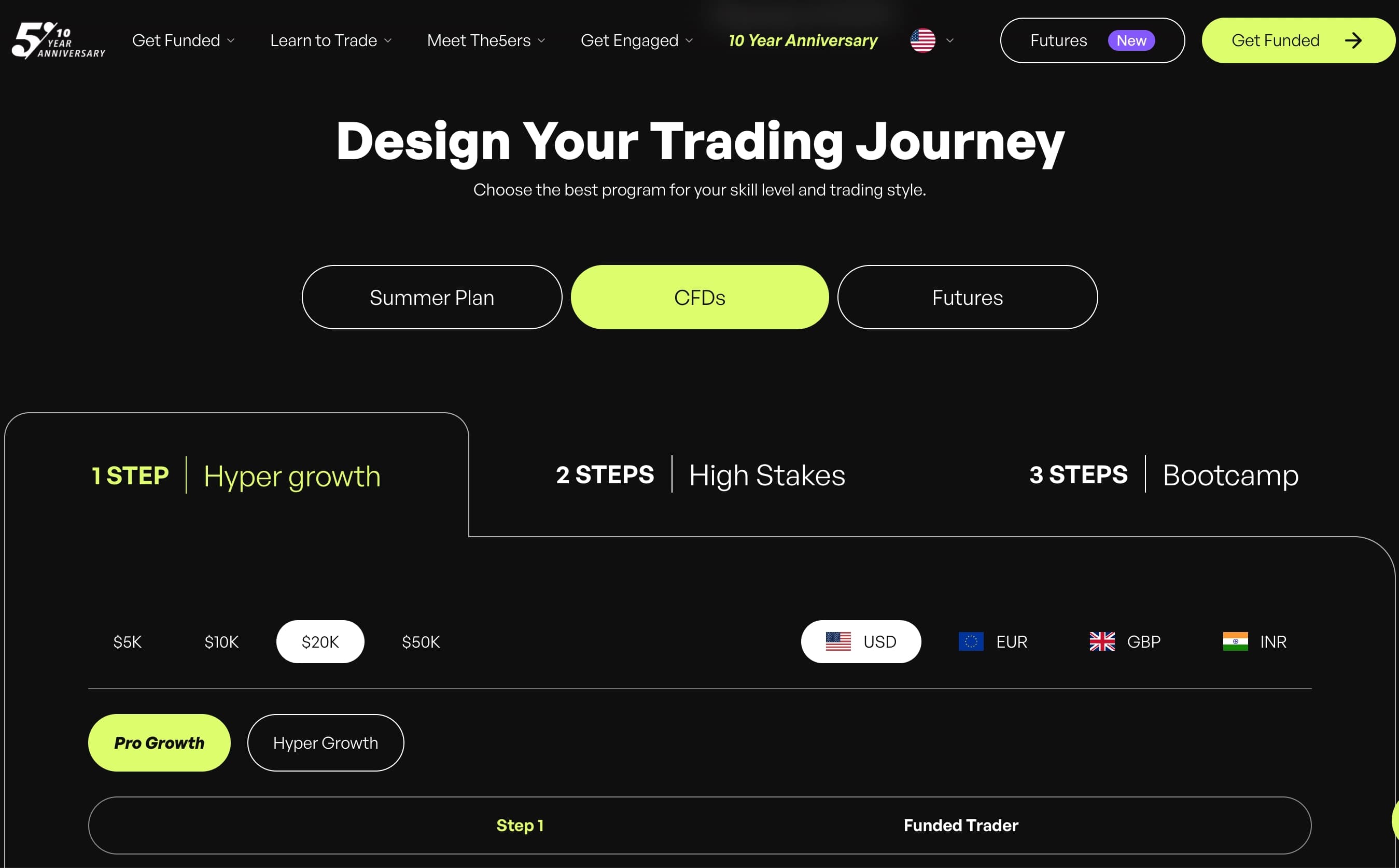
The5ers offers five evaluation models:
- Hyper Growth is a one-phase challenge with no minimum trading days
- Pro Growth follows the same one-phase structure but requires at least three profitable days
- High Stakes Classic uses a two-phase evaluation
- High Stakes also uses two phases, with a higher profit target than Classic in exchange for a lower price
- Bootcamp has three phases, a lower initial entry cost and an activation fee to pay later for the funded account
Drawdown and daily loss limits
All The5ers accounts use static drawdown.
Each account also has a daily loss limit, but the consequences of breaching it depend on the programme.
On High Stakes, High Stakes Classic and Pro Growth, the account is closed as soon as the daily loss exceeds the permitted limit.
On Hyper Growth and Bootcamp, trading is suspended until the next day without closing the account. For Bootcamp, this applies only to the funded account.
Don't get caught out by this distinction, especially if you switch account types or want to try a few different ones.
Funded account scaling
Once funded, you can increase your account size by reaching the profit target set by your programme.
Progression follows a schedule specific to each offer. The cap is $4 million on Hyper Growth and Bootcamp, compared with $500,000 on High Stakes:
- Hyper Growth requires 10% profit per stage to double the account size
- High Stakes also requires 10% profit, with increases set by its own schedule
- Bootcamp requires 5% profit per stage to increase the account size by 25%
Profit split
The profit share increases with account size and can reach 100% at the highest levels, regardless of the programme.
The starting share depends on the programme:
- Hyper Growth and Pro Growth start at 75%
- High Stakes starts at 80%
- Bootcamp starts at 50%
Limited offers
The5ers occasionally runs time-limited offers on specific account sizes, such as the Summer Plan.
These offers provide access to funded accounts at a lower entry cost than the standard programmes.
The Summer Plan comes in different versions, with either a one-phase or a two-phase evaluation.
What is Hub Credit?
Hub Credit is an internal balance you can use only to pay for all or part of a new evaluation account.
It cannot be withdrawn as cash and remains valid for three months from the date it is granted.
You can receive it in three ways:
- As a bonus after passing an evaluation phase
- By choosing to receive a payout in this form
- Through a partial refund of evaluation fees on some accounts
2) Advantages
Track record
The5ers has operated since 2016, compared with 2022 for firms such as FundingPips and FundedNext.
Remaining active, attracting traders and paying their profits after several years adds to its credibility.
News trading
Trading around economic announcements is allowed, apart from certain specific strategies.
Prices
Prices remain very competitive compared with other firms.
Weekend holding
Holding positions over the weekend is allowed on every account, both during the evaluation and once funded.
At FundingPips, for example, that option disappears once funded. All positions must be closed before the market closes on Friday.
Drawdown type
Every account uses static drawdown, the easiest drawdown type for a trader to manage.
3) Disadvantages
Slow progression to the highest profit share
Reaching the maximum profit share depends largely on keeping your account for a long time.
If you stay on smaller accounts and don't keep performing over time, you'll get a lower share than the maximum advertised by the programme.
The consistency rule
Limited offers such as the Summer Plan are attractive because of their lower prices. However, that comes with a 50% consistency rule, which is absent from the five standard account models.
The cheapest account upfront is therefore not automatically the best once funded.
4) My recommendation
I prefer the Pro Growth 20K. It offers the best balance between challenge price, capital, permitted risk and profit share.
At $189 as I write this, it has the best price-to-capital ratio in the Pro Growth range: $9.45 per $1,000 of capital.
It requires 10% profit, with a 6% maximum loss, a 3% daily loss limit and a starting profit share of 75%.
Hyper Growth has a more forgiving daily limit and faster scaling, but its 20K account costs $850.
If you already stick to a strict daily loss limit, I don't think paying four to five times as much is justified.