
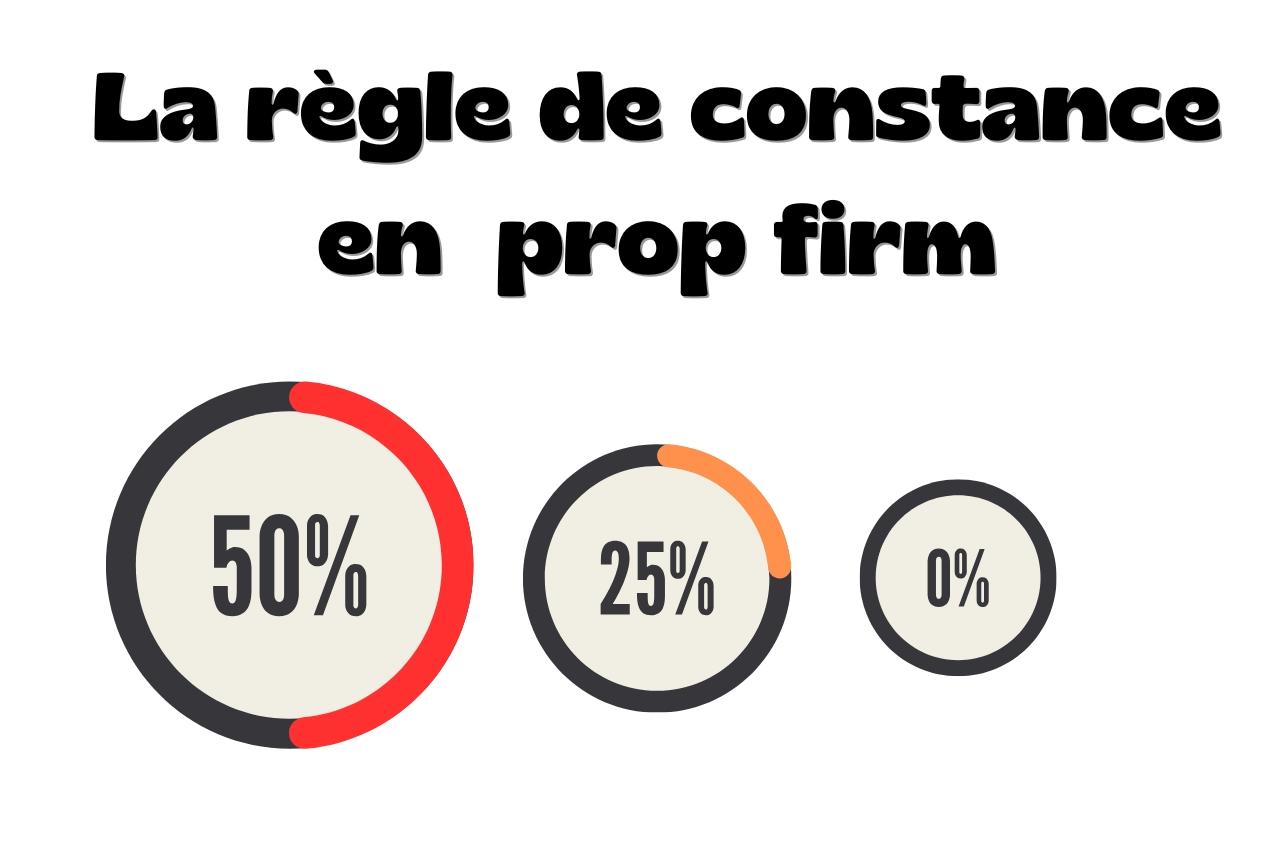
What is a consistency rule?
A consistency rule limits how much a single profitable day can contribute to a trader's overall performance.
A prop firm doesn't want you to hit the whole profit target in a single session.
It looks for steady performance over time rather than one large gain.
The exact name and conditions can vary between firms, but the principle is the same: your results should not depend too heavily on one day.
When does the consistency rule apply?
Prop firms apply the rule at different stages:
- Some apply it during the challenge
- Others apply it only to the funded account
- Some apply it to both
Before buying an account, don't just check whether there's a consistency rule. Check when it applies too.
You can use my challenge comparison tool to do this more quickly.
How do you calculate it?
Consistency rules are usually expressed as a percentage.
To calculate the daily profit threshold relative to the challenge's profit target, multiply the target by the consistency percentage.
The formula is:
Daily profit threshold = profit target × consistency percentage
This gives the daily profit level to stay within when aiming to pass at that target.
Example on a 50K account
Take a 50K account with a 6% profit target, or $3,000.
The prop firm applies a 50% consistency rule.
The calculation is:
3,000 × 50% = 1,500
A single day therefore cannot contribute more than $1,500 towards meeting that $3,000 total under this rule.
One session cannot account for more than half of the target.
| Consistency rule | Calculation | Daily profit threshold | Restrictiveness |
|---|---|---|---|
| 50% | 3,000 × 50% | $1,500 | Relatively flexible |
| 30% | 3,000 × 30% | $900 | Moderate |
| 20% | 3,000 × 20% | $600 | Restrictive |
A 20% rule leaves less room than a 50% rule because it reduces the share of profit allowed to come from one day.
What happens if you do not meet the rule?
The consequences depend on the firm and the stage where the rule applies.
During a challenge, you may reach the profit target without passing because the firm considers that your performance does not meet its requirements.
On a funded account, the issue often appears when requesting a payout.
The trader asks for a withdrawal, and the firm rejects it because the results do not meet the consistency rule.
Many traders are surprised at this point.
They think they managed the account well because they made money, while the firm also looks at how those profits were earned.
Why do prop firms use consistency rules?
There are two ways to look at this rule.
The first is purely about business.
It's not always in a prop firm's interest for a trader to make large profits very quickly.
Limiting the concentration of daily profits gives the firm more control over whom it funds and who qualifies for withdrawals.
The second makes more sense and, to me, is healthier when you're dealing with a serious firm.
A consistency rule helps select traders who can produce steady results with sound risk management.
It filters out overly aggressive traders who make a large gain one day and lose a substantial part of it the next.
Is a consistency rule a bad rule?
I don't think so.
I understand why it can be frustrating: it limits the benefit of unusually strong days.
It makes you rein in the excesses, spread your gains more evenly and stop trying to do everything too quickly. You manage risk better and progress more steadily.
Prop firms have other rules that are much more questionable.
Some drawdown models, especially certain trailing loss limits, can be much more of a pain to manage and make a lot less sense. The consistency rule, at least, has a logical basis.
If I were starting a prop firm, I'd probably include a rule like this. It can give you a useful framework rather than an absurd restriction.
