
Apex Trader Funding is among the prop firms that pay out the most each year.
To give you an idea, FTMO, another well-known prop firm, paid its traders $100 million in 2024.
Over the same period, Apex paid $200 million to its US traders alone.
For me, that sums up Apex: a very accessible prop firm that actually pays.
1) Account types
Apex has changed a lot since 1 March 2026. There was enough to cover that I made a full video explaining each point in detail:
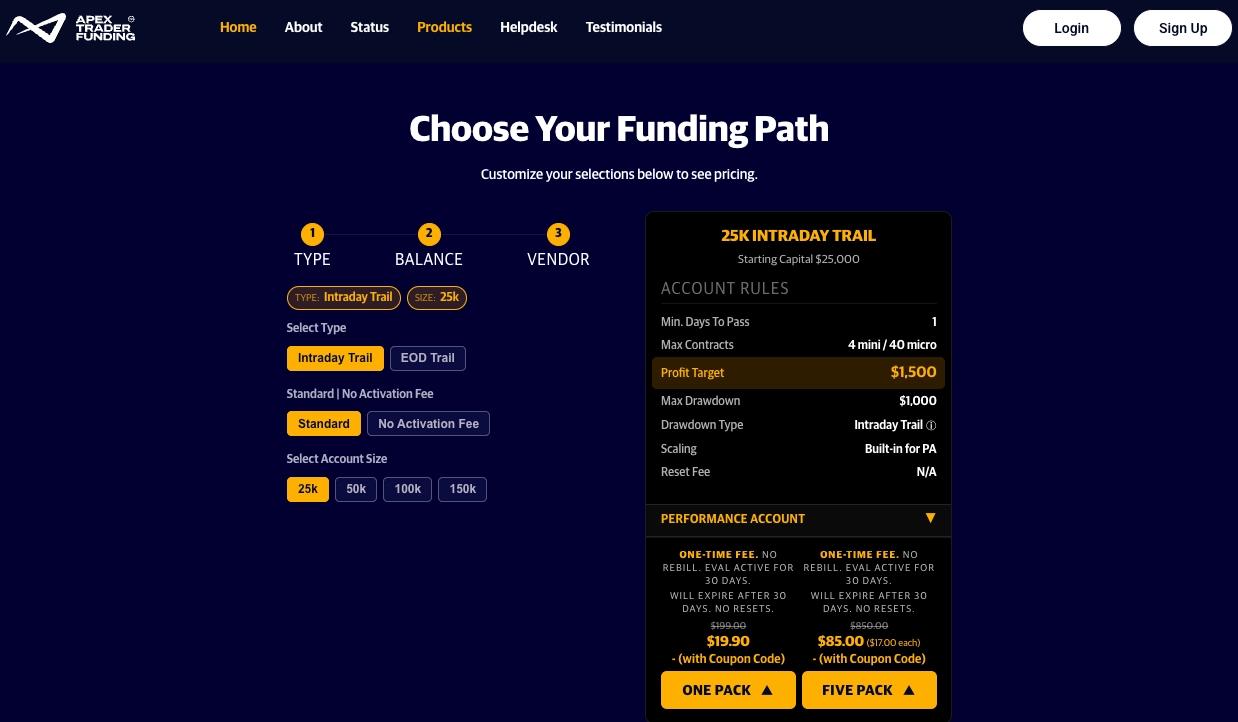
The old 250K and 350K accounts are no longer available, nor is the 100K static drawdown account.
The new challenges use two drawdown types:
- Trailing
- End of day (EOD)
Four account sizes are available:
- 25K
- 50K
- 100K
- 150K
Apex also offers two challenge formats: the standard format, with an activation fee after you pass, and the no-activation-fee format.
2) Advantages
Very low prices
During promotions, Apex is one of the cheapest prop firms on the market.
Discounts can be substantial, sometimes 80% or 90% off. That makes a challenge very inexpensive relative to the account size offered.
Depending on the promotion and account type, a 100K funded account can cost around €120 in total.
The no-activation-fee format also makes the offer more attractive. It costs more upfront, but there is nothing further to pay when you move to the funded account.
If you pass your challenges easily, this can work out cheaper overall than a standard account with an activation fee to pay afterwards.
Apex also runs promotions on bundles of challenges, including five-account packs that bring the cost down further.
On price, I still find Apex hard to beat.
Flexible evaluation rules
Apex gives traders plenty of freedom during the evaluation.
You can pass in a single day, trade during economic news releases, and use almost any trading style.
There is also no consistency rule during the challenge. You can pass without spreading your performance across several days, as some other firms require.
An attractive profit split
Apex offers a very favourable split on approved payouts: the trader keeps 100% of the first $25,000.
Payouts still come with conditions, but the profit split is clearly more attractive than at competing firms.
Up to 20 funded accounts
In my view, one of the main reasons Apex pays out so much is that it allows up to 20 funded accounts.
You can link these accounts and trade them together. That completely changes how much you can withdraw.
I used this option to trade 20 Apex challenges at once during an order flow scalping session.
I passed all 20 challenges and received 20 funded accounts.
This is one of Apex's biggest advantages over firms such as Topstep, which limits traders to five funded accounts.
End-of-day drawdown
End-of-day drawdown is one of Apex's strongest features today.
It makes accounts easier to manage than trailing drawdown, especially if you do more than very short-term scalping.
Personally, it's the format I prefer at Apex.
On a 50K account, the price difference compared with trailing drawdown is fairly small: around $40, including the challenge and activation fee.
At that price, I think EOD is well worth the difference.
Removal of complicated rules
Apex has removed several rules that made withdrawals difficult:
- The MAE rule
- The 5:1 rule
These rules were a pain to follow, especially when it came to requesting a payout.
The withdrawal process is now easier to understand.
The possibility of live trading
Apex recently introduced a live trading programme, allowing selected traders to access real funding.
Traders may be selected to move to a live account if the firm considers their results, consistency and risk management strong enough.

3) Disadvantages
The 50% consistency rule
Apex applies a 50% consistency rule to funded accounts.
Your best day cannot account for 50% or more of the total profit made since your last payout.
For example, if your account has $3,000 in profits, your best day must stay below $1,500.
This rule does not apply during the challenge. It mainly matters when you request a withdrawal.
If one day accounts for too much of your total profit, you need to keep trading to bring that percentage down before requesting a payout.
A limit of six payouts per account
Apex now limits each funded account to a maximum of six payouts.
In my view, this is the most important rule to consider today.
Some traders, including me, used to aim for modest but regular profits across several accounts and make repeated withdrawals.
That approach is less attractive over time because every funded account now has a limited lifespan.
Large payouts are still possible, especially with several accounts, but the model is less favourable than before for the most consistent traders.
A model that can encourage risk-taking
One of Apex's advantages is also one of its main drawbacks.
Its flexible rules and permissive conditions can encourage some traders to take more risk than usual.
Rules change frequently
Apex's rules have changed a lot in recent months, and some of those changes make a real difference.
For some traders, that lack of stability is a disadvantage. It can take time to adapt and find your bearings again.
4) My recommendation
I think Apex is one of the best Futures prop firms on the market.
It offers a real opportunity for traders who know how to manage risk.
I regularly receive payouts myself, which backs up my experience with the firm.

The most attractive Apex account remains the 50K EOD. It offers the best balance between price, profit target and ease of trading.
The choice between a standard challenge and a no-activation-fee challenge depends on your pass rate:
- If you pass challenges regularly and often reach the funded stage, the no-activation-fee option can be better value over time.
- If you still fail many challenges, the standard format makes more sense because each failed attempt costs less.
That said, I wouldn't necessarily recommend Apex if you want a very stable setup with rules that rarely change.
In that case, another prop firm such as Bulenox will probably be a better fit.
