
What is a futures contract?
A futures contract is a derivative: an agreement between two parties to buy or sell an asset on a future date at a price agreed in advance.
It's called a derivative because the contract's value depends on a reference asset, known as the underlying.
Futures trade on organised exchanges, such as CME in the United States or Euronext in Europe.
Their specifications are standardised. The exchange sets the contract terms in advance, and those terms are the same for everyone.
Trading futures means taking positions in these contracts without directly owning the underlying asset.
What are futures used for?
Futures have three main uses: hedging, speculation and arbitrage.
Hedging risk
Hedging means using a futures contract to reduce price risk.
Here's a simplified example.
I'm a baker. I need wheat throughout the year, and I'm worried prices will rise.
I can buy wheat futures today at €1,000 per tonne, for delivery in six months:
- If the price rises to €1,100, I've locked in a price below the market price.
- If it falls to €950, I could have bought more cheaply, but I've secured my price in advance.
In this situation, buying a futures contract means giving up the chance of a great deal in exchange for protection against a really bad one.
Speculation
The same contract can be used to take a directional bet:
- Buying because you expect prices to rise
- Selling short because you expect prices to fall
For example, if I think wheat prices will rise, I can buy wheat futures.
If I buy 10 contracts at €1,000 per tonne and the price rises to €1,200, I make €200 per tonne.
If the price falls to €800, I lose €200 per tonne.
Arbitrage
Arbitrage means taking advantage of a temporary price discrepancy.
An arbitrage trader can take positions in several contracts, different expiries or related assets to exploit a temporary inconsistency in their prices.
This requires very good execution and a precise understanding of the markets involved.
It generally isn't how retail traders or beginners use futures.
Why trade futures?
Futures are widely used by traders, particularly professionals, because they offer several advantages.
- An organised market: standardised contract specifications, an order book and clear exchange rules. This isn't an OTC product with terms set solely by the broker.
- Liquidity: the most actively traded contracts have plenty of buyers and sellers, making it easier to enter and exit positions.
- Short selling: selling a contract is as straightforward as buying one, so you can trade rising and falling markets.
- Leverage: you can control significant exposure with less capital than the contract's full value.
- Costs: fees can be more competitive than on some products offered by CFD brokers.
- Diversification: futures give you access to a wide range of assets.
What defines a futures contract?
The underlying asset
The underlying is the asset the contract is based on.
Futures can be based on several types of assets:
- Stock indices, such as the Nasdaq-100, S&P 500 or CAC 40
- Commodities, such as gold, wheat or corn
- Energy products, such as crude oil or natural gas
- Currencies, such as the euro, US dollar, pound sterling or yen
- Bonds or interest rates
- Cryptocurrencies, such as Bitcoin or Ethereum
If you trade Nasdaq-100 futures, for example, you don't own the shares that make up the index.
You're trading a contract whose value depends on movements in the Nasdaq-100.
Contract size
Every futures contract has a contract size. That size determines your position's actual exposure.
To understand it, start with an index point.
If the Nasdaq-100 moves from 18,000 to 18,001, it has moved 1 point.
The contract you choose determines how much that point is worth in money.
Here's an example using Nasdaq-100 futures:
| Contract | Underlying | Contract size |
|---|---|---|
| E-mini Nasdaq-100, NQ | Nasdaq-100 | $20 per point |
| Micro E-mini Nasdaq-100, MNQ | Nasdaq-100 | $2 per point |
NQ and MNQ both track the Nasdaq-100, but they aren't the same size:
- NQ is worth $20 per index point.
- MNQ is worth $2 per index point.
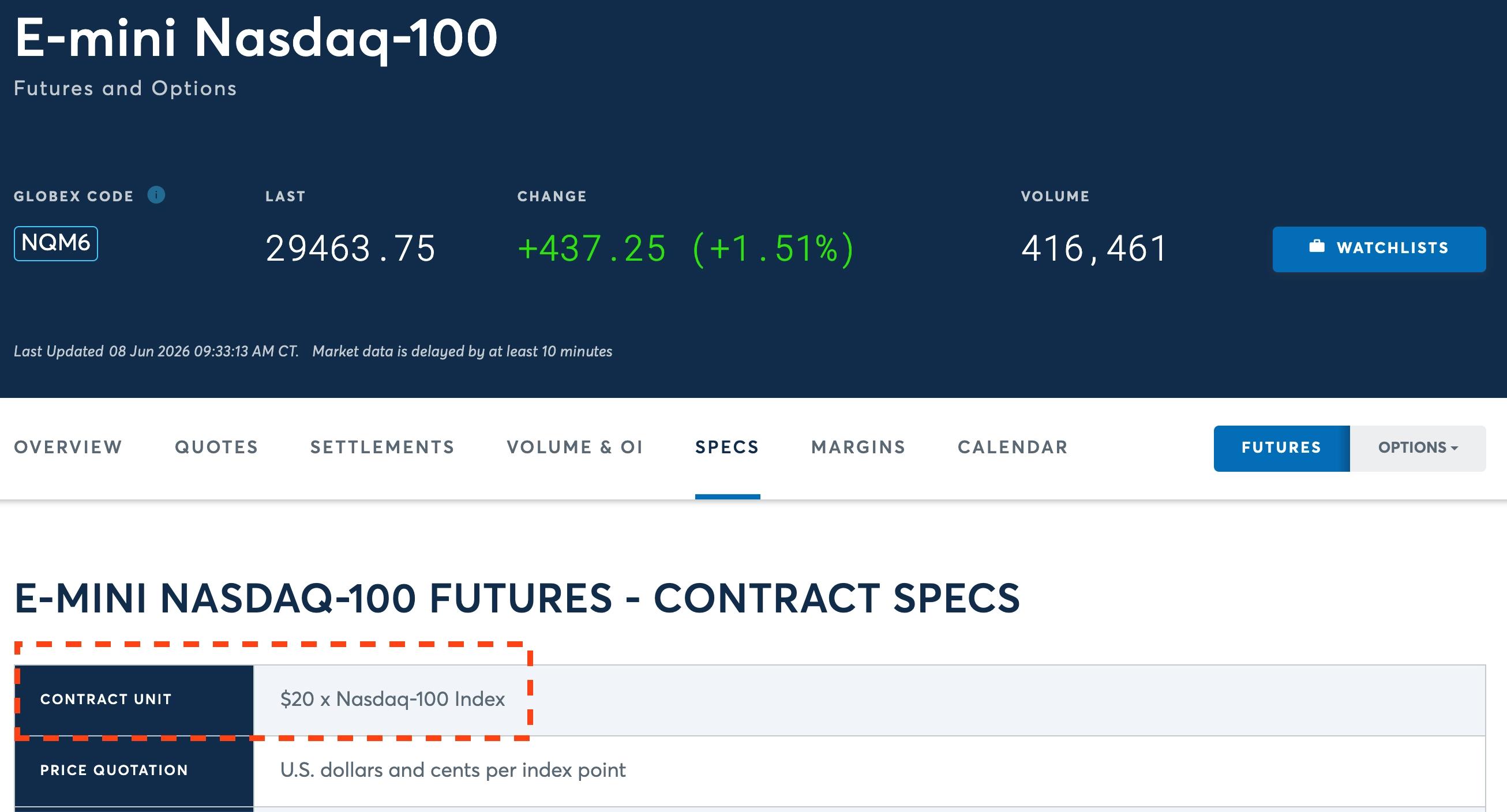
NQ is ten times larger than MNQ. That's why two contracts can follow the same market while carrying very different levels of risk.
Mini and micro futures let traders choose a contract size that fits their capital and the risk they want to take.
Ticks and price increments
Futures prices don't necessarily move a whole point at a time. They move in smaller increments.
The smallest increment is called a tick.
For Nasdaq-100 futures, a tick is 0.25 points.
That means the price can go from 18,000 to 18,000.25, then 18,000.50, then 18,000.75, then 18,001.
There are 4 ticks in a point, so a tick's monetary value depends directly on the contract size:
- For NQ, 1 point is worth $20, so a 0.25-point tick is worth $5.
- For MNQ, 1 point is worth $2, so a 0.25-point tick is worth $0.50.
| Contract | Point value | Tick size | Tick value |
|---|---|---|---|
| E-mini Nasdaq-100, NQ | $20 | 0.25 points | $5 |
| Micro E-mini Nasdaq-100, MNQ | $2 | 0.25 points | $0.50 |
Delivery months and expiry dates
A futures contract has an expiry date, also called its maturity date.
The exchange determines which expiries are available. You choose from contracts already listed, such as June, September or December for NQ.
You'll often hear the term delivery month because each contract is tied to a specific month.
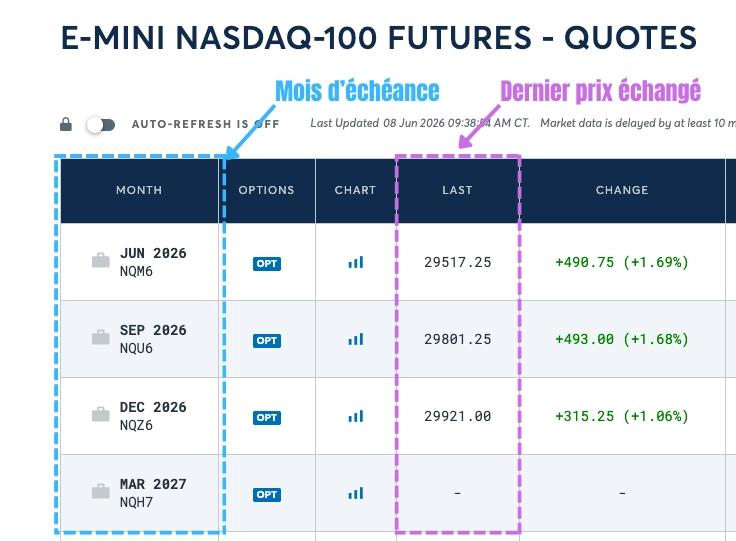
Several contracts on the same underlying can therefore be listed at once, each with its own expiry.
Each expiry can have a different price. That price depends on the underlying, but also on the time remaining before expiry and market conditions.
That's why two futures contracts on the same asset can have different prices when they expire at different times.
Settlement at expiry
At expiry, a futures contract can be settled in two ways:
- Physical delivery of the underlying
- Cash settlement
Physical delivery mainly applies to certain commodity contracts.
Cash settlement is more common for contracts whose underlying can't be physically delivered, such as stock indices.
In practice, many retail traders close their positions before expiry.
To maintain exposure to the same market, they can close the near-expiry contract and open one with a later expiry.
That's called rolling the position, or rollover.
Crypto futures
In crypto, the word futures is often used for several different products.
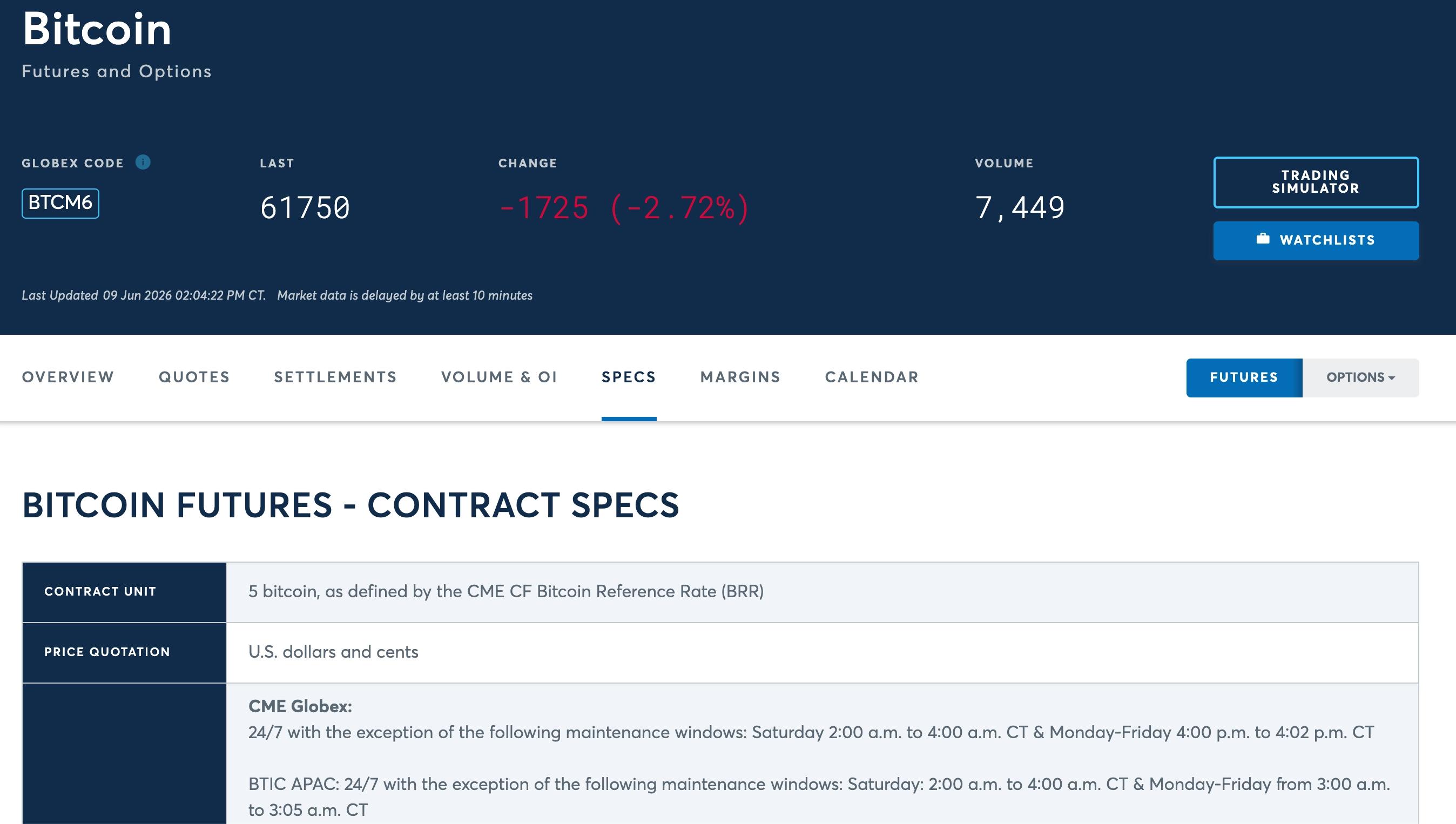
There are genuine crypto futures listed on organised exchanges, such as CME's Bitcoin and Ethereum futures.
These contracts have precise specifications: contract size, price increments, an expiry date and a settlement method.
Crypto exchanges such as Binance, Bybit and Kraken also offer perpetual contracts, often called perpetual futures or perps.
They let you take long or short positions using margin, but they don't work like traditional futures. Their characteristics and predefined rules are different.
Futures vs CFDs
Futures are often compared with CFDs because both let you take long or short positions on an asset without necessarily owning it directly.
But they're different products:
- A futures contract is standardised and listed on an organised exchange, with a contract size, expiry date and rules set in advance.
- A CFD is a contract offered by a broker, with terms that depend more on that broker.
In practice, CFDs are often easier to access, especially with a small account.
Futures require more knowledge, but generally provide a more transparent and structured trading environment.
I've written a full comparison in CFDs or futures: which should you trade?
How do you trade futures?
To buy or trade futures, you need a broker or platform that provides access to contracts listed on organised exchanges.
Well-known brokers offering futures trading include:
Understanding margin and risk
With futures, you don't pay the contract's full value to open a position.
The broker only sets aside margin: a security deposit required to open or maintain the position.
This is where people often get confused. Margin tells you how much the broker sets aside in your account. It doesn't tell you how much you could lose on the trade.
You need to distinguish three things:
| Term | Meaning |
|---|---|
| Exposure | The total value controlled by the contract |
| Margin | The amount set aside to open or maintain the position |
| Risk | The potential loss if the market moves against the position |
Once your position is open, your account balance changes with the contract's price.
If it moves your way, you make money. If it moves against you, you lose money.
If losses become too large, the broker may issue a margin call.
It can then ask you to add funds or close the position to limit the risk.
A trade's risk mainly depends on three things:
- Contract size
- The number of contracts traded
- The distance between your entry price and stop
For example, if a contract is worth $2 per point and your stop is 50 points away, the risk is $100 per contract:
50 points x $2 = $100
With two contracts, that becomes $200.
Before entering a trade, calculate your position size using your acceptable risk, the point value and the distance to your stop.
You can do this easily with my futures position size calculator.
How much do you need to start?
To start trading futures with your own money, I consider $1,000 to $2,500 a necessary starting point.
Some brokers let you open an account with just a few hundred dollars. But that's mainly the minimum needed to access the market, not necessarily the ideal amount to trade with.
As explained above, margin lets you open a position. It doesn't represent the trade's actual risk.
Below $1,000, opening a position is sometimes possible, but there's very little room for error.
That starting amount also assumes you're using micro futures, not standard contracts such as ES or NQ.
Another option is a futures prop firm, which can give you access to futures for a lower upfront cost.
Choosing a suitable contract
Once you have access to the market, you need to choose the exact contract you'll trade.
Its size, liquidity and margin requirements need to fit your available capital and your strategy.
Personally, I don't try to trade every available contract.
I focus on markets that suit my trading style, mainly US indices and gold, because I prefer the US session and the overlap between Europe and the United States.
Futures trading hours
Not all futures trade at the same times.
Hours depend on the contract, the exchange and sometimes public holidays.
The most actively traded contracts, such as US index and gold futures, are generally open almost 24 hours a day during the week.
They aren't open all weekend, though.
Most CME contracts open on Sunday evening in the United States and close on Friday evening, with a daily break.
From Europe, that often means the market reopens overnight between Sunday and Monday.
Always check your contract's trading hours, especially if you're holding a position for several days.
Which strategy should you use?
You can trade futures using the usual strategies based on fundamental or technical analysis.
But their real appeal is the quality of the market data.
Because contracts trade on organised exchanges, volume, executed trades and the order book provide a more reliable picture of what's actually happening.
That's why many futures traders use order flow.
It helps them understand buying and selling pressure instead of looking at price alone.
The risks of futures trading
Futures are considered risky financial products.
The risks include:
- Leverage: you can hold a large position with limited capital. A small move can therefore produce a significant gain or loss.
- Rapid losses: prices can move sharply in a short time, especially during volatile periods.
- Margin calls: as explained above, a losing position can quickly reduce the capital available in your account.
- Losing more than expected: depending on the product, leverage and market conditions, losses can exceed the amount initially committed.
- Liquidity: some contracts can be difficult to buy or sell at your intended price.
- Expiry: a futures contract expires. You need to know what happens then: closing the position, rolling it or taking delivery, depending on the contract.
- The broker: a website can use the word futures in its marketing without offering a genuine exchange-listed contract.
Is futures trading allowed in France?
Yes, you can trade futures in France, but they must be offered by an authorised intermediary.
The AMF recommends checking that the broker is registered as an investment services provider and appears on the Regafi register.
