
What is a trading session?
A trading session is a period when activity in a market is concentrated.
On a traditional exchange, this means its official opening hours.
Euronext Paris has its own trading hours, for example, just like the Nasdaq or the Tokyo Stock Exchange.
We also talk about the Asian, European and US sessions to describe the main periods of activity across the global trading day.
| Session | Region | Associated financial centres |
|---|---|---|
| Asian session | Asia and Oceania | Tokyo, Hong Kong, Singapore, Sydney |
| European session | Europe | London, Paris, Frankfurt, Zurich |
| US session | North America | New York, Chicago, Toronto |
Each region becomes more active when its main financial centres are open and its banks, funds, brokers and investors participate more heavily in the market.
An active session is mainly characterised by higher volume, better liquidity and sometimes stronger price moves (more orders are traded during this period).
That doesn't mean only participants from that region can trade during its session.
A US investor can trade during the European session if they have access to the relevant market, just as a French trader can trade US markets during the US session.
The session mainly tells you which region has the most activity, not who is allowed to take part.
The main trading session hours
Session hours vary depending on the exchange, the country and daylight saving time.
For a trader based in France, it's simpler to work in Paris time.
That makes it easier to fit the main sessions into your own trading day.
Here are the main reference points:
| Session | Exchange | Local hours | Equivalent in Paris time |
|---|---|---|---|
| Asian session | Tokyo Stock Exchange | 09:00 to 11:30, then 12:30 to 15:30 JST | 02:00 to 04:30, then 05:30 to 08:30 during summer time |
| European session | Euronext Paris | 09:00 to 17:30 | 09:00 to 17:30 |
| US session | NYSE and Nasdaq | 09:30 to 16:00 ET | 15:30 to 22:00 during summer time |
These hours can change with public holidays, half-day sessions and the switch between summer and winter time.
Europe, the United States and Japan don't always follow the same rules, which can shift some of these times for part of the year.
Some markets also offer trading before or after the main session. In the US, these periods are called pre-market before the open and after-hours after the close.
They sometimes let you trade outside normal hours, but conditions are different: there is often less volume, wider spreads and prices that are less representative of the main market.
When sessions overlap
A session overlap is a period when two major financial regions are active at the same time.
For a trader based in France, the most important overlap is between Europe and the United States.
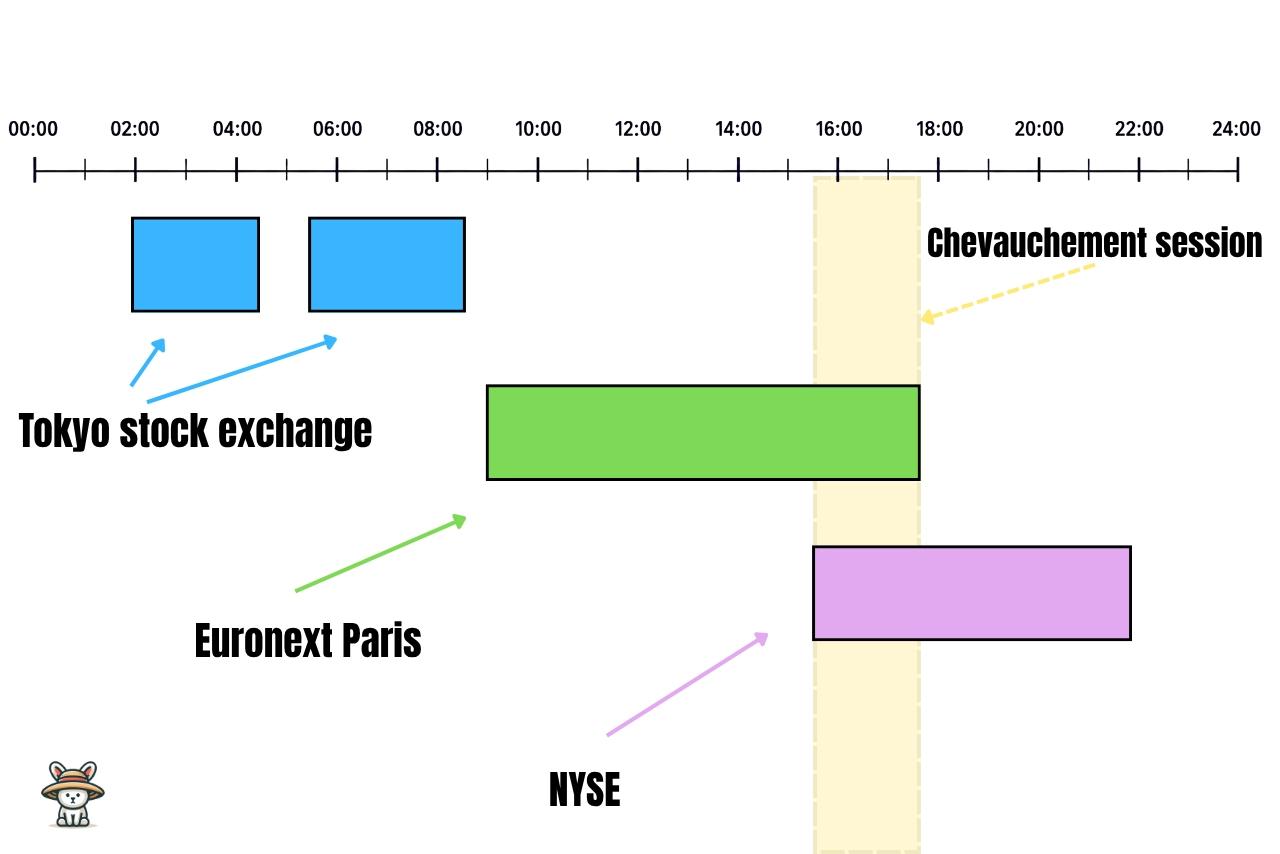
During Paris summer time, this falls between 15:30 and 17:30, when US markets open while European markets are still trading.
This overlap can bring more volume, more liquidity and faster reactions, particularly around the US open or major economic releases.
Session overlaps also exist in Forex, but the logic is different because Forex doesn't operate like a traditional exchange.
Forex trading sessions
Unlike a traditional exchange such as the Nasdaq or Euronext, Forex doesn't have a single central exchange.
It's a global market where currency pairs such as EUR/USD are traded.
Activity shifts throughout the day according to which major financial centres are open.
That's why Forex is generally available almost 24 hours a day, Monday to Friday.
A currency pair can be more active when the financial centres associated with its currencies are open.
For example, EUR/USD often attracts more attention during the European session and the London-New York overlap.
Crypto and the idea of a session
Cryptocurrencies don't have an official trading session, since they can be traded at any time, including overnight, at weekends and on public holidays.
Volume can vary with the time of day, announcements, market moves or investor activity in different parts of the world.
But these variations are less structured than in a market with fixed opening hours.
Sessions are therefore less useful for crypto than for stocks, indices or Forex.
You're better off looking at actual volume, available liquidity and events that could influence the market.
Does the trading session matter?
Your choice of session mainly depends on the market you follow, the asset you trade and your strategy.
Personally, I mainly trade the US session, particularly the overlap between Europe and the United States.
As I explained earlier, this period brings together a lot of market participants.
There is often more volume and liquidity in the assets I trade, especially gold and US indices.
That makes it a good fit for my strategy, because I need confirmation from volume.
I'm much less keen on the Asian session: in France, it takes place in the middle of the night or very early in the morning, which makes it difficult to follow regularly.
It also doesn't suit the way I trade as well.
On the assets I follow, volume is often lower during this period because the major European and US participants are less active at that time.
Volume confirmations are therefore less useful for my strategy.
