
A trader can make money even when an asset loses value.
Short selling is what makes that possible.
Short selling
Short selling means borrowing an asset, selling it immediately, then buying it back later in the hope its price has fallen, before returning it to the lender.
The aim is to pocket the difference between the initial selling price and the later purchase price.
In other words, it's a bet on an asset falling.
A profitable short-selling example
A trader thinks a stock will fall.
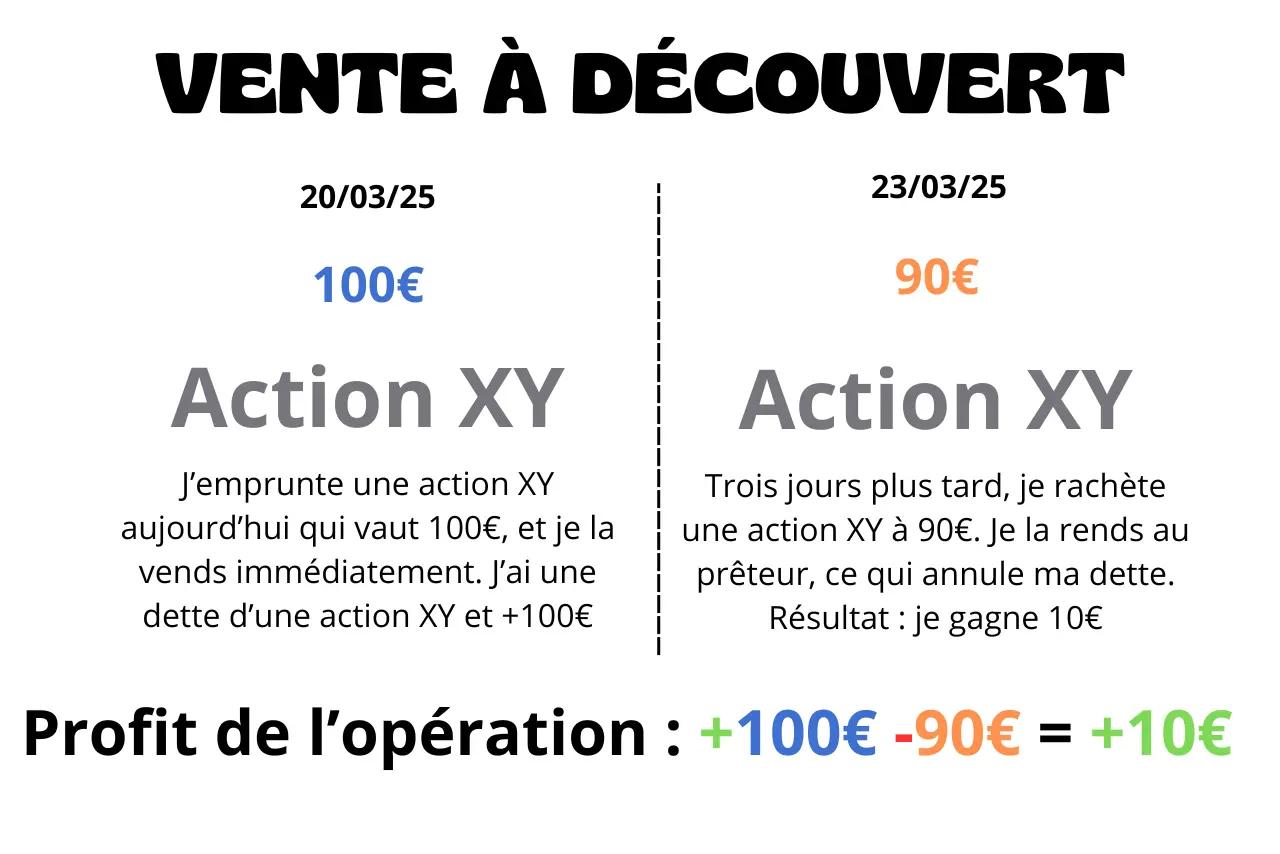
They borrow it at €100, sell it immediately and receive €100.
Three days later, the stock has fallen to €90.
They buy it back, return it to the lender and keep the difference: a €10 profit.
That's the ideal scenario. The asset loses value, and the trader profits from the decline.
A losing short-selling example
But things don't always go to plan.
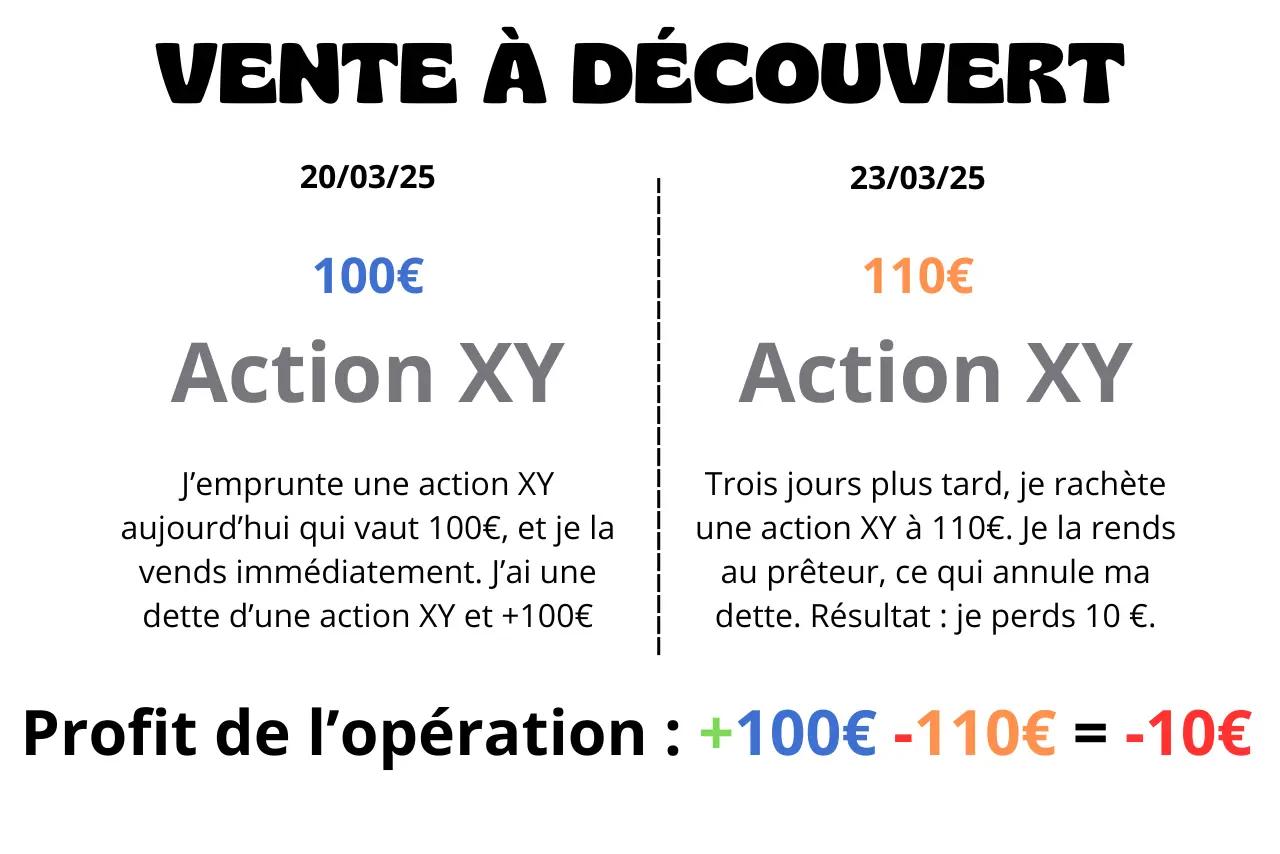
If the stock borrowed at €100 rises to €110, the trader has to buy it back at a higher price to return it.
They lose €10.
Short selling today
Short selling used to be complicated to arrange.
Today, derivatives such as CFDs and futures make it possible in one click.
On a trading platform, you can short without borrowing the asset:
- Going long means buying
- Going short means taking a position that profits from a fall
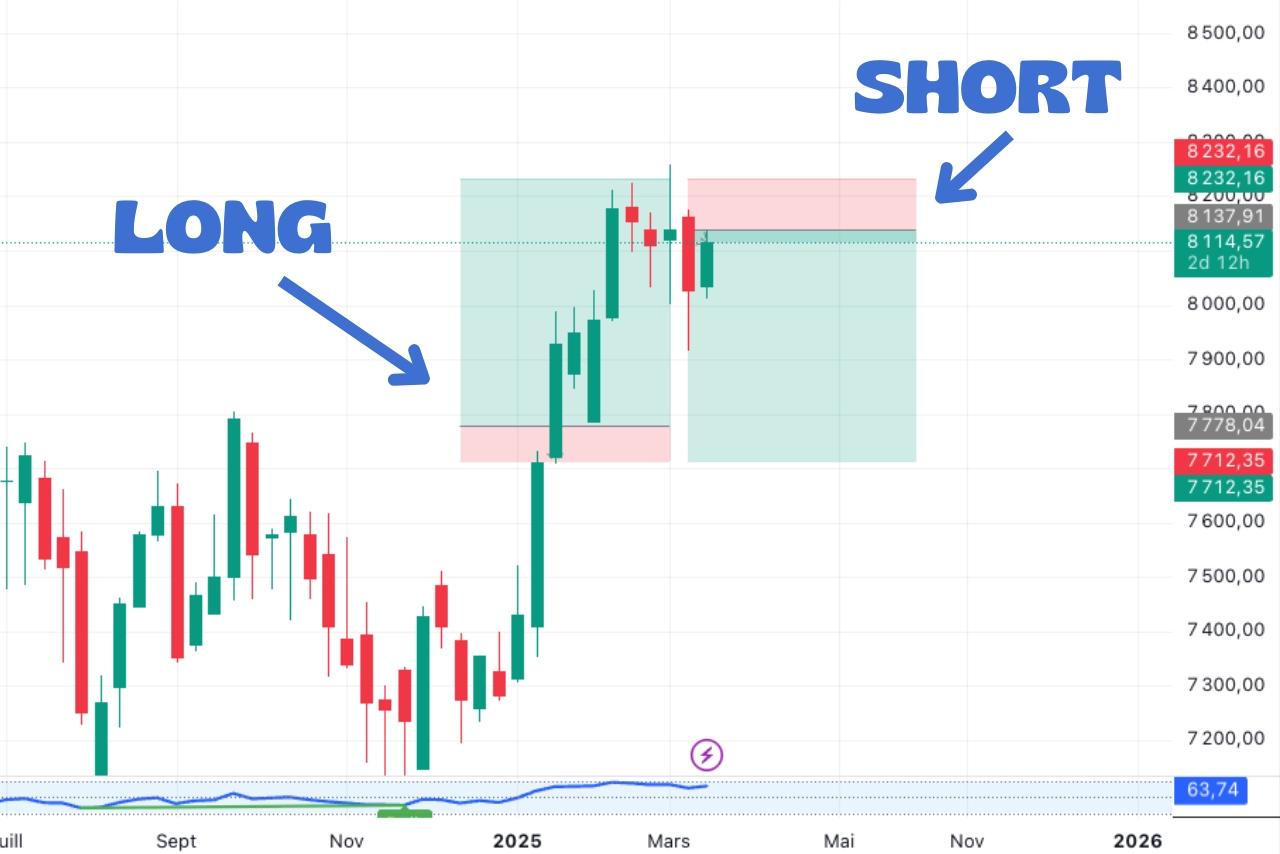
On TradingView, you can easily identify the position type by the red stop-loss area:
- Red below, green above: long. Price needs to rise for a profit
- Red above, green below: short. Price needs to fall for a profit
Which financial assets can be shorted?
- Stocks
- Bonds
- Currencies
- Stock indices
- Commodities
- Cryptocurrencies
Read this article to learn more about financial markets and their products.
Are losses limited when short selling?
No. Unlike a straightforward purchase, where the loss is limited to the amount invested, a short position has no theoretical loss limit.
When you buy a stock, your maximum loss is the amount you invested.
Buy at €100 and the stock falls to zero: you lose €100.
Short selling works the other way around. The more the stock rises, the more you lose, without a limit.
If the stock you shorted rises from €100 to €200, you're already down €100.
At €500, your loss is €400.
At €1,000, you're down €900.
In theory, your debt keeps growing as long as price rises.
Fortunately, in practice, your broker doesn't let it go that far. It requires margin: money you must hold in your account to cover potential losses.
If your short becomes too risky, the broker can force the position closed by automatically buying the stock back, even if you don't want it to.
This is called a margin call.
Previously, you had to borrow the actual stock to short it.
If the trade went wrong, some people ended up ruined.
What does a broker get out of short selling?
The broker makes short selling easier.
Without one, borrowing assets to sell would be complicated.
With derivatives, there's no actual borrowing.
The broker acts as counterparty, charges fees and requires margin to cover losses.
If the position becomes too risky, it can demand more funds or force the trade closed.
In return, it collects a commission on each transaction.
Both sides benefit: the broker generates revenue, and the trader can speculate on falling prices.
Criticism of short selling
Short selling is accused of making crises worse.
When an asset falls, short positions accelerate the decline, potentially worsening market panic.
Elon Musk has criticised the practice, arguing that it penalises innovative companies.
Tesla has been one of the world's most heavily shorted stocks.
Bill Gates reportedly bet against the company too, causing tension between the two billionaires.
Musk accuses short sellers of trying to cause harm rather than invest for the long term.
Despite the criticism, short selling remains legal, with rules intended to limit abuses.
