
What is a tick in trading?
A tick is the smallest permitted price change for an asset when the market sets a minimum price increment.
Price then moves in fixed increments, rather than by any arbitrary decimal amount.
This is particularly relevant to futures contracts, each of which has a tick size and tick value defined in its specifications.
In Forex, price changes are generally expressed in pips, although the idea is similar: measuring price movement with a standard unit.
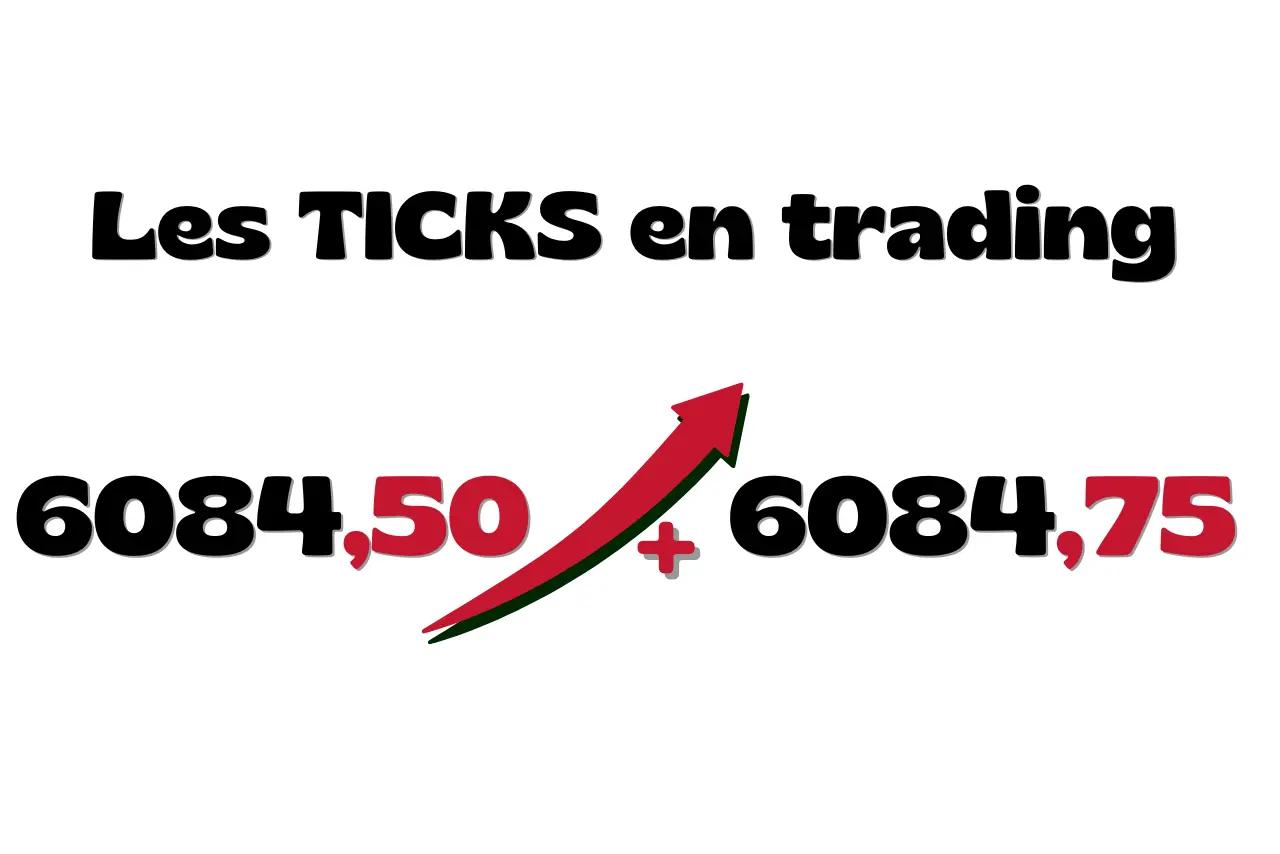
For example, the E-mini S&P 500 can't move from 6,084.25 to 6,084.26.
It can only move in increments of 0.25 points, or 1 tick.
If price moves from 6,084.25 to 6,084.50, it has moved 1 tick.
Tick value varies by contract
In futures, a tick doesn't just measure the smallest permitted price move.
It also lets you calculate what that movement is worth in money for one contract:
- Tick size tells you the minimum amount price can move
- Tick value tells you how much that move gains or loses when you hold one contract
Two contracts can therefore have the same price increment but different monetary values per tick.
This table shows the difference across several futures contracts.
| Instrument | Symbol | Tick size | Tick value |
|---|---|---|---|
| E-mini S&P 500 | ES | 0.25 points | $12.50 |
| Micro E-mini S&P 500 | MES | 0.25 points | $1.25 |
| E-mini Nasdaq-100 | NQ | 0.25 points | $5.00 |
| Micro E-mini Nasdaq-100 | MNQ | 0.25 points | $0.50 |
| E-mini Dow | YM | 1 point | $5.00 |
| Micro E-mini Dow | MYM | 1 point | $0.50 |
| E-mini Russell 2000 | RTY | 0.10 points | $5.00 |
| Micro E-mini Russell 2000 | M2K | 0.10 points | $0.50 |
| Gold Futures | GC | $0.10 | $10.00 |
| Micro Gold Futures | MGC | $0.10 | $1.00 |
| Crude Oil Futures | CL | $0.01 | $10.00 |
| Micro Crude Oil Futures | MCL | $0.01 | $1.00 |
Take NQ and MNQ.
Both move in 0.25-point increments:
- On NQ, that move is worth $5 per contract
- On MNQ, it's worth $0.50
The same logic applies to ES and MES.
Both have a tick size of 0.25 points, but a tick is worth $12.50 on ES and $1.25 on MES.
Where can you find a contract's tick value?
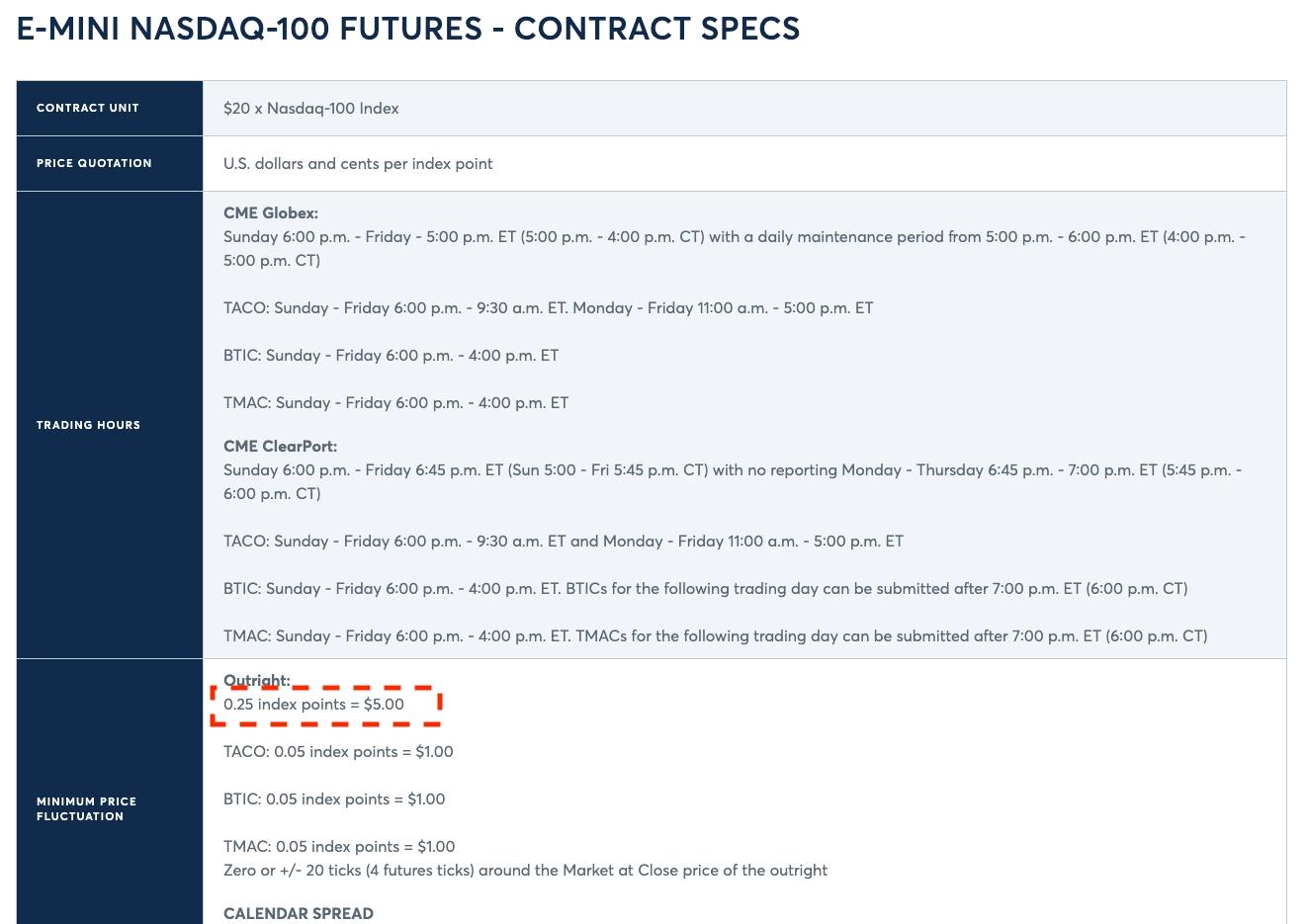
You can find it in the contract specifications, on CME Group for example, or directly on your broker's website.
For E-mini Nasdaq-100 futures, for example, the specifications state: 0.25 index points = $5.00.
Calculating profit or loss with ticks
To convert a move into dollars, you need the number of ticks, tick value and number of contracts.
Profit or loss = number of ticks × tick value × number of contracts
On ES, 1 tick is worth $12.50.
With 1 contract, a 10-tick move is worth:
10 × $12.50 × 1 = $125
With 2 contracts, the same move is worth:
10 × $12.50 × 2 = $250
The calculation works the same way for a loss.
Calculating stop-loss risk in ticks
A stop placed 20 ticks away doesn't represent the same risk on every contract.
Risk = stop distance in ticks × tick value × number of contracts
On MNQ, 1 tick is worth $0.50.
With a 20-tick stop and 1 contract:
20 × $0.50 × 1 = $10
With 5 contracts:
20 × $0.50 × 5 = $50
Risk therefore depends on the contract, stop distance and contract quantity.
Using ticks to size your position
Once you know the risk per contract, compare it with your maximum risk per trade.
Risk per contract = stop distance in ticks × tick value
Number of contracts = maximum risk / risk per contract
For example, you want to risk $50 on MNQ with a 20-tick stop.
20 × $0.50 = $10 risk per contract
$50 / $10 = 5 contracts
You can therefore take 5 MNQ contracts.
If the result isn't a whole number, round down so you don't exceed your risk limit.
You can also use my futures position size calculator to do this automatically.
