
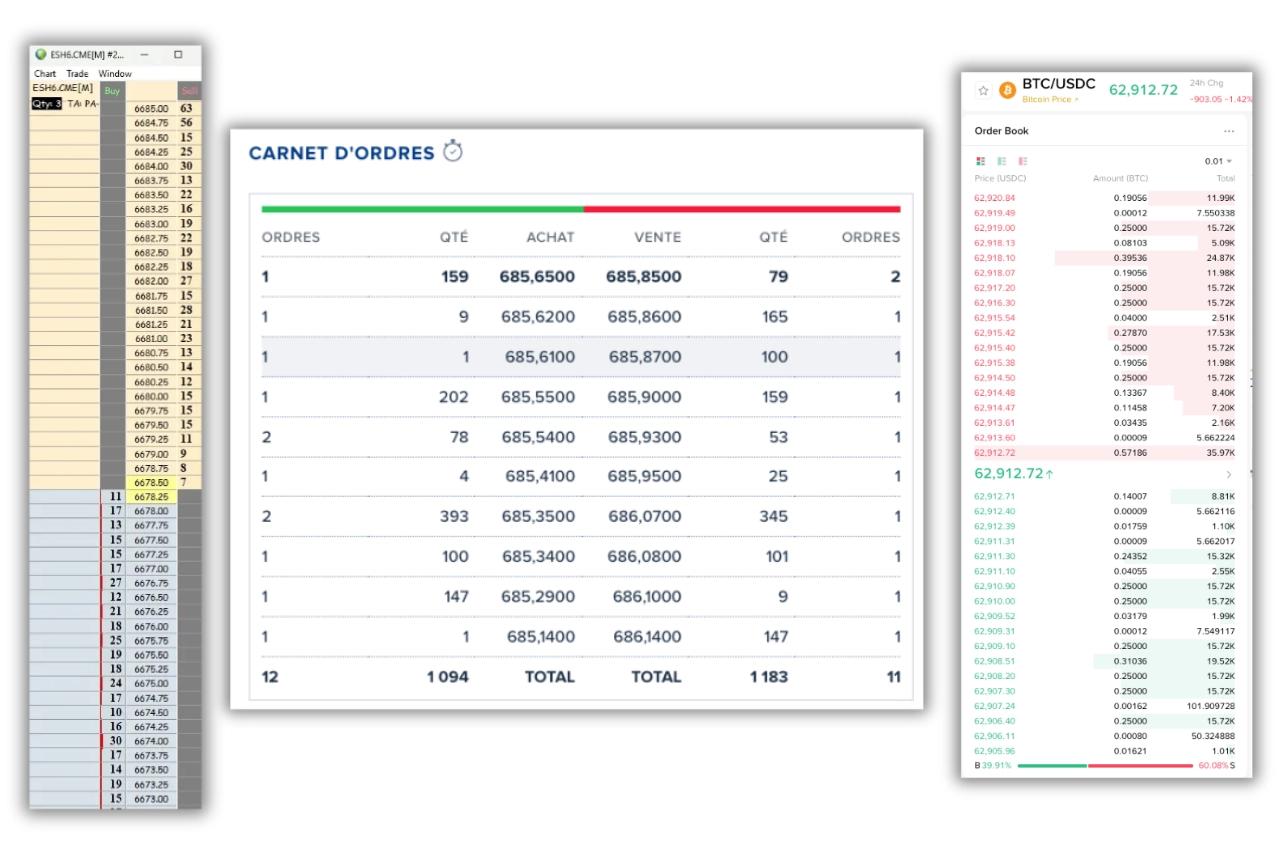
What is an order book?
An order book is a register of visible buy and sell orders awaiting execution for an asset, arranged by price.
An order book doesn't always represent the whole market
An order book shows orders received by the exchange, platform or broker providing the data.
For stocks and futures contracts traded on organised markets, each venue manages its own book.
When an asset trades on several venues, each book shows only the orders that venue has received.
In spot Forex and CFDs, no single book contains all market orders.
Displayed prices and quantities can therefore vary between brokers.
Crypto orders are also spread across different exchanges, each running its own book.
The parts of an order book
The buy side and sell side
An order book is generally divided into two sides.
- Bid: the buy-order column shows prices buyers are willing to pay
- Ask: the sell-order column shows prices sellers are asking
Each price level also shows the quantity waiting there.
Depending on the market and platform, this can be expressed in shares, contracts, units of the asset or lots.
Some interfaces call it volume, but don't confuse it with volume already traded.
Multiple orders at the same price can be grouped into one row.
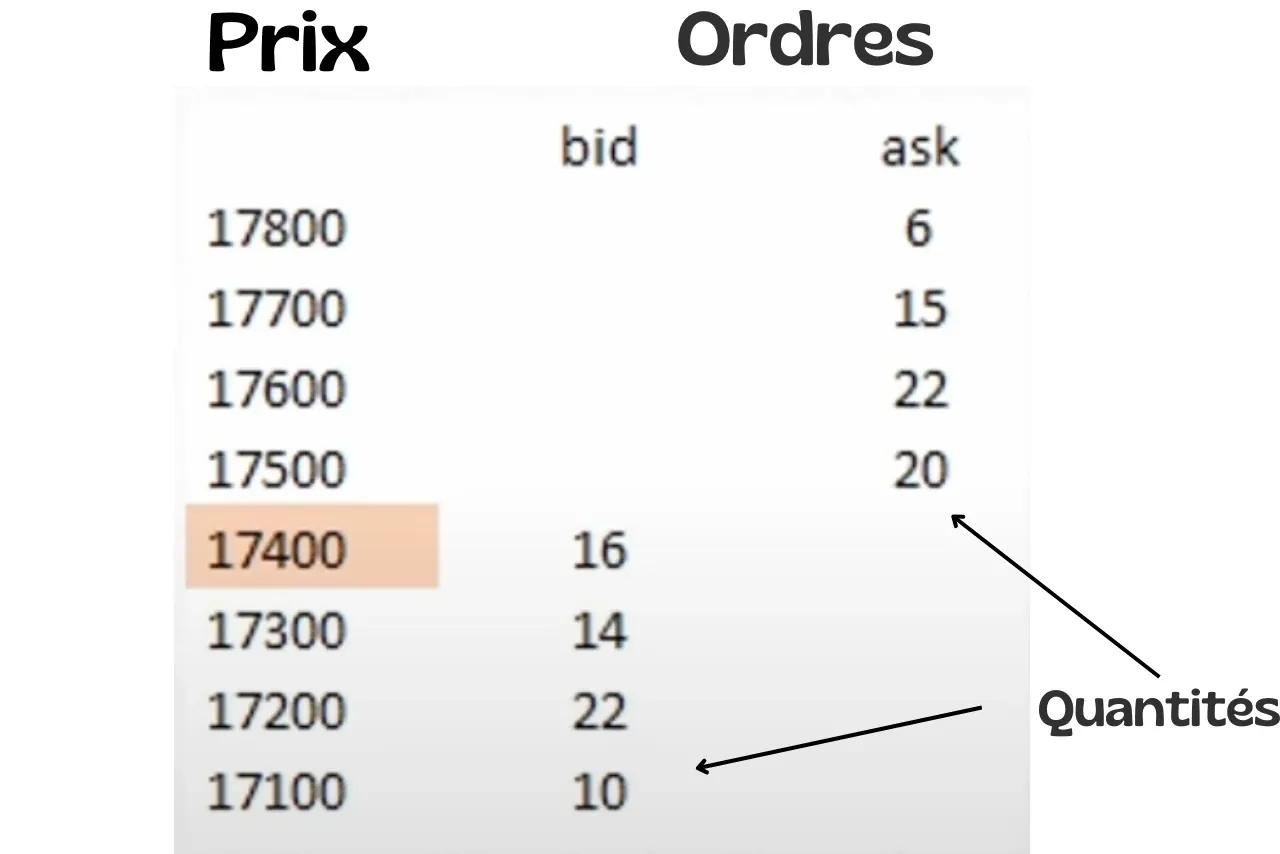
In this example, 16 lots are waiting to buy at $17,400, as shown by the orange-highlighted row.
Just above, 20 lots are offered for sale at $17,500.
The best bid and best ask
The best bid is the highest price a buyer is offering.
The best ask is the lowest price a seller is requesting.
In the book above, the best bid is $17,400 and the best ask is $17,500.
The spread
The spread is the difference between the best ask and the best bid.
In our example, it's $100: $17,500 - $17,400 = $100.
A tight spread generally indicates a liquid market and reduces the cost of immediate execution.
A wide spread makes buying and quickly reselling more expensive.
However, you need to compare the spread with the asset's price and its usual trading conditions.
A €0.10 difference doesn't have the same significance for a €5 stock as for a €500 stock.
Market depth
Market depth, often called DOM for Depth of Market, is the volume available across several price levels on both the buy and sell sides.
A book is considered deep when substantial volume is available at several levels close to the best bid and ask.
It's considered shallow when volume near those prices is low.
- In a deep book, a large order can execute close to the best displayed price
- In a shallow book, it reaches subsequent levels more quickly, making its average execution price less favourable
Market makers can contribute to depth by regularly placing buy and sell orders in the book.
They provide liquidity for other participants, although they aren't the only ones supplying the book.
| Price | Bid quantity | Ask quantity |
|---|---|---|
| €50.05 | 1,200 | |
| €50.04 | 1,400 | |
| €50.03 | 1,300 | |
| €50.02 | 1,500 | |
| €50.01 | 1,600 | |
| €50.00 | 1,300 | |
| €49.99 | 1,100 | |
| €49.98 | 900 |
The book above is considered deep because substantial volume is available at several levels near the best bid of €50.01 and best ask of €50.02.
How orders interact with the book
The order book changes as orders are added, filled, modified or cancelled.
Depending on their price and the available quantity, new orders may remain in the book or execute against existing orders.
I explain the different order types and how they work in my article on trading orders.
Limit orders
A limit order sets the maximum price you're willing to pay when buying or the minimum price you're willing to accept when selling.
It can only execute at the specified price or a better one.
A limit buy order can behave in two ways:
- If its limit price matches or exceeds the best ask, it can execute against available sell orders
- If its limit price is below the best ask, it joins the bid side of the book
In the example below, the best ask is $17,500, while a limit buy order for 5 lots is placed at $17,200.
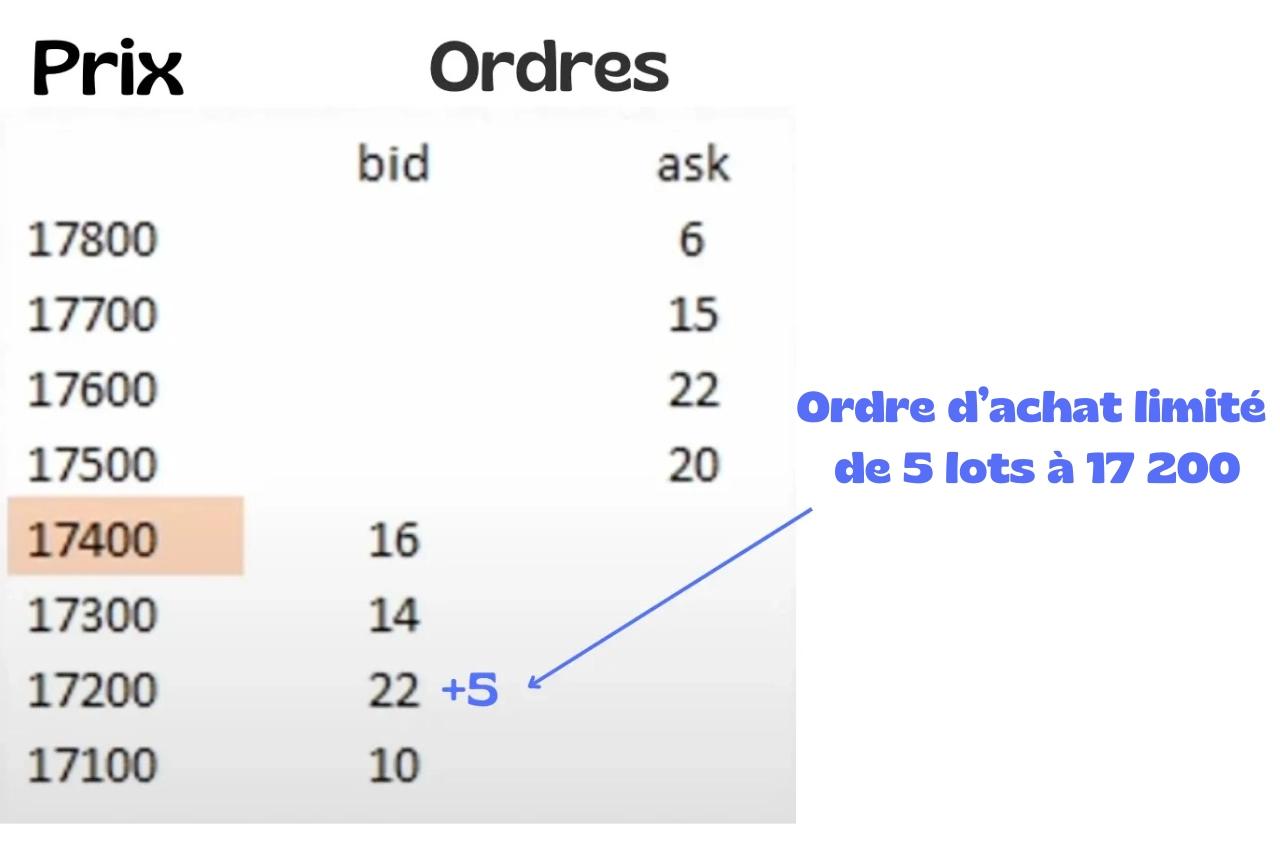
No seller offers that price or lower, so the order can't execute.
The 5 lots join the 22 lots already waiting to buy at $17,200, bringing the displayed quantity to 27 lots.
Orders at the same price are ranked by arrival time.
If sellers accept $17,200, the 5 new lots will execute after the 22 already waiting.
Market orders
A market order seeks execution without setting a price limit.
A buy order uses quantity at the best ask; a sell order uses quantity at the best bid.
If there isn't enough at the best price, execution continues at subsequent levels.
Execution across several price levels
In this example, a market buy order is placed for 25 lots.
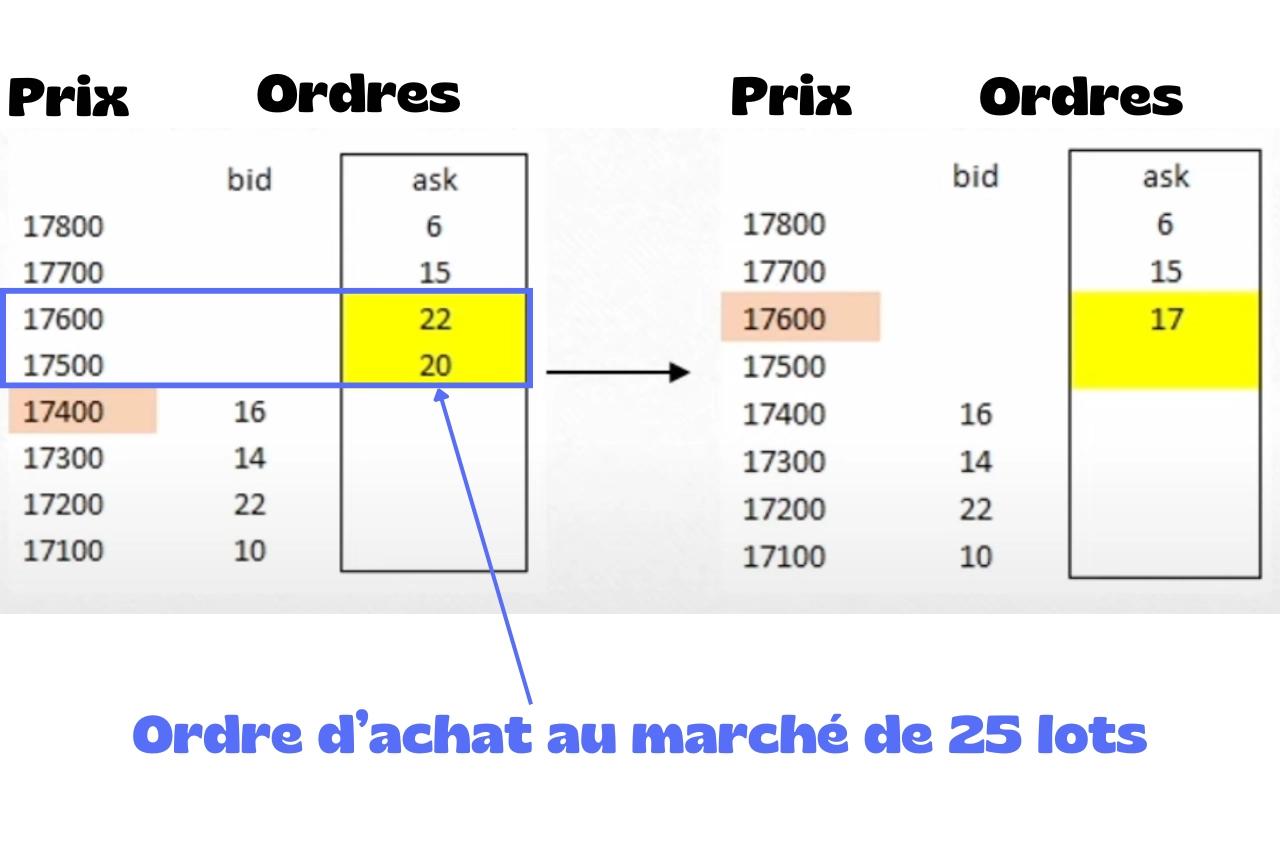
The best ask of $17,500 contains 20 lots, which are bought first.
The remaining 5 lots are bought at $17,600.
If 22 lots were offered at that price, 17 remain after execution.
The $17,600 level becomes the new best ask because every lot at $17,500 has been filled.
The 25-lot order has been fully filled, but at two different prices.
Partial fills
An order is partially filled when only part of the requested quantity finds a counterparty.
For example, a limit buy order for 10 lots may fill for just 4 lots if no further quantity is available at its limit price.
The remaining 6 lots stay in the book until they're filled, cancelled or expire.
Execution across several price levels isn't a partial fill if the entire order is filled.
Interpreting an order book
Reading an order book means comparing visible buy and sell quantities across several levels near the best bid and ask.
- More quantity on the bid side means more buy orders are waiting in the area you're observing
- More quantity on the ask side indicates a stronger seller presence
This imbalance describes the distribution of resting orders, but can't predict price direction by itself.
Spotting concentrations of orders
A level with a large quantity is an area of visible liquidity.
- Concentrated buy orders can slow a decline
- Concentrated sell orders can slow a rise
These concentrations may slow price if the orders remain when price reaches that level.
Watching the book change
A screenshot only shows the book at one moment.
Watching over time reveals whether quantities stay in place or disappear as price approaches.
The book shows resting orders, not executed trades.
I explain how to analyse both in my article on order flow trading.
The limits of the order book
The book doesn't always show the full quantity available at a price level.
Displayed orders also can't tell you participants' intentions with certainty.
Iceberg orders
An iceberg order displays only part of its total quantity in the book.
For example, an order for 5,000 shares may show only 50.
When those 50 shares execute, a new quantity can appear at the same price.
The book may therefore continue showing 50 shares even though the order is much larger.
Replenishment at the same price can suggest an iceberg order, but you can't confirm it from the book alone.
Spoofing
Spoofing means placing visible orders with the intention of cancelling them before execution.
These orders can give the impression that substantial buy or sell quantity is available, then disappear as price approaches.
Repeated appearances and cancellations can draw attention, but don't prove spoofing.
The practice depends on an intention to cancel before execution, something the book alone can't establish with certainty.
Spoofing is prohibited on the regulated markets concerned.
