
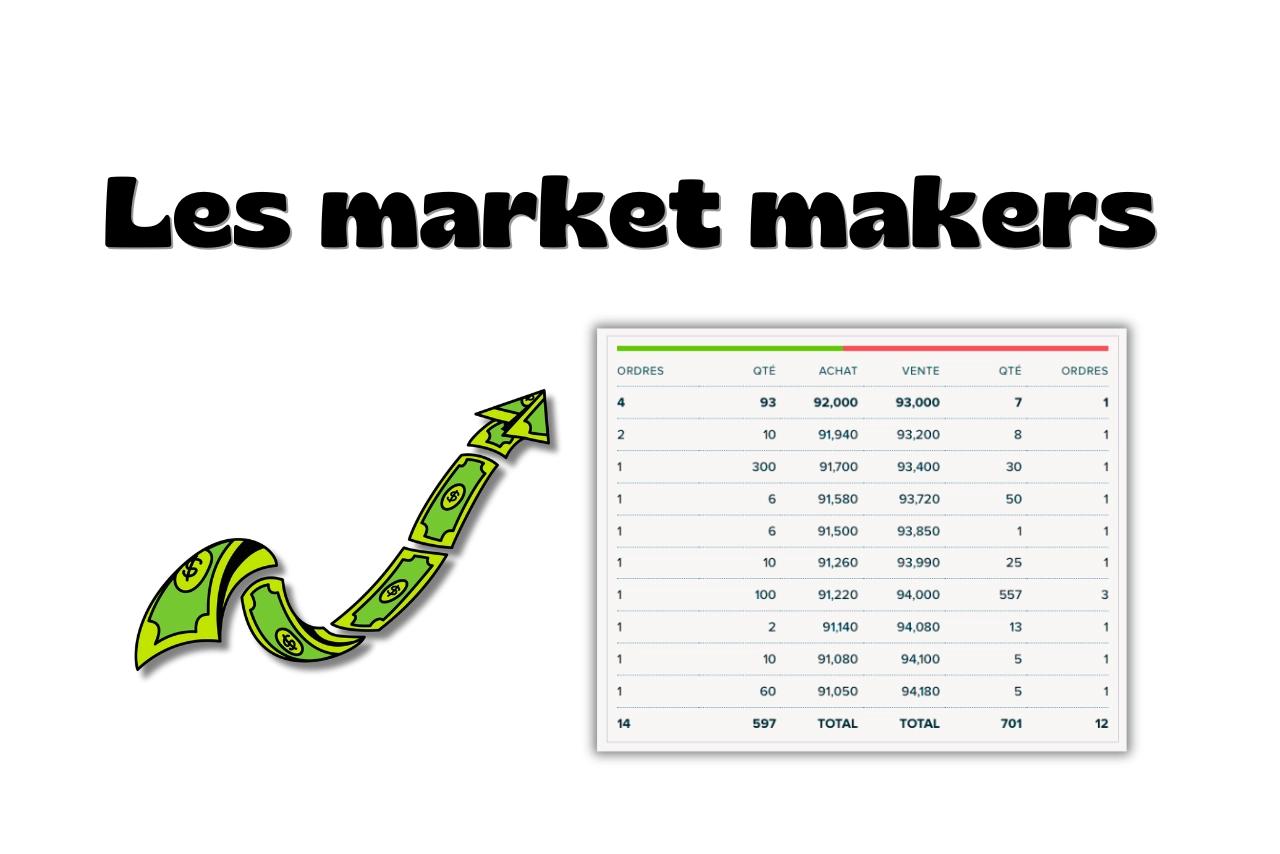
Market makers play a crucial role in financial markets, but how they work is still poorly understood.
I'll explain what you need to know.
What is a market maker's main role?
A market maker is an entity whose role is to provide liquidity in a financial market.
In practice, it continually fills both sides of the order book:
- The bid: the price it's willing to buy at
- The ask: the price it's willing to sell at
Market makers operate across all kinds of assets: crypto, stocks, derivatives, futures, CFDs and more.
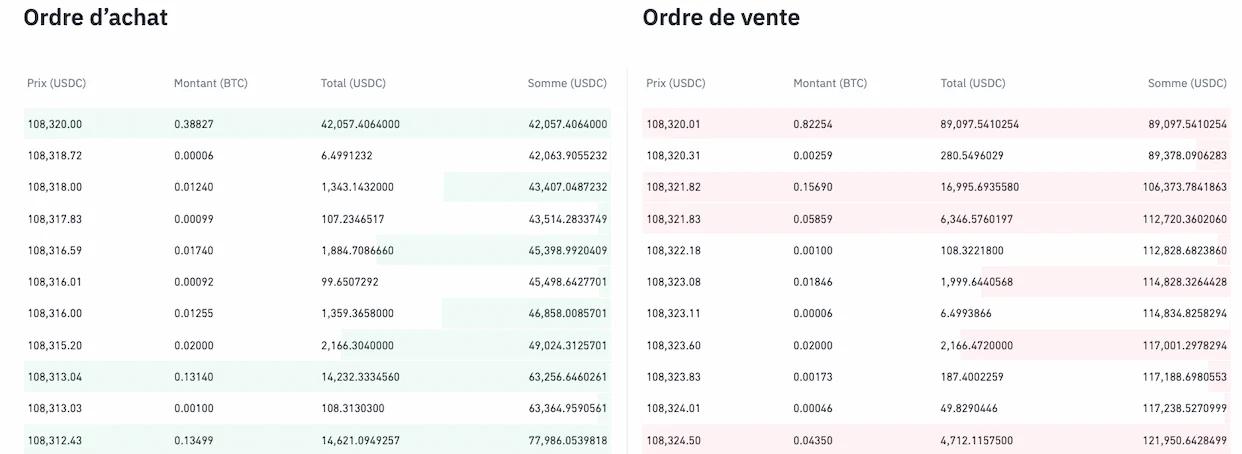
Source: BTC/USDC order book on Binance.
Who can become a market maker?
This isn't a role just anyone can take on. It requires skills, technical resources and enough capital.
Real expertise
Market making requires expertise in several areas.
- Finance: understanding markets, listed products and position risk
- Technology: managing continuous order flows, optimising latency and connecting systems to exchanges
- Statistics: building pricing models, analysing order-book behaviour and adjusting strategies automatically
That level of expertise comes from specialist teams, often made up of quants, engineers and experienced traders.
Strong technical infrastructure
A market maker continuously sends, modifies and cancels orders.
Everything happens very quickly, sometimes in microseconds.
In some markets, getting filled a fraction of a second before another participant can make all the difference.
Staying competitive requires servers close to exchanges, extremely fast network connections and engineers monitoring everything continuously.
Substantial capital
To stand behind its quoted prices, a market maker must be able to execute at any moment.
It can't just display a price. It needs to be able to buy or sell immediately.
That means keeping substantial capital available at all times.
Official authorisation
In regulated markets such as stocks, futures and options, having the resources isn't enough.
You also need permission to operate as a market maker through an agreement with the exchange.
That requires a complete application covering financial strength, risk management, performance history and the team's reliability.
Conditions can be more flexible in crypto, but exchanges still ask for guarantees before authorising the role.
Who are the actual market makers?
They're well-resourced, often specialised organisations:
| Participant type | Where they commonly operate |
|---|---|
| Large investment banks | Stocks, futures, regulated options |
| High-frequency trading firms | Futures, currencies, indices, crypto |
| Specialist brokerage firms | Bonds, ETFs, listed products |
| Internal crypto-exchange desks | Spot pairs and the exchange's own derivatives |
What about individual traders?
An independent trader can technically place lots of orders, but that isn't real market making.
They have no agreement, none of the benefits such as lower fees or special book and data access, and above all, they lack the necessary infrastructure.
Capital requirements, hardware costs, risk management and approval criteria put this role beyond a lone individual.
Why do we need market makers?
Saying they provide liquidity doesn't fully explain their usefulness.
You need to understand the problems they help prevent.
They reduce volatility
As you know, asset prices change with supply and demand.
When both are present, trading runs normally and price remains coherent.
But if one is missing, the market can become unstable.
Price can suddenly jump from one level to another. That's a gap.
Market makers limit those moves by ensuring prices are quoted in the book, adding depth.
They attract participants and build confidence
An empty or inactive book puts traders off.
A well-filled book reassures them and shows activity.
Crypto exchanges such as MEXC understood this at launch: they paid market makers to fill their books.
Even though the platform was new, traders saw activity and liquidity, making them comfortable placing orders there.
They keep prices consistent across markets
An asset can be listed on several exchanges at once.
Sanofi shares, for example, are listed in both Europe and the United States.
Without intervention, prices can diverge according to local supply and demand.
Market makers help limit these differences and keep prices consistent.
That gives different market participants, including traders, banks and regulators, a common reference.
Who benefits from market makers?
Although some people distrust them, market makers bring concrete benefits across the market:
- Retail traders: better execution and fewer sudden jumps between price levels
- Funds and investors: the ability to place large orders without moving price too much
- Brokers and platforms: fuller order books and a more credible image with users
- Listed companies: more stable share prices, reassuring shareholders
- The market as a whole: more consistent quotes across platforms and smoother trading
Can market makers do whatever they want?
No. They must follow rules imposed by platforms, brokers or regulators.
Signing a market-making agreement comes with obligations.
Common ones include:
- Minimum presence: they must quote for a certain percentage of the time, although brief absences around major announcements may be allowed
- Minimum volume: they must offer meaningful quantities. The aim is real liquidity, not a token presence
- Spread requirements: the bid/ask gap can't be too wide. Wide spreads hurt traders and market quality
- Executable orders: some markets require a percentage of orders to actually execute
These rules aim to prevent an illusion of liquidity and keep the order book reliable.
Prohibited practices
Some practices may appear to provide liquidity but are prohibited.
| Practice | Description |
|---|---|
| Spoofing | Displaying a large order, then cancelling it before execution |
| Layering | The same tactic as spoofing, across several price levels |
| Wash trading | Trading with yourself to inflate volume artificially |
| Pump and dump | Pushing price higher to sell to the crowd, then letting it collapse |
That's why regulators monitor them closely.
Several banks, including JPMorgan, have been fined hundreds of millions of dollars for such practices.
What's in it for them?
Market makers aren't doing charity work. Their goal is profit.
They earn in two ways:
- Through their trading strategies, which we'll cover next
- Through benefits negotiated with exchanges or platforms
For example:
- Reduced or waived transaction fees
- Access to exclusive data, such as books and real-time feeds
- Direct server connections for faster execution
- Payments based on liquidity provided or volume handled
- In some cases, unsecured asset loans, particularly in crypto
How do market makers make money?
In theory, they earn the difference between the buying price, the bid, and the selling price, the ask.
That's the spread.
They buy slightly cheaper than they sell, and the difference is their margin.
For example, simultaneously buying at 5,909.75 and selling at 5,910 earns 0.25 points per round trip.
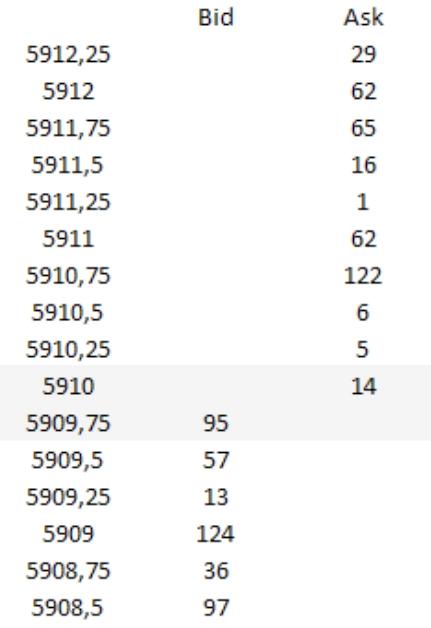
In practice, that strategy alone isn't enough. The spread is often too small to cover fees, market risk and infrastructure costs.
Market makers therefore use other, more profitable strategies.
Deliberately widening the spread
When uncertainty increases, because of an economic announcement or low liquidity, a market maker may widen its spread.
It increases its margin to compensate for the risk.
Instead of earning 0.25 points, it may target a full point.
For example, buying at 5,909.5 and simultaneously selling at 5,910.5.
The wider margin also helps offset possible losses on other positions.
Complex and bespoke products
For some assets, such as structured products, the spread isn't so simple to calculate.
The market maker does more than quote prices in a book.
Sometimes it must create a bespoke product for a client with specific parameters: duration, volatility, underlying asset, interest rates and so on.
It then works with technical teams, including quants and structurers, to build, price and quote the product.
The aim isn't to scrape a few points. It's to assess the risk correctly while staying competitive with other desks.
Arbitrage between platforms
A market maker can also operate in several markets at once.
When prices differ between two markets, it can exploit the difference through arbitrage.
If Bitcoin is €100,000 on MEXC and €101,000 on Binance, for example, it buys on MEXC and sells on Binance.
When prices converge, say at €100,700, it pockets the difference.
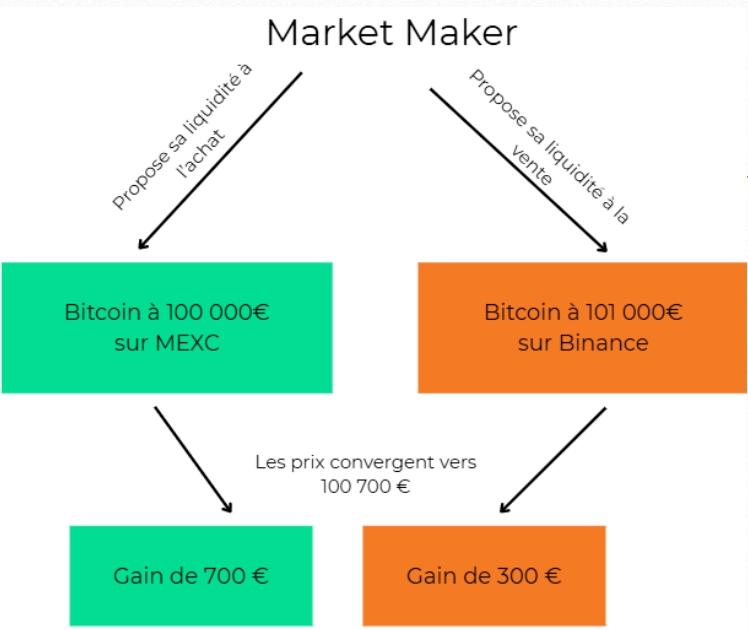
This is high-frequency trading. It requires fast algorithms and direct access to the books.
This arbitrage also exists in stocks listed on several exchanges. The goal is the same: identify a pricing anomaly, act quickly and exit when prices become consistent again.
Statistical market making
Here, quantitative or statistical models identify gaps between normally correlated assets.
For example, the Nasdaq and S&P 500, or Bitcoin and Ethereum.
These assets often move similarly.
When one moves too far from the other, the market maker sells the one that's "too high", buys the other and waits for them to come back into line.
This relies on correlation, not simply a price difference.
Some strategies go further, recalculating an index such as the CAC 40 from its actual components and comparing that "internal" value with its quoted price.
If there's a difference, they sell the index and buy the stocks, or vice versa.
Options market making
Here, market makers don't just display prices. They value options using expected volatility, the underlying price, time remaining and interest rates.
They hedge market direction and seek profits from volatility dynamics, including gamma, carry and skew.
For example, they may position for higher volatility.
Well-known approaches include volatility arbitrage and dispersion.
Order-flow-based market making
Some market makers adjust decisions in real time according to order-book activity.
If they spot a large buyer pushing price higher, for example, they may:
- Widen the spread to reduce exposure
- Withdraw temporarily
- Increase their buy-side presence
- Even become liquidity takers themselves to trigger a breakout and sell higher
In this approach, they use their own liquidity to support or slow a move according to their objectives.
It's a form of controlled speculation that remains compatible with providing liquidity.
Inventory management around the open and close
Managing inventory, particularly at the beginning and end of a session, is central to the role.
It helps optimise entries and exits while respecting regulatory limits.
If a market maker considers an asset temporarily undervalued, it will try to accumulate it during the session and sell it higher later.
Conversely, if it's overexposed, it will try to reduce its position without disrupting the market.
This takes finesse: splitting orders, adjusting its presence in the book and using techniques such as sweep orders to limit impact.
Misconceptions about market makers
Do they hunt our stop losses?
Not in regulated markets.
An individual account is too small to interest them.
That kind of manipulation mainly occurs at some unregulated CFD brokers that trade directly against clients.
Do they take no risk?
They take risks every day.
If a huge flow buys or sells their entire inventory in one go, they can suffer losses.
That's why they adjust spreads, hedge in real time and diversify strategies.
Do they control price for hours at a time?
That's unlikely.
Their role operates over very short horizons, sometimes seconds.
Artificially holding price for hours would cost too much and quickly become obvious.
A lasting trend is more likely driven by other participants: funds, options hedging or macroeconomic announcements.
This information comes from my professional experience on a trading floor and the many conversations I've had with traders.
