
Some prop firms offer immediate access to a large funded account without making you pass a challenge first.
I'll explain how it works and whether I think it's worth it.
What is a prop firm without a challenge?
Normally, a prop firm requires a challenge with a profit target, a drawdown limit and sometimes a deadline.
The aim is to assess your trading before giving you a funded account.
No-challenge prop firms, also called instant funding or no-evaluation firms, skip that stage.
You access the account immediately, with no initial test to pass.
See the list of instant funding prop firms.
Why do traders want to skip the challenge?
Traders want to avoid challenges because they can be difficult to pass.
Between the strict rules, the limits to respect and the conditions that keep changing, it's a real test.
It takes time, it costs money, and until you pass, you don't get access to the funded account.
For beginners, this is often the biggest obstacle.
In practice, though, passing is only the first step. The real challenge is keeping the funded account long enough to receive a payout.
If you want to try a conventional challenge, I also explain how to improve your chances of passing.
Advantages and disadvantages
Advantages:
- Quick access to a large account
- The potential to earn payouts sooner if you are already profitable
- No conventional evaluation stages
Disadvantages:
- Higher fees
- Rules that tend to be stricter than on evaluation-based accounts
- Some conditions may remain unclear
- Immediate funding does not mean unrestricted trading
| Evaluation-based prop firm | Instant funding prop firm |
|---|---|
| One or more evaluations to pass | Immediate access to the funded stage |
| Lower entry fees | Higher entry fees |
| Generally less restrictive rules | Often stricter rules |
The limitations of instant funding
A no-challenge prop firm still has rules you must follow.
There is no initial evaluation, but you still need to watch drawdown, trading-day requirements, payout conditions, position sizes and the firm's specific restrictions.
And because the entry fee is higher, a mistake costs you more too.
Check how the account actually works.
Some firms are transparent about simulated trading, while others are much less clear.
To understand the business model, read my full analysis of prop firms as a scam or an opportunity.
A practical example: InstantFunding.io
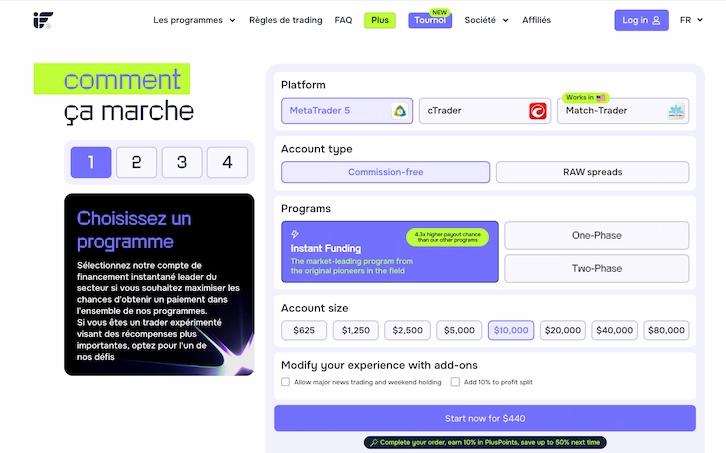
To see what this looks like in practice, let's take InstantFunding.io: a $10,000 funded account that costs $440.
Its legal terms state that all accounts are demo accounts.
There is no initial profit target to pass an evaluation, as there would be in a conventional challenge.
However, you must first earn 5% before payouts become available.
Once that milestone is reached, the account's maximum loss allowance is reduced to 5%.
The first withdrawal is allowed 14 days after your first trade. After that, you can withdraw weekly if you meet the conditions.
You keep 80% of profits, or 90% with an add-on or after achieving 10% growth in three months.
You must place at least one trade per week to request a withdrawal; otherwise, it is blocked.
So even though it's sold as "no challenge", it works a lot like a challenge.
You must reach a profit threshold before withdrawing money.
My view
I've always supported the idea behind prop firms, but I find the marketing around accounts without a challenge quite misleading.
You're sold immediate funding, yet you're often trading on a demo account, paying more and following rules that can be harder than at some conventional prop firms.
If you're already profitable and want to try another format, then why not?
But if you're not there yet, keep your money or take a conventional challenge. It'll cost you less.
