
What is liquidation in trading?
Liquidation in trading means a platform or broker forcibly closes a position.
It happens when the margin or collateral backing that position is no longer enough to keep it open.
In practice, liquidation mainly affects:
- Margin trading
- Futures contracts
- Perpetual contracts
- Leveraged long or short positions
- Accounts where an asset is used as collateral
Liquidation isn't the same as a stop loss. A stop loss is an order you place to limit a loss. Liquidation is a forced closure by the platform when your margin becomes insufficient.
Why does a position get liquidated?
A position is liquidated when the remaining margin is no longer enough to cover its risk.
To understand this, you need to distinguish three concepts:
- Initial margin: the capital set aside to open the position
- Maintenance margin: the minimum required to keep the position open
- Leverage: the mechanism that lets you open a position larger than your actual capital
Leverage matters because losses are calculated on the full position size, not just the capital you put up.
The higher the leverage, the faster an adverse market move can reduce your available margin.
Take this example:
A trader deposits €1,000 and uses 10× leverage, opening a €10,000 position.
If the market moves against them, losses are calculated on €10,000, not €1,000.
A 10% move against the position can therefore be enough to wipe out almost all their margin.
Depending on the platform and product, the trader may first receive a margin call: a request to add funds or reduce the position.
If available margin remains insufficient, the platform may then automatically close part or all of the position.
What is the liquidation price?
The liquidation price is the price level at which a position risks being automatically closed by the platform.
It indicates how far the market can move against your position before available margin becomes insufficient.
The displayed liquidation price is only indicative. It can vary between platforms and change when your available margin changes.
That's why calculating it can be complicated: each platform applies its own rules, depending on the product and margin conditions.
What happens to the money after liquidation?
When liquidation happens, any recovered funds first go towards covering what is owed on the position.
Generally, they may be used to:
- Cover losses on the position
- Repay any borrowing
- Pay closing or liquidation fees
- Settle the remaining balance under the platform's rules
If any available balance remains in the account after liquidation, it belongs to the trader.
If the funds aren't enough, what happens next depends on the product and the mechanisms the platform has in place.
Long and short liquidations: what's the difference?
A long liquidation happens when a long position is forcibly closed.
The trader is betting on a rise, but the price falls too far.
To close the position, the platform sells the asset on the market, which can intensify the decline.
A short liquidation happens when a short position, also known as short selling, is forcibly closed.
The trader is betting on a fall, but the price rises too far.
To close the position, the platform buys the asset back on the market, which can intensify the rise.
What is a liquidation cascade?
A liquidation cascade happens when forced liquidations trigger one another and amplify a market move.
These cascades mainly occur in volatile markets such as crypto, when many traders use high leverage around similar price levels.
During a sharp fall, long liquidations cause forced selling.
Those sales can push prices lower and reach further liquidation thresholds.
This is called a long squeeze.
For example, Ethereum experienced this kind of move during the week of 1 February 2025.
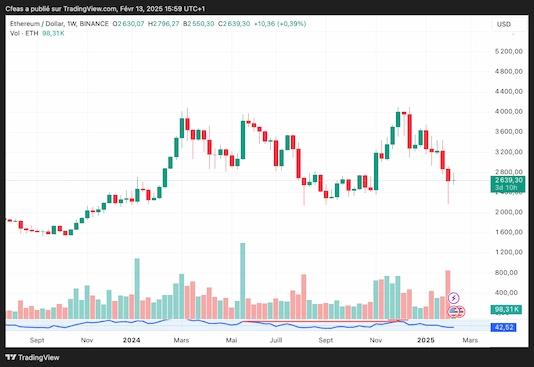
Its price fell from an area between $3,600 and $4,000 to below $3,000 in a few days.
That decline triggered a chain of long liquidations, adding selling pressure.
ETH then fell as low as $2,190 before recovering above that level.
During a sharp rise, short liquidations cause forced buying.
Those purchases can push prices higher and trigger more short liquidations.
This is called a short squeeze.
