
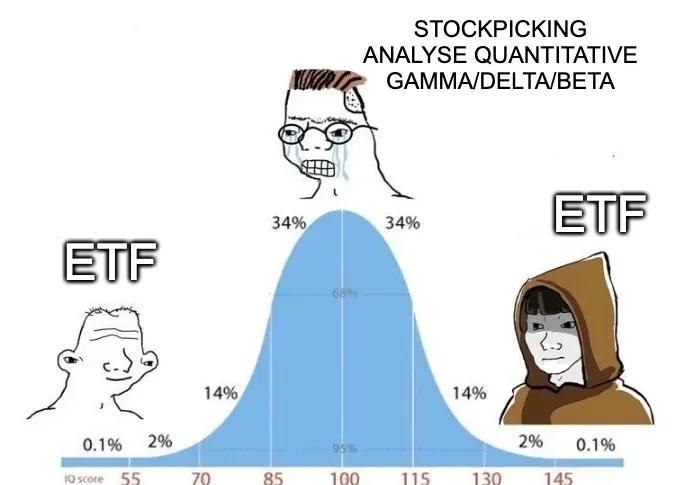
What is an ETF?
An ETF, or exchange-traded fund, also called a tracker, is a financial product that lets you invest in a group of assets in a single transaction.
It trades on an exchange like an ordinary share, making it accessible to everyone.
Instead of buying shares individually, you could buy an ETF holding companies from different sectors and parts of the world.
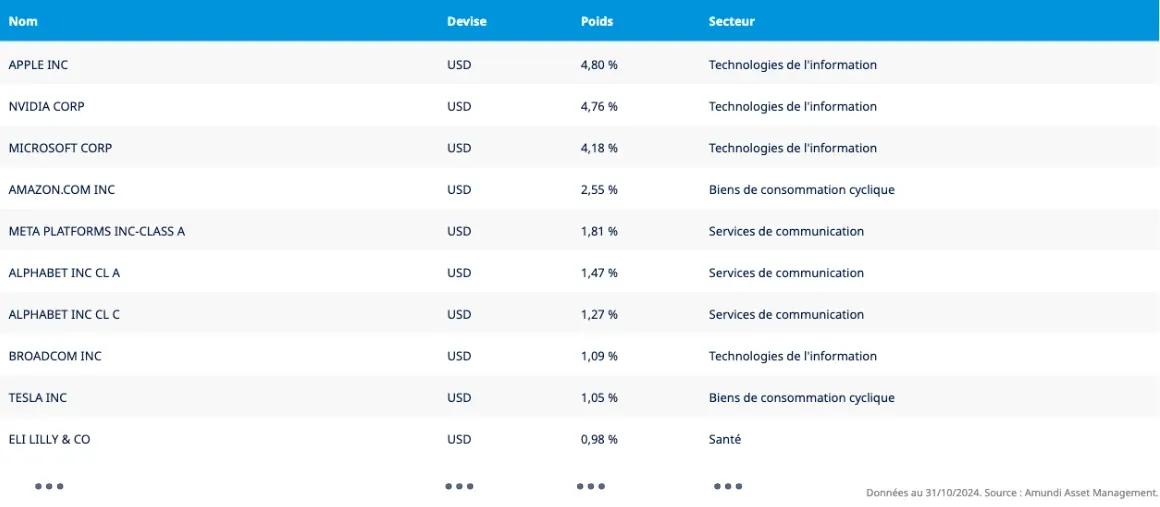
A well-known example is the Amundi MSCI World UCITS ETF - EUR (C). Here’s its allocation as of 31 October 2024:
Its geographical allocation looks like this:
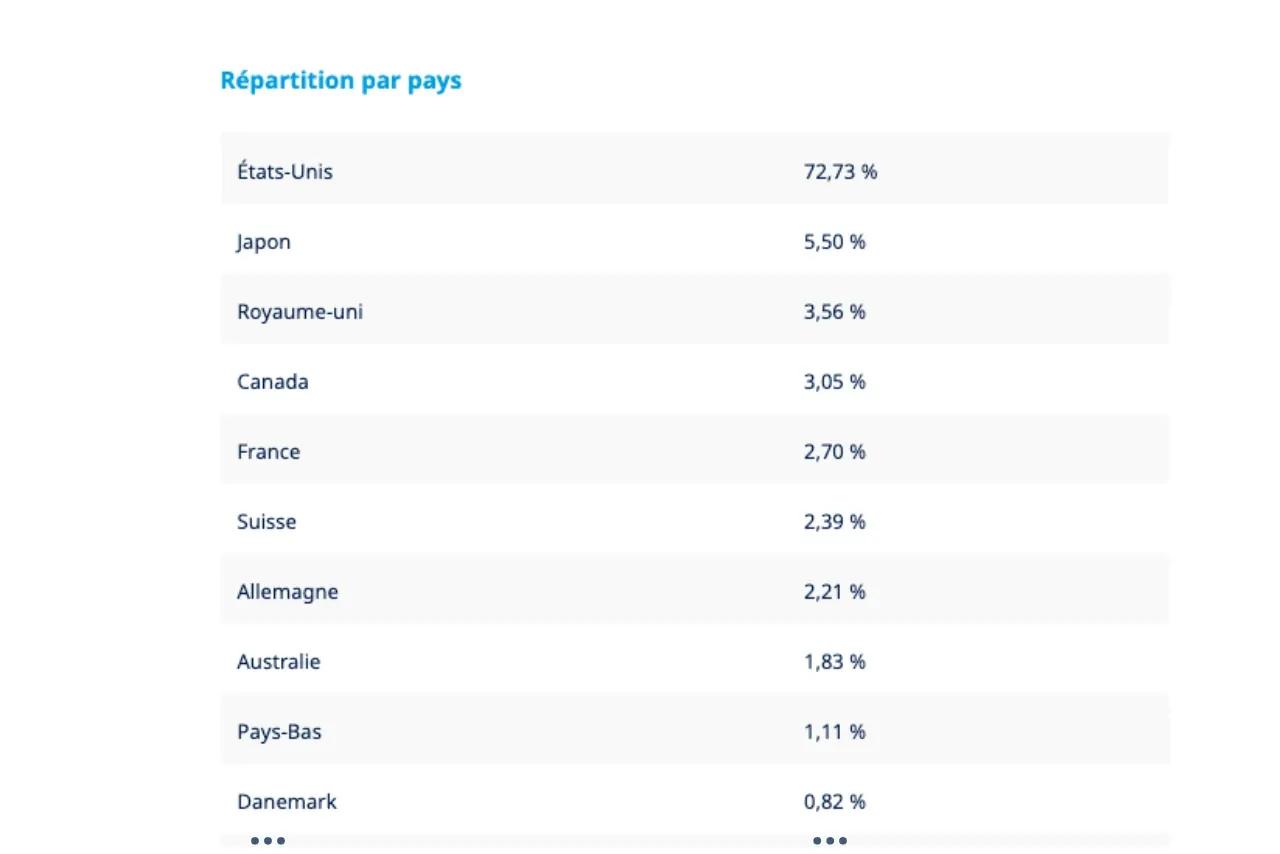
So, instead of buying 50 different shares, you buy one holding that gives you exposure to:
- Multiple companies
- Multiple sectors
- Multiple geographical regions
Different types of ETF
The interesting thing is that ETFs aren’t limited to shares.
There are ETFs for almost every asset type:
- Equity ETFs: groups of shares, sectors or indices
- Bond ETFs: corporate or government bonds
- Thematic ETFs: property, healthcare, natural resources and more
The CAC 40 index ETF example
First, what is a stock market index?
It’s a group of company shares selected to represent the performance of a particular sector, country or region.
In France, the CAC 40 brings together the 40 largest listed French companies.
It gives an overview of how major French businesses are performing.
If the CAC 40 rises, it generally means those companies are doing well. The reverse applies when it falls.
What does a CAC 40 index ETF do?
It replicates the CAC 40’s performance through a single investment.
Buying one share in the ETF means investing in France’s 40 largest companies.
Here’s the allocation of the Amundi CAC 40 UCITS ETF Dist:
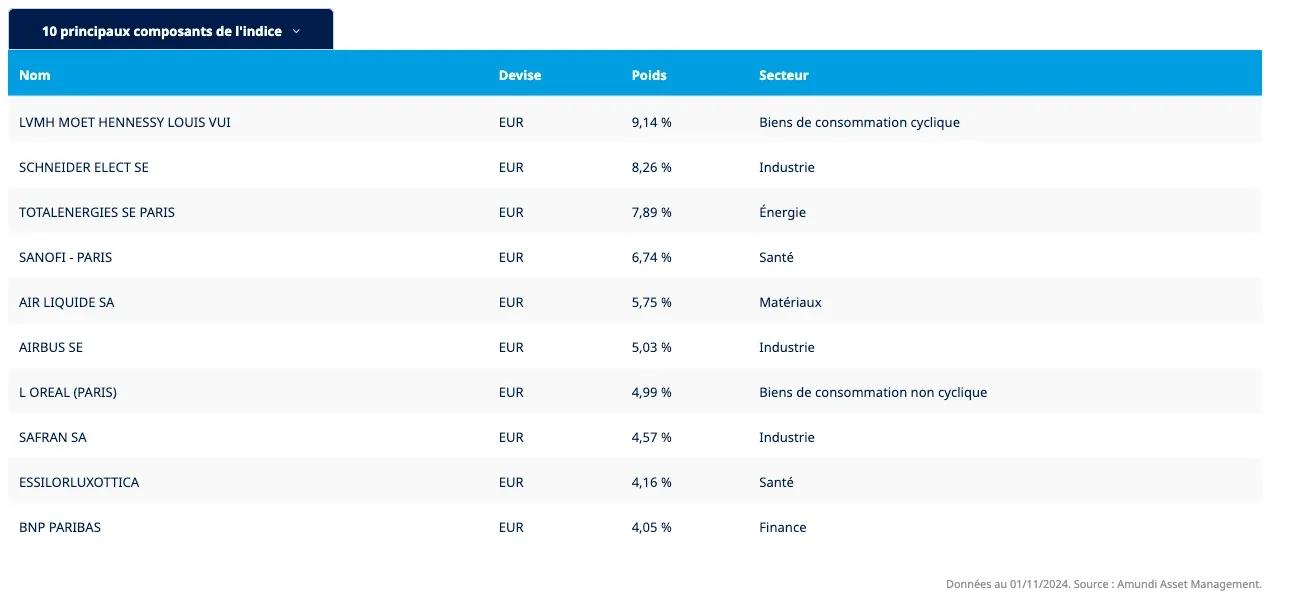
To explain: LVMH accounts for around 9.14% of the CAC 40 index.
That’s why it also has a 9.14% weighting in Amundi’s CAC 40 ETF.
The fund copies the index’s company weightings to track its performance faithfully.
One important detail
Some ETFs aren’t designed to diversify. They focus on a specific sector.
If you believe a sector has strong prospects and opportunities, you can choose to invest all your capital there.
There are ETFs specialising in property or artificial intelligence, for example.
How does an ETF work?
The next question is how ETFs actually replicate an index, sector or other basket of assets.
Is it a Ponzi scheme? No.
ETFs use two main methods:
- Physical replication
- Synthetic replication
Physical replication
With physical replication, the ETF directly buys the assets it wants to track.
Those could be shares in an index such as the CAC 40, or a particular sector such as property.
A physically replicated CAC 40 ETF, for example, buys shares in all 40 companies in the same proportions as the index.
LVMH makes up 9.14% of the index?
Then 9.14% of the fund goes into LVMH.
The advantage? It’s transparent and easy to understand, because the ETF actually owns the shares in the index it tracks.
The downside? You need a good fund manager, because there’s a risk of poor tracking.
Synthetic replication
With synthetic replication, the ETF doesn’t buy the underlying assets directly.
It uses derivatives to reproduce the desired performance.
The ETF enters an agreement with a financial institution, which commits to paying it the return of the target index or asset basket.
The advantage? It’s often cheaper and simplifies management.
The downside? Less transparency and counterparty risk: if the partner institution defaults, accurate tracking may be compromised.
How do you make money from an ETF?
ETF returns mainly come from two sources:
- Growth in the value of your shares
- Dividends
Growth in share value
Let’s return to the CAC 40 ETF example:
When the companies in the index gain value, the ETF follows the same trend.
If their share prices rise, your ETF shares increase in value.
If they fall, your shares lose value.
In other words, the ETF moves with its holdings.
Dividends
Returns can also come from dividends, but ETFs don’t all handle them the same way.
There are two main types:
- Accumulating ETFs: dividends are reinvested directly in the fund, gradually increasing the value of your shares
- Distributing ETFs: dividends are paid into your account, providing regular income
What are the advantages of investing in an ETF?
ETFs make investing much simpler, especially when you’re starting out.
You don’t need to follow every company in detail.
Instead of spending hours analysing individual shares, you can invest in a whole group at once.
Easy access to investing
I have a close friend. Let’s call him Sam.
Sam doesn’t have advanced financial analysis skills or the time to dissect every listed company.
But he still wants to invest.
After reading a few ETF books, including Créer et piloter un Portefeuille d’ETF by Edouard Petit, he realised he could "benefit from the global economy’s performance" by regularly investing in a World ETF.
He chose Amundi’s.
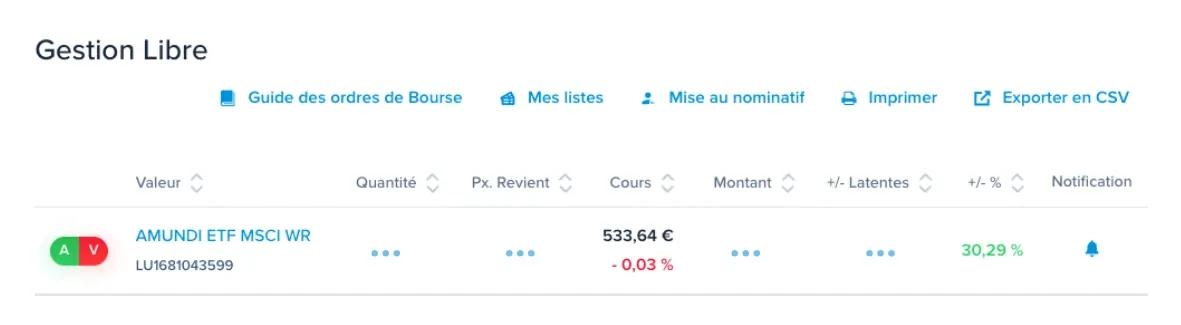
In two years, his investment gained 30%.
Could it have gone negative? Yes, but he understands the risks of the investment he chose.
His experience shows how ETFs can offer beginners a simple, effective way to invest.
What about experienced investors?
ETFs aren’t just for beginners.
Seasoned investors use them too.
Why?
Because statistically, most actively managed funds fail to beat their benchmark indices over the long term.
Even with expertise and sophisticated strategies, beating "the market" remains difficult.
Where do Bitcoin ETFs fit in?
A Bitcoin ETF tracks Bitcoin’s price through physical holdings.
But why bother?
Before these ETFs existed, buying Bitcoin meant using specialist exchanges such as Binance, or buying directly on the blockchain.
You can imagine why a bank, insurer or hedge fund might be reluctant to put large amounts of capital on a platform with significant counterparty risk.
ETFs now let major market participants invest more securely through a stock exchange.
An ordinary investor can also buy a Bitcoin ETF through their bank.
The same applies to ETH ETFs.
The problem ETFs help solve: diversification
As an investor, you can choose between different instruments for your money.
The best-known is a share.
It represents part of a company, making you a co-owner with the possibility of receiving a share of its profits.
An investment example
Say you believe in Apple’s potential and ability to innovate, so you buy AAPL shares.
You also think Microsoft has solid foundations, so you buy MSFT shares.
Your portfolio now contains only Apple and Microsoft.
Look closer, though, and there’s a problem: both companies are American and both specialise in tech.
In technical terms, your portfolio lacks diversification.
Why?
Because the two stocks are highly correlated.
You’re too exposed to one sector and one economy: technology and the United States.
Two concrete risks:
- The US economy takes a hit: imagine a presidential election causing economic instability. The stock market could fall, directly affecting both holdings
- The technology sector struggles: a slowdown or new regulations in tech could affect both stocks
That’s where diversification comes in.
Diversifying your portfolio
Diversification means spreading your capital across different assets, sectors and geographical regions to limit the risks tied to one industry or market.
Now imagine you want to diversify.
How do you reduce the risks I’ve described?
Add other shares so you no longer depend only on US tech.
You could invest in different sectors or companies based elsewhere in the world.
Say you add LVMH, a luxury group with greater exposure to the European market.
You could also add an American company in another sector, such as Coca-Cola in food and beverages.
To go further, add an Asian company such as Toyota, an automaker with little connection to American tech or European luxury.
And why not add Nestlé?
That would broaden your portfolio with a well-known Swiss food company.
You now hold six businesses: Apple, Microsoft, LVMH, Coca-Cola, Toyota and Nestlé.
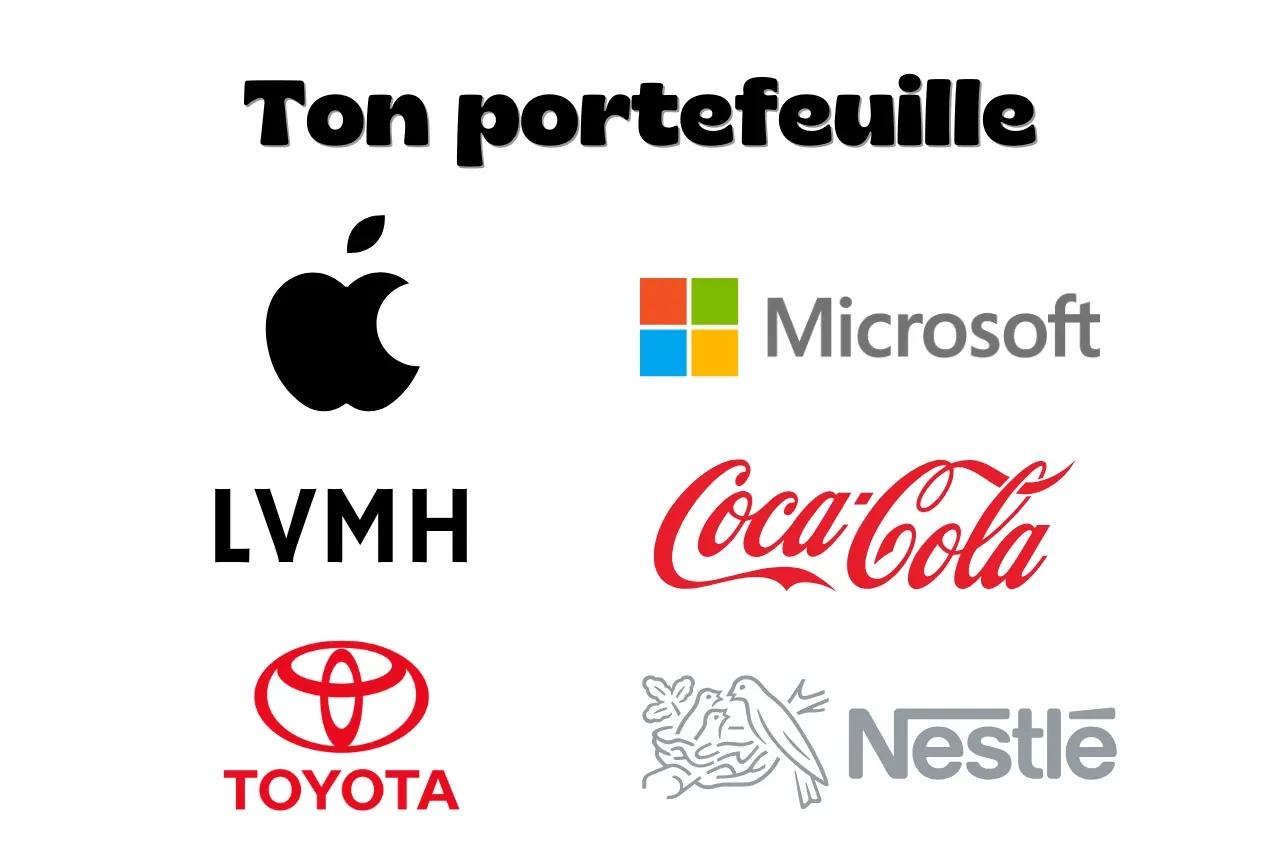
You no longer depend solely on the US economy or tech.
Your exposure is more balanced, with holdings in:
- Luxury
- Cars
- Food
Across:
- The United States
- Europe
- Asia
But there are still a few catches...
Buying all those shares individually takes time and money.
Your portfolio probably still isn’t diversified enough, and researching ways to improve it would take even more time.
So how can you make life simpler while diversifying effectively?
The answer is an ETF.
All examples are for explanation and educational purposes.