
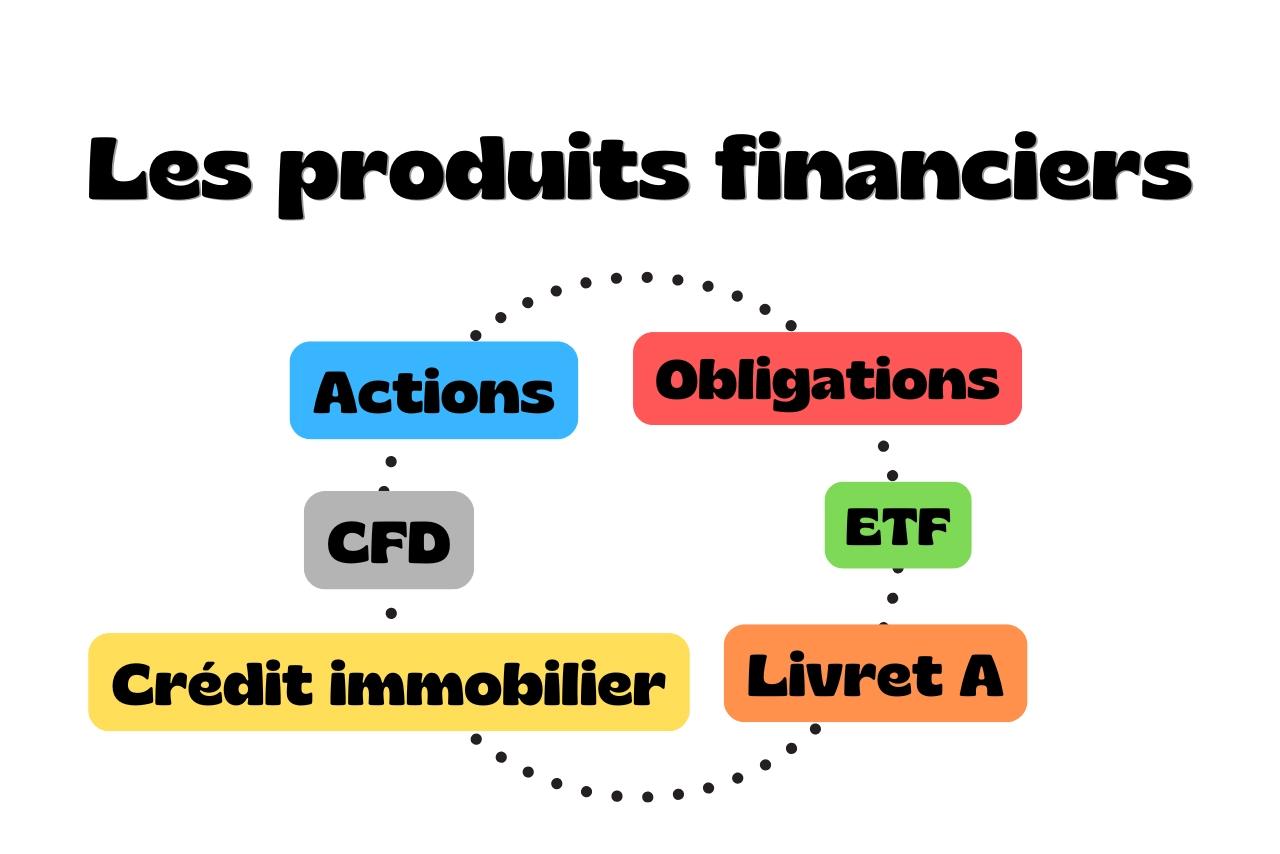
What is a financial product?
A financial product is a structured solution that lets you save, invest, borrow money or protect yourself against financial risk.
Each product has its own rules: purpose, conditions, potential returns, fees, risks and duration.
For example, a share lets you buy part of a company, a bond means lending money to a company or government, and a savings account lets you set money aside while keeping it accessible.
Two financial products can therefore meet very different needs.
That's why you need to compare them as a whole, not just by their advertised return.
Financial products, investments and financial instruments: what's the difference?
These terms are related, but operate at different levels.
"Financial product" is the broadest term.
It describes a solution for saving, investing, borrowing or protecting against financial risk.
"Financial investment" means a product used to put money aside with the aim of preserving it, growing it or generating income.
"Financial instrument" is a more technical and legal concept.
It covers certain securities or contracts used in financial markets, such as shares, bonds, fund units, ETFs, options, futures and swaps.
These concepts can overlap.
The simple point to remember is that all financial instruments can be called financial products in everyday language, but not every financial product is a financial instrument.
The main families of financial products
Financial products can be classified by their main purpose.
This helps you make sense of them, although some products fit several categories.
For example, a French assurance-vie policy can be an investment wrapper, a savings product and an investment product, depending on the assets you choose within it.
Savings products
Savings products mainly help you set money aside as an accessible reserve or for a near-term goal.
The best-known examples in France include:
They're generally simple to understand and prioritise security, but returns remain limited.
They mainly suit emergency savings or people who don't want to expose their capital to financial markets.
Investment products
Investment products aim to generate a return while accepting more risk than traditional savings.
This family includes:
- Stocks
- Bonds, including government bonds
- Investment funds
- UCITS funds, known as OPCVM in France
- ETFs
Several of these investment products are also financial instruments.
That's the case for stocks, bonds, fund units, UCITS funds and many ETFs.
Their value can fluctuate, making them more suited to a medium- or long-term horizon.
Tax wrappers
Investment wrappers aren't always investments in themselves. Their main purpose is to hold several investments within a specific framework.
You therefore need to distinguish the wrapper from what it contains.
Your choice affects taxation, available investments, access to your money and withdrawal conditions.
Common French wrappers include the PEA, the ordinary securities account or CTO, assurance-vie and the PER retirement savings plan.
For example, a PEA can hold European shares or certain eligible funds.
Financing products
Financing products let you obtain money to buy an asset or fund a project, then repay it with interest.
They include:
- Mortgages
- Consumer loans
- Student loans
- Business loans
- Leasing
Compare their interest rate, duration, total cost, fees and required guarantees.
Insurance and protection products
Insurance and protection products safeguard a person, family or assets against risks such as death, disability, inability to work, dependency, accidents or borrowing-related risks.
Borrower insurance, personal protection cover and certain insurance contracts fall into this category.
Compare their coverage, exclusions, cost, beneficiaries and conditions for making a claim.
Derivatives
Derivatives let you take a position on changes in an underlying asset, such as a stock, index, currency, interest rate or commodity.
Options, futures, CFDs, swaps and warrants belong to this family.
They can be used to hedge, speculate or gain leveraged exposure.
In many cases, derivatives are also financial instruments because they're financial contracts used in markets.
They're more complicated than traditional savings products, and losses can be substantial.
That's why they're better suited to knowledgeable investors who understand how they work, their risks and their possible consequences.
Comparing the main financial products
| Financial product | Main purpose |
|---|---|
| Livret A, LDDS | Keep savings accessible |
| LEP | Save at a favourable interest rate |
| Unit-linked assurance-vie | Invest across several assets |
| PEA | Invest in European equities |
| Securities account | Invest freely in the markets |
| Stocks | Buy part of a company |
| Bonds | Lend money in return for interest |
| ETFs | Invest in a basket of assets |
| Futures | Buy or sell an asset at a future date |
| CFDs | Bet on an asset rising or falling |
| Mortgage | Finance a property purchase |
