

What is a PEA?
The Plan d’Épargne en Actions (PEA) is an investment account that lets French tax residents invest in European shares while benefiting from an attractive tax advantage.
Why you should consider a PEA
Once the PEA has been open for five years, gains are exempt from income tax.
Only social contributions remain payable.
In practice, instead of paying 31.4% in total tax and contributions, you pay only 18.6% in social contributions. The income tax portion is 12.8%.
Let’s put numbers on it:
Imagine an investment in your PEA has made €10,000 in gains, and you want to withdraw them.
You’ll have to thank the French government for its kindness by paying what it’s owed.
Here are the two scenarios, with and without the PEA advantage:
| Scenario | Income tax | Social contributions | Total deductions | Net amount received |
|---|---|---|---|---|
| Withdrawal before five years (without the PEA advantage) | 12.8% of €10,000 = €1,280 | 18.6% of €10,000 = €1,860 | €1,280 + €1,860 = €3,140 | €6,860 |
| PEA withdrawal after five years | Exempt = €0 | 18.6% of €10,000 = €1,860 | €0 + €1,860 = €1,860 | €8,140 |
Without the PEA, you’d miss out on €1,280.
Why the five-year rule without withdrawals?
The government imposes this five-year condition to encourage stable investment in European businesses.
The idea is to encourage savers to leave their money invested rather than withdraw it whenever the market moves.
If you withdraw before five years, your PEA is closed and you lose the income tax exemption.
The tip to remember
Open your PEA as early as possible, from age 18, and make an initial deposit, however small.
And no, it isn’t too late if you’re 40.
Opening fees are small, a few dozen euros.
Once the five years have passed, your account is ready to use with the income tax exemption.
Even if you don’t plan to invest straight away, having the account open can be a smart long-term move.
Why PEAs and ETFs work well together
As you’ll have noticed, the PEA limits you to European shares, which may seem restrictive.
But ETFs offer a way around that limitation.
Using a PEA to buy "World" ETFs, such as those from Amundi or BlackRock, gives you exposure to shares around the world while staying within the PEA’s tax framework.
After five years, you benefit from a globally diversified portfolio with no income tax on gains.
Where to open your PEA
Most traditional French banks offer PEAs, including LCL, Banque Populaire, Bred, BNP and Société Générale. Contact your adviser.
Online banks are another option, often cheaper.
Compare fees carefully, but remember that you can transfer your PEA between banks without losing the account’s age.
For example, if you transfer a PEA that’s been open for three years, you only have two more years to wait for the tax exemption.
So even if your first choice isn’t the most cost-effective, you can change later.
I asked my YouTube subscribers where they held their PEAs. Here are the results:
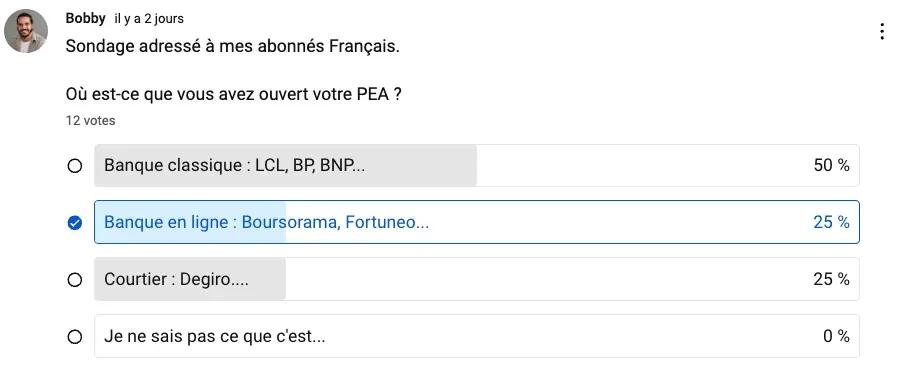
As you can see, all the options are viable and in use.
For brokers, check carefully because not all offer a PEA. DEGIRO, for example, doesn’t.
Also check which ETFs your chosen bank offers.
The key conditions to remember
- You must be a French tax resident to have a PEA
- You must avoid withdrawals during the first five years to benefit from the income tax exemption
- Contributions are capped at €150,000, excluding compound growth
For more information, see the official French public service website.
What’s the alternative?
The alternative is a compte-titres ordinaire, or CTO, a standard securities account.
It has no contribution limit and lets you buy shares, ETFs and foreign securities.
The downside is that there’s no income tax exemption.
So the idea is to fill the PEA first, up to €150K in contributions, then move on to a CTO.