
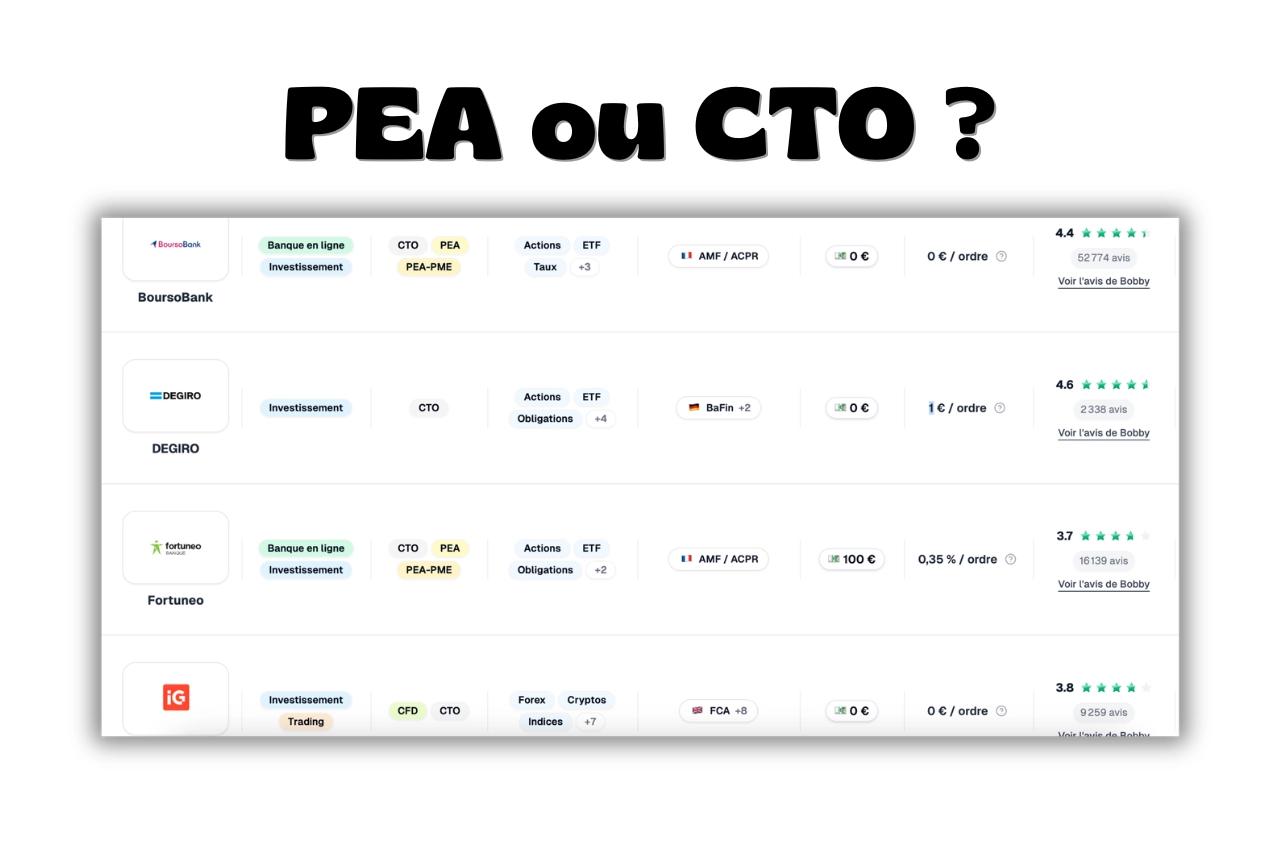
The choice mainly depends on two things: which financial products you want to buy, and how long you plan to hold your investments.
If you're a French tax resident investing for the long term, a Plan d'Épargne en Actions (PEA) is often the first account to open.
It only holds eligible securities, mainly European shares and certain funds and ETFs, but its tax treatment becomes more attractive after 5 years.
An ordinary securities account, or compte-titres ordinaire (CTO), becomes useful when the PEA starts limiting you.
For example, if you want to buy shares that aren't PEA-eligible, access more ETFs, invest in bonds, use several currencies or keep investing without a contribution cap.
PEA vs CTO: the differences to know
| Feature | PEA | CTO |
|---|---|---|
| Main purpose | Invest with reduced taxation after 5 years | Invest with more freedom |
| Tax treatment | Favourable after 5 years | Standard taxation |
| Capital gains | Exempt from income tax after 5 years; social levies still apply | PFU flat tax by default |
| Contribution cap | €150,000 for a standard PEA | None |
| Available investments | European shares and eligible funds and ETFs | Stocks, ETFs, bonds and other products depending on the broker |
| Direct international share ownership | No | Yes |
| World ETFs | Yes, if PEA-eligible | Yes, with more choice |
| Bonds | Very limited | Yes |
| Derivatives | No or very limited | Possible, depending on the broker |
| Withdrawals before 5 years | Generally close the plan | Unrestricted |
| Withdrawals after 5 years | Possible without closing the plan | Unrestricted |
| When it makes most sense | Long-term investing | When you need more choice |
To choose properly, though, you mainly need to look more closely at two things: taxation and available products.
Taxation
Taxation is where the PEA really gains the advantage.
After 5 years, gains made within a PEA are exempt from income tax.
You only pay social levies.
In a CTO, dividends received and realised capital gains follow the standard rules for investment income.
The PFU flat tax applies by default.
Since 1 January 2026, the PFU is 31.4%, comprising 12.8% income tax and 18.6% social levies.
For example:
You invest €10,000.
Your investment later reaches €15,000.
You therefore realise a €5,000 capital gain.
In a CTO, you pay 31.4% on that gain, or €1,570.
With a PEA older than 5 years, you only pay social levies, or €930.
In this example, the PEA saves you €640.
For a single transaction, the difference is limited. But over several years, especially if you reinvest gains, it can become substantial.
That's why the PEA often suits a long-term strategy better.
Available products
The choice between a PEA and CTO depends heavily on what you want to buy.
A PEA keeps you within a limited framework.
You can mainly buy European shares and certain eligible funds and ETFs.
Some PEA-eligible ETFs, such as World or S&P 500 ETFs, also give you exposure to US or global markets.
But that exposure is indirect.
If you want to buy a non-eligible share yourself, such as Tesla in the US or Toyota in Japan, you need a CTO.
Depending on the broker, a CTO opens up more markets and products: shares outside the PEA-eligible area, non-eligible ETFs, bonds, derivatives and foreign currencies.
So if you want a simple portfolio with a few eligible ETFs, a PEA may be enough.
If you want to pick individual stocks, invest outside the PEA framework or access a wider product range, a CTO becomes necessary.
Which account should you open for your situation?
You're starting out and want to invest for the long term
If you want to build investments gradually over the long term, a PEA is often enough.
You can start with one or two PEA-eligible ETFs and keep the strategy simple.
Even a small amount can make opening a PEA worthwhile to start the tax clock.
That's what I did by opening a PEA with BoursoBank.
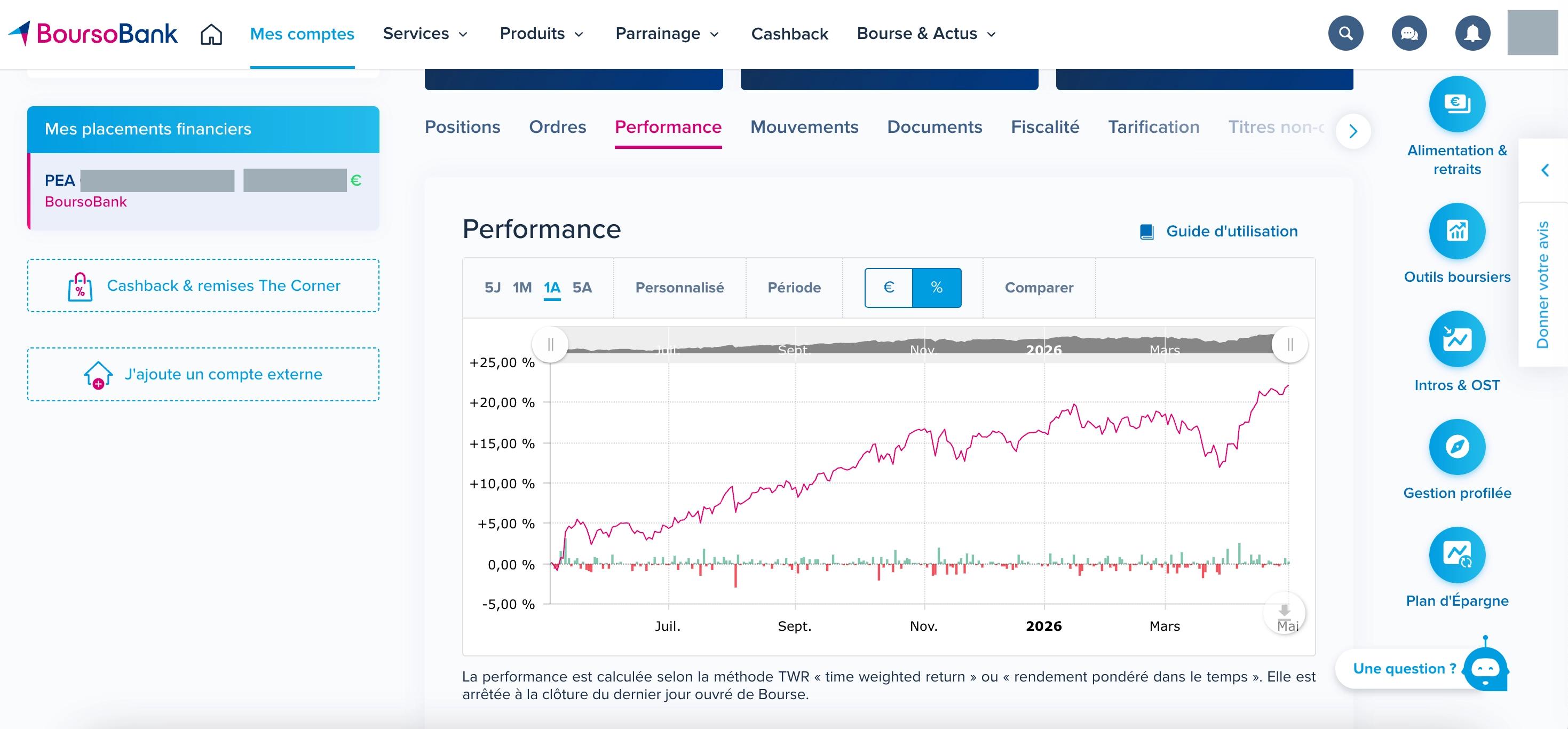
I explain the reasoning in my article on why to open a PEA now.
You want to buy shares outside the PEA
If you want shares that aren't PEA-eligible, you need a CTO.
A PEA can sometimes provide indirect exposure through eligible ETFs, but that isn't the same as choosing and owning individual shares yourself.
You want more ETFs or other products
If you want a more precise asset allocation, the PEA can quickly become restrictive.
A CTO becomes necessary for non-PEA-eligible ETFs, bonds or more specialised products, depending on your broker.
You want to trade actively
A CTO is better suited to active trading.
A PEA can work for long-term investing with occasional portfolio adjustments, but quickly becomes limiting if you want to trade several markets, use specific products or make frequent transactions.
You also need to consider the broker, fees, available products and tax treatment of trades.
You can use my stockbroker comparison to make that easier.
Your PEA is already full
A standard PEA has a €150,000 contribution cap.
Once you reach it, a CTO is the logical next step if you want to keep investing.
Your PEA continues to benefit from its tax framework.
The CTO simply lets you invest beyond the cap.
Can you have both a PEA and a CTO?
Yes, you can hold both at the same time.
Use your PEA for eligible investments, then open a CTO for products the PEA can't hold.
For example, I have a PEA with BoursoBank and a CTO with DEGIRO.
