
Our cognitive biases influence our trading more than we think.
What is a cognitive bias?
A cognitive bias is a mental shortcut that lets you make instinctive, unconscious decisions.
The brain uses these shortcuts for two reasons:
- To make us more efficient and help us act faster, both to make life easier and to keep us alive
- To save energy, so we don't have to think everything through every time
A common misconception is that cognitive biases are always a bad thing. They aren't.
Take this example:
Imagine you didn't have confirmation bias telling you that the roof wouldn't collapse on you before you entered a house.

You'd have to stop and think every time to make sure you were safe.
Life would be unbearable. But thanks to confirmation bias, you don't need to spend that time thinking.
Your brain knows how to recognise a solid roof.
The downside of cognitive biases
But when the brain takes shortcuts to be more efficient, it inevitably jumps to conclusions and loses touch with reality.
- Sometimes cognitive biases kick in when we don't need them
- Some situations require conscious thought to make better decisions
In those moments, I don't want my confirmation bias taking over.
I want to make a conscious decision about whether there is a risk.
In trading, situations like this are everywhere.
That's why I want decisions to be based on facts and rational thinking every time, rather than on a cognitive bias.
How can you protect yourself from cognitive biases in trading?
Some biases come up again and again when you trade.
The best-known include:
- Confirmation bias: you see what you want to see and ignore the rest
- Anchoring bias: you fixate on a price, even when the situation has changed
- Loss aversion: you hold losing positions hoping they'll recover, but close winners too early because you're afraid of losing
Recognise when they kick in
Knowing about cognitive biases is a great start, but it won't stop them working against you.
As Taha Mansour put it so well during our psychology podcast:
Knowing about more biases doesn't make you less biased.
You also need to recognise the moments when they kick in without you noticing.
That takes conscious effort: you have to focus on what you don't instinctively notice, rather than what seems obvious.
You know those moments when you think, "I've got a good feeling about this," even though you have no factual reason to believe it?
Or when you refuse to close a losing position because "it's bound to go back up"?
That's your biases showing themselves.
Write down those moments and how you let them influence you.
Strategies for countering cognitive biases
Confirmation bias in trading
Let's use a game to understand confirmation bias.
I'll show you three number sequences.
There's a hidden rule to discover. What do you think it is?
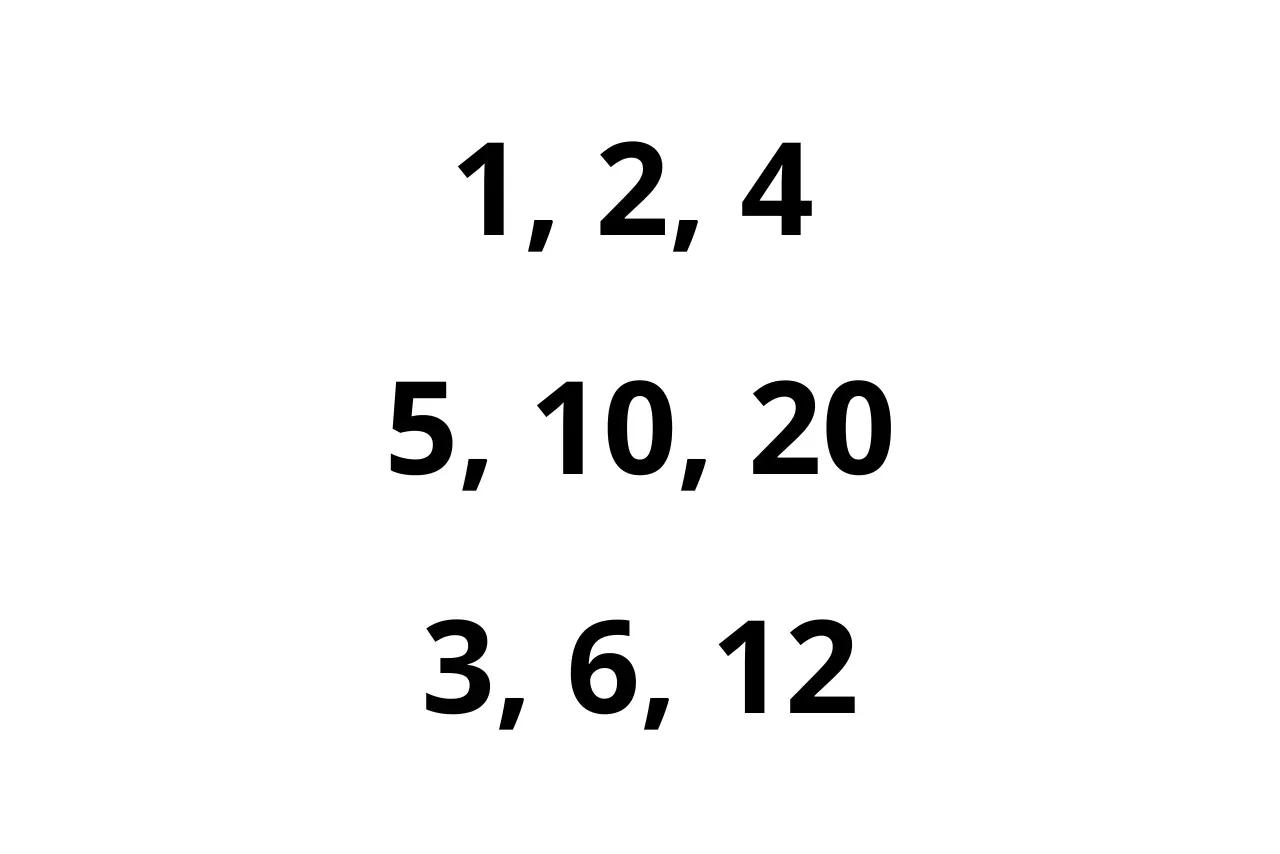
Most people first notice that the numbers double at each step and assume the rule is to multiply by two.
They only see that rule and only look for evidence that confirms their hypothesis.
They've fallen into confirmation bias.
The actual rule is much simpler: it's a sequence of increasing numbers.
Your brain does the same thing when you prepare your trades.
Confirmation bias makes you notice the evidence that supports what you already believe.
Imagine an asset's price bounces several times at €150, forming a support level.
Your brain, anchored to that number, looks for anything that confirms the idea that support will hold again.
You notice oversold indicators or an uptrend, reinforcing your belief that this is the perfect time to buy.
What you might overlook are the signs that buying pressure is weakening and a break is imminent.
How do you counter confirmation bias?
The trick is to force yourself to look for evidence that could contradict your hypothesis.
Ask yourself:
What would prove my current view wrong?
Continually questioning your view is what will help you avoid confirmation bias.
Anchoring bias in trading
You fixate on a reference price, even when the information coming from the market changes.
Take ETH, which reached an all-time high of $4,891 on 16 November 2021.
That price becomes a mental reference point.
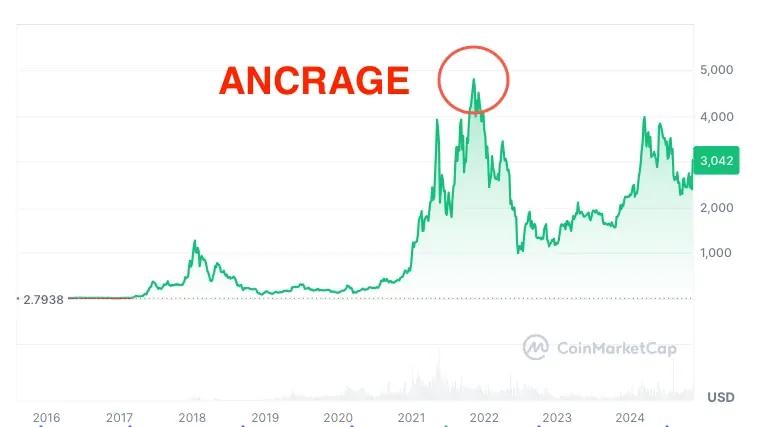
If the price drops to $1,000, you might think it's "an opportunity" because you're anchored to that $4,891 high.
You tell yourself it will probably recover, and cling to the idea that this was a "normal" price for ETH.
The problem is that markets change, and that $4,891 high may no longer be relevant at all.
But your brain remains focused on it, which can stop you seeing signs of a possible downtrend.
How do you counter anchoring bias?
To avoid being influenced by a reference price, give yourself another value from the outset.
For example, if you have 5,000 in mind for an asset, imagine a different value, such as 2,000 or 3,000, to put that first number into perspective.
This helps you view price movements more objectively and avoid fixating on a single price.
Loss aversion in trading
You tend to avoid losses and lock in gains, sometimes at the expense of your original strategy.
Imagine a trade starts moving in your favour.
Because of loss aversion, your brain tells you to secure that profit before a sudden drop.
You think, "I'll take my profit now, just in case it falls."
Even though nothing tells you it's going to fall.
On the other hand, when a position loses value, your aversion to risk kicks in.
Your brain looks for every reason to stay in the trade, despite signs telling you otherwise.
You think, "I'll wait for it to recover before I get out."
How do you counter loss aversion?
To manage this bias, you need to stay aware and ask yourself:
Is the fear of losing influencing my decision?
If the answer is yes, you need to keep yourself in check and return to your original strategy.
