
A take-profit order (TP) is a trading order that automatically closes all or part of your position at a better price than your entry.
- If you're long, your take profit is a sell order above your entry. You're looking to sell for more than you paid.
- If you're short, your take profit is a buy order below your entry. You're looking to buy back for less than you sold for.
A stop loss (SL) limits your loss if the price moves against your position.
How do you choose your take-profit price?
Your take-profit price is the price at which you want to lock in your gain.
Depending on the trade, you might set a target close to your entry or aim to capture a larger move.
I use the volume profile to see where trading was concentrated in previous sessions and how price reacted at those levels.
- If I'm long, I might set my target just below a price where sellers previously stalled a rally.
- If I'm short, I might plan to buy back just above a price where buyers previously stopped a decline.
Once I'm in the trade, I watch order flow to see whether my target is still within reach.
At each price within a candle, the footprint chart shows me how much volume came from buyers lifting the offer and how much came from sellers hitting the bid.
If I'm long and buying picks up but price stops rising, I may bring my target closer. If price is still moving up easily as it approaches my target, I may aim higher.
Here are two examples on TradingView, one long and one short.
Going long
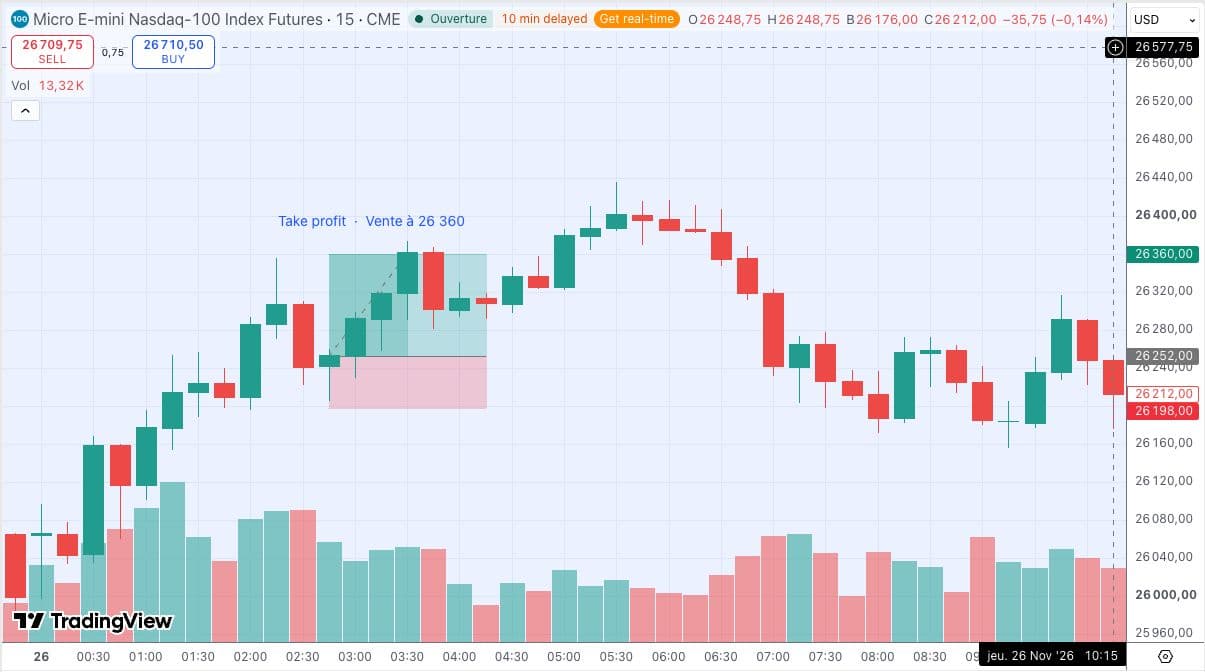
On MNQ, I marked a long entry at 26,252 with a stop at 26,198. That's 54 points of risk.
To target twice that distance, I place my sell order 108 points above my entry, at 26,360.
Going short
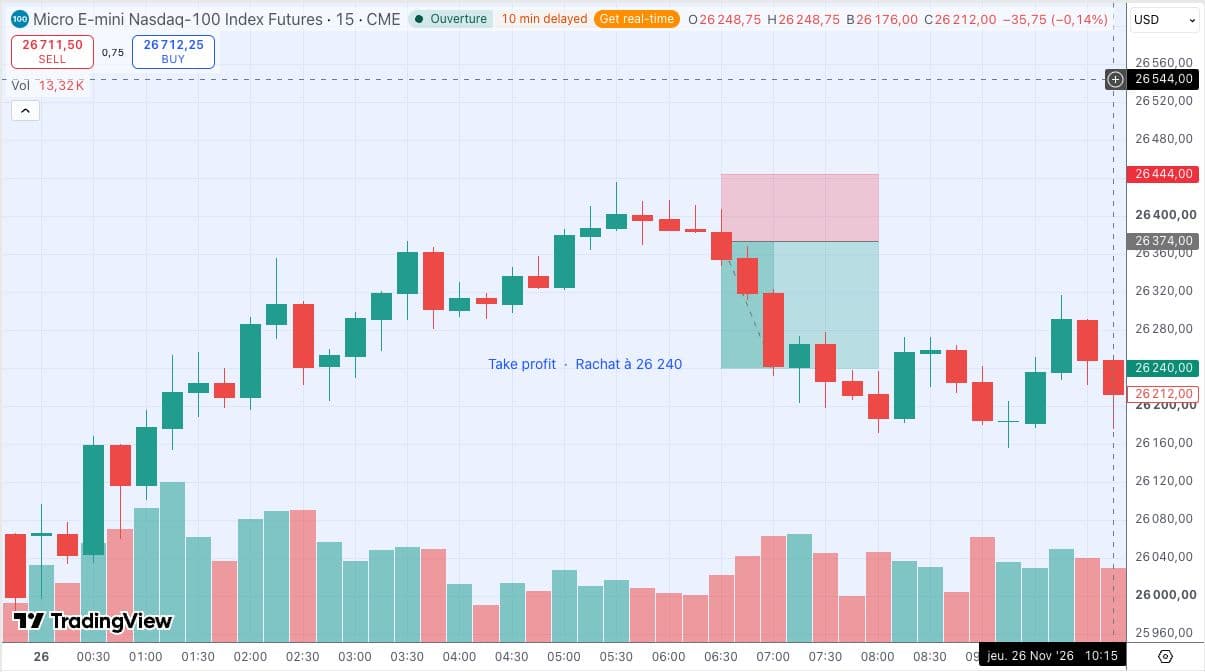
Later in the session, I marked a short entry at 26,374 with a take profit at 26,240.
If my buy order fills at that price, I close the short for a gain of 134 points.