
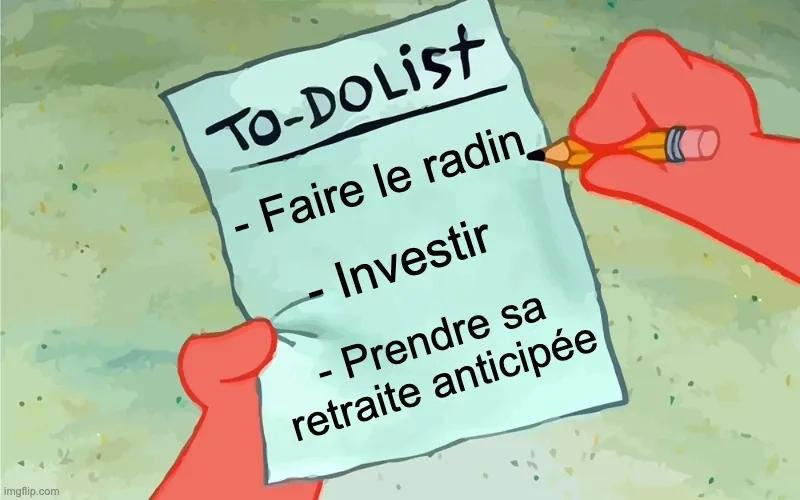
That’s exactly the idea behind FIRE: Financial Independence, Retire Early.
In French, that’s "Indépendance Financière et Retraite Anticipée".
The principle behind FIRE
- Save aggressively
- Invest your savings
- Retire early and live off the income your investments generate
The goal?
Reach financial independence as early as possible.
There are two main ways to get there:
- Earn more
- Spend less
If you choose to spend less, you have to accept a frugal lifestyle. In other words, live like a cheapskate for a while.
Why?
Every euro counts. You need to build a large pot quickly enough to generate sufficient passive income.
Why aim for FIRE?
The reasons are straightforward:
- Freedom
- Stopping work
- Travel
- Devoting yourself fully to a passion
How do you reach FIRE?
The aim is to generate enough passive income to cover your expenses without needing to work.
Spoiler alert: that takes a lot of preparation and fine-tuning.
First, you need to earn the money you’ll invest, through employment, a business or trading. The method doesn’t matter.
Then you need to invest wisely. I’ll come back to that.
How much do you need to invest?
People often talk about the 4% rule: withdraw 4% of your capital each year to cover expenses while letting the portfolio keep growing.
A couple of examples:
- Sam needs €1,000 a month, or €12,000 a year. He needs to build up €300,000
- Jean needs €1,500 a month, or €18,000 a year. He needs €450,000
Looking at those figures, you might think the income is fairly modest for life in France.
True, but someone pursuing FIRE can choose to live in a country with a much lower cost of living.
In some countries, particularly in Asia, €1,000 a month provides an excellent standard of living.
That’s a common FIRE strategy: choose where you live to match your income.
Allow for surprises and tax
The 4% rule assumes investments generate enough to cover expenses while preserving capital.
In reality, several factors, including inflation, can complicate that ideal scenario.
To receive €12,000 net a year, you’ll need to generate more to cover taxes.
Unexpected expenses can crop up too.
The head gasket on your Renault Clio 2, for example.
You need to plan for those costs so they don’t eat into your capital too quickly.
Build in a safety margin by increasing your target.
For example:
- Sam could aim for €350,000 instead of €300,000
- Jean could aim for €500,000 instead of €450,000
One last important point: if you stop paying into the pension system, you can’t expect further pension benefits from it.
"No contributions, no pension." And that’s not Omar Sy saying it.
Where should you invest?
FIRE is about freedom, but that doesn’t mean going full degen with your money.
Investments need to be thought through and suited to your needs.
The ideal?
Minimise risk while maximising returns.
Usually, that means combining several types of investment.
Bonds
For those seeking as much stability as possible, bonds remain a key option.
They work like a loan: a company or government borrows money, pays regular interest and repays the principal at maturity.
But greater stability also means lower returns.
Take US 10-year government bonds:
As I write this newsletter, their yield is around 4.42% a year.
A €300,000 investment would generate around €13,200 in annual interest.
Remember, though, that yields can change with economic and political conditions.
ETFs
For people who can tolerate fluctuations in returns, ETFs, or exchange-traded funds, are a very good alternative.
I’ve already written a newsletter explaining how they work.
Go and read it if you haven’t already.
Here’s a concrete example:
Over the past ten years, Amundi’s S&P 500 ETF has returned an average of 14.97% a year before tax.
Some years can be spectacular, but remember that the S&P 500’s long-term historical average is around 7% after inflation.
With €300,000 invested, that could generate €21,000 a year over the long term.
My take on FIRE
It’s about more than saving. It takes a lot of discipline and strategy.
It also means thinking about the life you want:
- Are the sacrifices worth it?
- Is living frugally for years really what I want?
To me, the best approach is to reach FIRE and keep working.
By choice, rather than necessity.
That means:
- Working on projects you care about
- Doing meaningful things without the pressure of bills to pay