

Last Friday, Moody’s downgraded the United States’ credit rating.
The country went from Aaa to Aa1.
But that’s more than a change of letters...
Let me explain what it really means.
What exactly does Moody’s do?
Moody’s is one of the major credit rating agencies, alongside S&P, Fitch and Morningstar.
It assesses how likely governments, banks, insurers and companies are to repay their debt.
How?
By assigning them a rating from Aaa to C.
The higher the rating, the more reliable the borrower is considered.
The lower it is, the greater the perceived risk of non-payment.
| Moody’s rating | Category | Meaning |
|---|---|---|
| Aaa | Highest quality | Minimal risk. Excellent creditworthiness. |
| Aa1 / Aa2 / Aa3 | Very high quality | Very low credit risk, with progressively finer distinctions. |
| A1 / A2 / A3 | High quality | Low credit risk. |
| Baa1 / Baa2 / Baa3 | Medium quality | Moderate risk. The boundary between investment grade and speculative grade. |
| Ba1 / Ba2 / Ba3 | Moderately speculative | Significant risk. Below investment grade. |
| B1 / B2 / B3 | Highly speculative | High credit risk. |
| Caa1 / Caa2 / Caa3 | Very low quality | Very high risk. A serious likelihood of default. |
| Ca | Default likely | Issuer near or in default. Some potential for recovery. |
| C | In default | In default. Very little chance of recovering principal or interest. |
Why do these ratings matter?
Ratings directly influence borrowing conditions.
They can push interest rates higher, drive investors away or even stop a government raising funds.
That’s why markets, central banks, major institutions and governments watch them closely.
Why was the US rating cut?
According to Moody’s, there are three problems:
- Debt is already high and keeps growing
- Interest payments are rising quickly and could reach 30% of revenue by 2035
- No concrete action has been taken to reduce deficits
Its verdict: fiscal risk is increasing, with little sign that things will improve quickly.
Trump’s recent decisions don’t help, but he isn’t the main culprit. This problem neither appears nor gets solved in a few weeks.
What changes, and what doesn’t?
The short-term impact is limited.
Markets reacted, but without real panic, as the 10-year Treasury chart shows.
For more on why yields matter to the economy, read my newsletter on Treasuries.
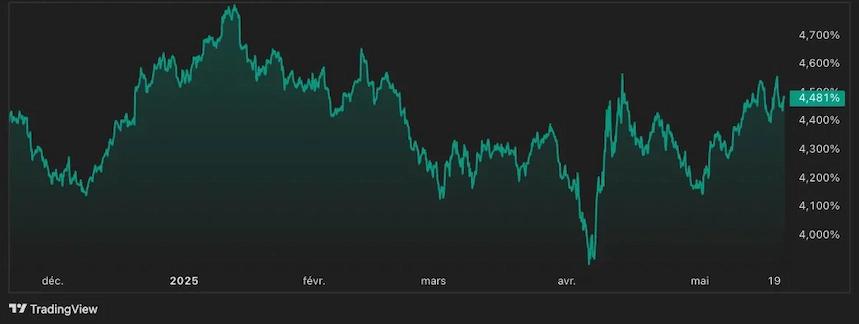
Moody’s also points out that demand for US debt remains strong. But three risks are emerging over the medium term:
- Debt servicing costs keep rising
- Other agencies could follow. Morningstar is the only one still maintaining AAA
- Some funds will no longer be able to buy these securities, as many require AAA ratings
What this really shows is:
US debt is starting to worry people, and the United States is no longer seen as infallible.
Can a country earn its good rating back?
Yes, through action, not speeches.
Moody’s wants concrete measures: smaller deficits, better-controlled debt and a clearer fiscal path.
For now, that isn’t what’s on the horizon for the US.
The political climate remains difficult, disagreements keep coming, and no credible plan seems to be in preparation.
Under those conditions, an upgrade looks unlikely.
What about France?
We’re not doing much better than our American friends.
France was downgraded to Aa3 in late 2024 for similar reasons: rising debt, a structural deficit and political instability.