

France has passed its social security budget
Last week, I explained that the social security budget bill still had to go through the National Assembly and Senate.
That’s now done: the budget was adopted on 16 December.
Hallelujah. They finally agreed on something.
But remember, the social security budget is only a small part of the government’s overall budget.
Our parliamentarians still have plenty of work ahead. Unfortunately, getting everything finished before the end of the year isn’t looking promising.
Over in Europe
Last week, I talked about the US central bank’s decision to cut its policy rate.
What about the European Central Bank?
It chose to leave things unchanged.
Its rate has stayed at 2.15% since June 2025, with eurozone inflation around 2.1%.
The case of Turkey
The economist in me often wants to see what’s happening elsewhere and compare it with France.
And I’ve found a country that beats the lot: Turkey.
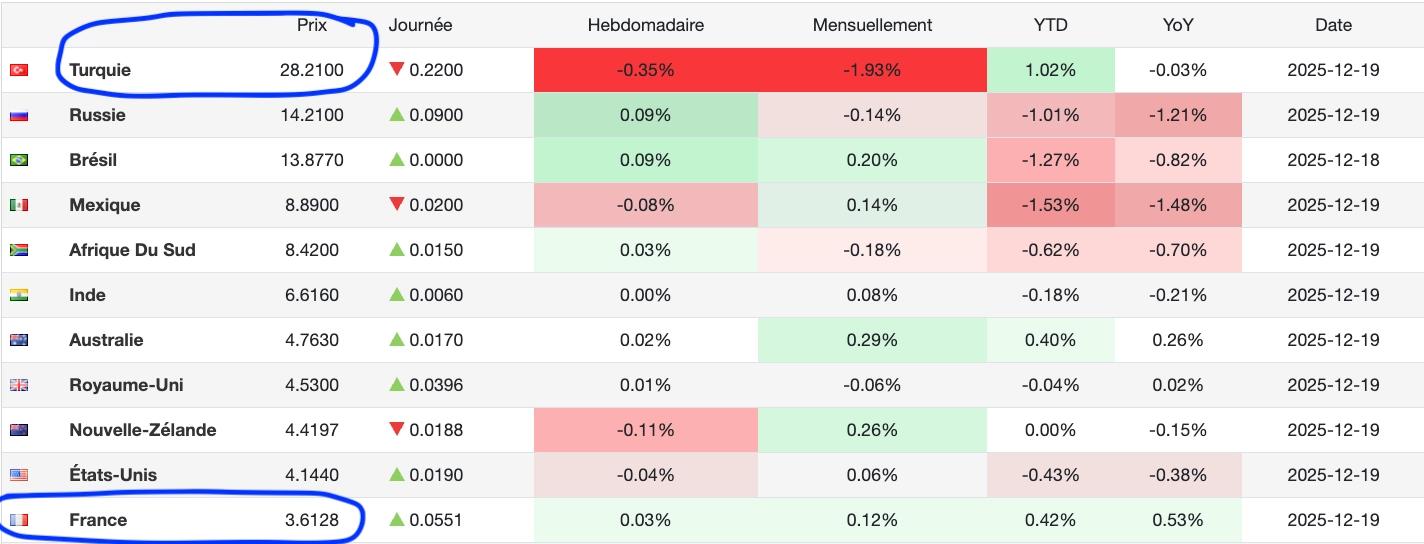
Turkish 10-year bond versus the French 10-year OAT
One look at the numbers quickly puts France’s performance into perspective.
As I write:
- Inflation is 31.07%, already sharply down from 2024
- The Turkish 10-year bond yields 28.21%, the highest in the world
- The central bank’s policy rate is 38%
For comparison, in a previous newsletter I mentioned Russia and its 16.5% policy rate.
How did Turkey get here?
From what I’ve read, the situation largely stems from internal political problems.
Turkey’s central bank has very little independence. The government has made a series of questionable budget decisions and maintained an unconvincing monetary policy.
For a long time, the central bank kept cutting its policy rate even as inflation rose.
The result was a weaker Turkish currency and persistently high inflation.
The government and central bank had no choice but to take drastic action.
Could this happen to a country like France?
Under current conditions, no, for several reasons:
- France is part of the eurozone
- Monetary policy is set by a central bank independent of national governments
- Debt is issued in a stable currency with strong demand
That doesn’t prevent inflation, but it limits the risk of things spiralling as they have in Turkey.
Looking at all this, you might wonder: why doesn’t Turkey join the European Union?
It’s not for lack of trying...
But its current economic and political system doesn’t meet EU rules.
Despite several attempts, Turkey has seen its applications rejected.