
Bitcoin supporters’ main criticism of the current monetary system is the government’s ability to create money out of nothing.
We often hear the phrase "printing money".
Is that really what happens?
Why create money?
Money creation isn’t supposed to be impulsive.
It responds to clear economic needs:
Funding spending
Governments need to build infrastructure, pay public employees and invest in health and education.
Those projects need funding that taxes don’t always provide.
Stimulating the economy
Sometimes governments need to get the economy moving again, during a crisis, for example, to help both businesses and individuals.
When activity slows, as it does in a recession, injecting money can encourage spending and investment.
What "printing money" means
I won’t keep you waiting:
It isn’t the government that creates money out of nothing. It’s the central bank, the European Central Bank in our case.
"Printing" is also a poor choice of word, since only 10% of money in circulation is banknotes, compared with 90% held as bank-account balances.
So money creation isn’t just about physically printing notes and putting them into circulation.
How does the central bank do it?
In my newsletter on the history of money, I explained that our monetary system relies on trust.
Money isn’t backed by something tangible such as gold.
That gives central banks a degree of flexibility to create it.
Here are the two main methods:
Through lending
The central bank sets what are known as policy interest rates.
Those rates determine the cost of lending money to commercial banks such as Société Générale, LCL and BNP.
Commercial banks then lend to customers: businesses, individuals and governments.
But they charge more than they pay to borrow.
For example, if they borrow from the central bank at 1%, they might lend to us at 2%.
That’s how they create money out of nothing.
Every time a loan is granted, money is created through a simple entry in a bank account.
Through purchases of financial securities: quantitative easing
When the policy rate is already very low, the central bank has little room left to encourage money creation.
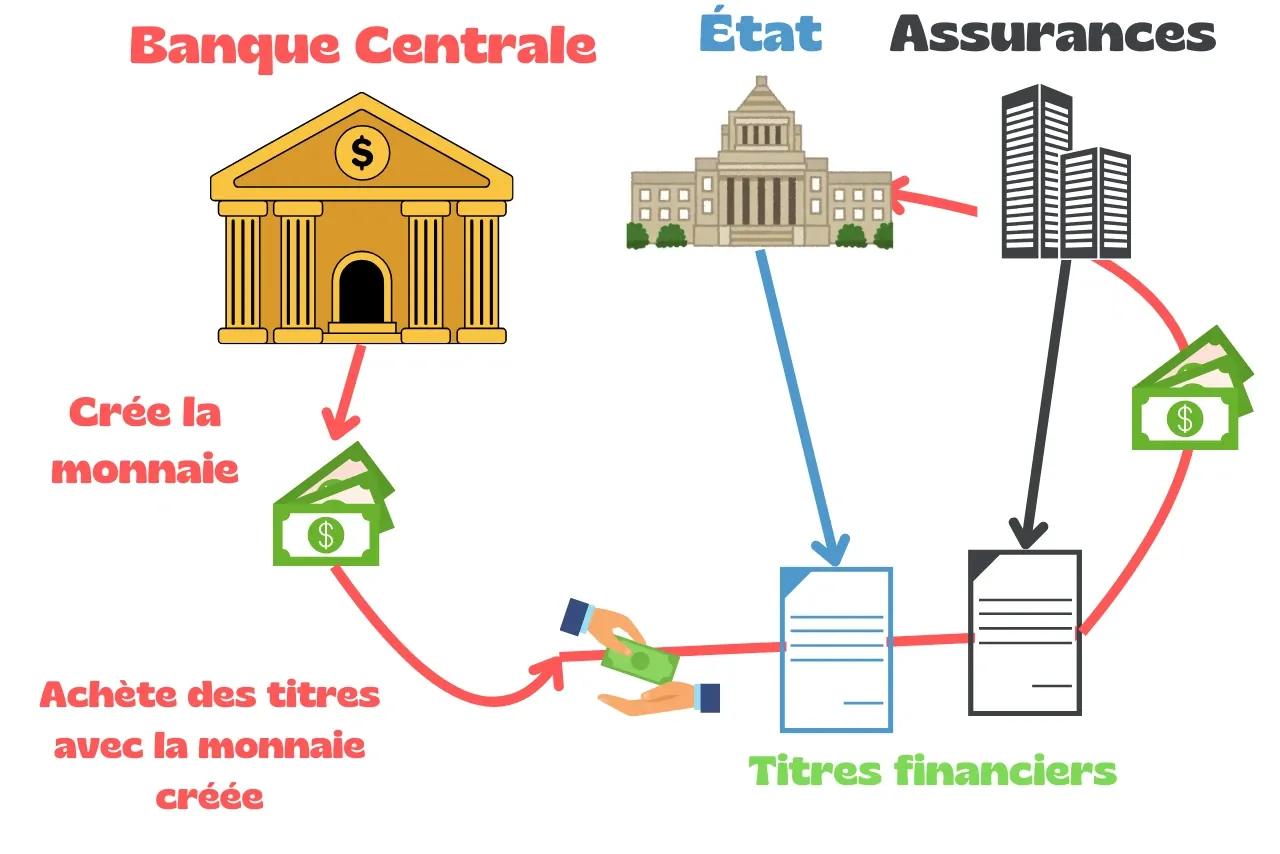
It can then turn to an unconventional policy: quantitative easing.
The central bank starts buying financial securities that:
- Are held by governments, banks, insurers, pension funds and others
- Have little or no value
It deliberately pays extremely high prices for those securities to inject money into the economy.
That’s how the central bank creates money without going through lending.
The consequences of money creation
If the central bank can create money out of nothing, why not print an unlimited amount?
Money creation has limits, and poorly managed, its consequences can be serious:
- Inflation: too much money in circulation could push prices up and reduce the value of the money you already hold
- Economic inequality: money injected into the economy doesn’t benefit everyone
Also, a central bank’s role, particularly the ECB’s, is to keep inflation at 2%.
It isn’t really concerned with an individual country’s economic growth or unemployment rate.
I’ve simplified complex ideas to make them accessible. Some deserve a fuller explanation.