
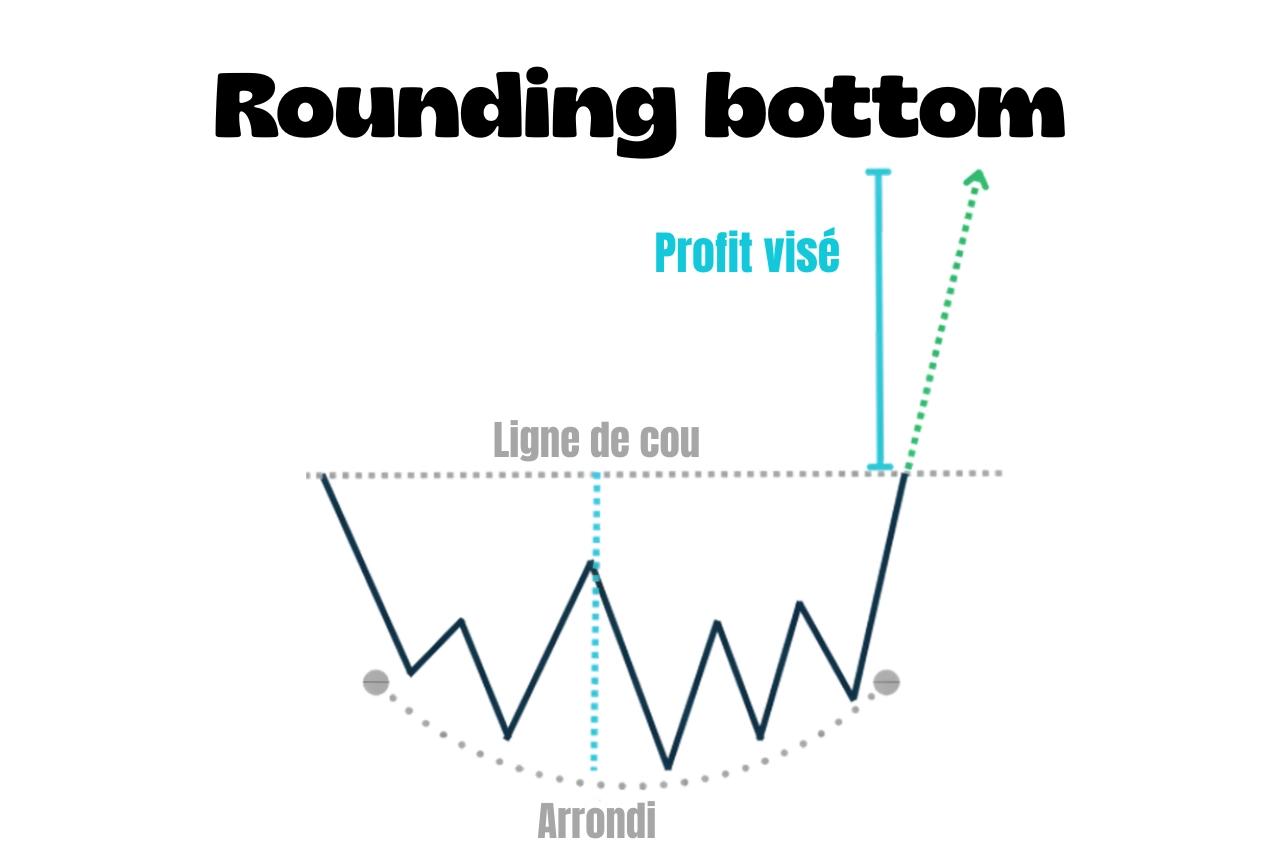
A rounding bottom, also called a saucer bottom, is a bullish reversal chart pattern.
How do you recognise it?
Several features help you identify a rounding bottom:
- A downtrend before the pattern appears
- Price falls, slows down and stabilises in an area
- Price gradually recovers to the neckline, then breaks through it
- The whole pattern forms a rounded, U-shaped low
The rounding top is its opposite. It appears at the end of an uptrend and forms an inverted U.
How do you trade a rounding bottom?
You can enter long on the break above the neckline.
The stop-loss usually goes below the pattern's most recent low.
For the take-profit, measure the distance from the bottom of the pattern to the neckline, then project it above the breakout point.
How is it different from a cup and handle?
Both patterns share the same starting point: a rounded, U-shaped low.
The difference is what happens next.
Difference 1
With a cup and handle, price doesn't break the neckline straight after recovering.
It pauses first and forms another small consolidation: the handle.
A rounding bottom doesn't necessarily have this stage.
Price returns to the neckline and breaks through more directly.
Difference 2
The cup and handle is generally considered a continuation pattern, while the rounding bottom is described as a reversal pattern.
