
A regulated broker is authorised by a financial authority to provide investment services.
That authorisation requires it to follow rules on client protection, handling funds, fees, risks and dispute resolution.
But be careful: being regulated somewhere doesn't always mean being authorised to operate in France.
Why does broker regulation matter?
Regulation matters because a broker does more than display a trading interface.
It receives your money, routes your orders, provides access to financial products and charges its own fees.
Without a defined regulatory framework, it's much harder to know:
- How your funds are protected
- Which rules the broker must follow
- What recourse you have if something goes wrong
A regulated broker must meet obligations set by its supervisory authority.
Depending on its status and services, these may cover fund protection, client information, risk management, fee transparency and complaints handling.
Regulated or reliable: what's the difference?
Regulation is essential, but it isn't enough to choose a broker.
Two brokers can both be regulated without offering the same service, products, guarantees or execution quality.
A reliable broker also needs to suit your needs, be transparent about fees, have clear terms and take execution seriously.
That's why you should consider other criteria before opening an account: account type, products, fees, platform, customer service and protections.
For more detail, read my guide on how to choose a stockbroker.
You can also use my stockbroker comparison to compare them directly.
What regulation changes for investors
Client funds must be separated from the broker's funds
A regulated broker must keep client money separate from its own.
The aim is simple: stop the company using client deposits as its own working capital.
A broker that mixes client deposits with its own accounts exposes clients to unnecessary risk.
If it runs into financial trouble, recovering funds can become much harder when the money hasn't been properly segregated.
Segregation doesn't remove every risk, but it prevents certain dangerous practices.
Some protection schemes may apply
In France, certain guarantee schemes may apply if an institution can no longer return its clients' securities or cash.
For securities such as stocks, bonds, ETFs and fund units, the securities guarantee can cover up to €70,000 per client per institution.
For cash associated with a securities account, protection depends on the type of institution: up to €70,000, or up to €100,000 if the intermediary is a bank.
You have recourse in a dispute
A regulated broker must have a structured complaints procedure.
In practice, you first contact customer service or the broker's complaints department.
If the problem remains unresolved, you can approach the relevant bodies depending on the country of regulation, type of institution and nature of the dispute.
This matters most when a serious problem arises: blocked withdrawals, incorrectly executed orders, disputed fees, account closures, unresponsive support or difficulty recovering funds.
With an unauthorised platform or one based in an opaque jurisdiction, recourse is often weak, slow or nonexistent.
Risky products are subject to rules
Regulation also limits certain abuses involving complex products.
These rules aim, among other things, to prevent very risky products being offered to retail clients without adequate safeguards.
In Europe, for example, retail CFDs have specific rules, including leverage caps by asset type and negative balance protection.
That doesn't make them risk-free.
But it prevents certain excesses, such as very high leverage or losses exceeding deposited capital.
Brokers can be inspected and sanctioned
A regulated broker can be inspected by its supervisory authority.
If it breaks the rules, the regulator can demand corrective action, impose sanctions or withdraw its authorisation.
That's an important difference from an unauthorised platform, which may operate without meaningful external oversight.
What a regulated broker doesn't protect you against
A regulated broker provides a more protective framework, but doesn't guarantee performance.
Regulation doesn't protect against market losses.
It doesn't replace choosing suitable products, managing risk or understanding fees.
If you buy a stock that falls, invest in an ETF that crashes or take too much risk, the problem isn't necessarily the broker.
It may simply be your investment decision or the market's movement.
You can lose money with a regulated broker if you trade without a method, buy something you don't understand or the market moves against you.
The main regulators to know
Different regulators apply depending on where the broker is based.
For investors, the main differences are which authority to contact, which register to check, which guarantee scheme applies and what recourse exists in a dispute.
Here are some authorities commonly mentioned in brokerage.
AMF and ACPR: the French authorities
The AMF, Autorité des marchés financiers, supervises financial markets in France, among other responsibilities.
It protects savers, oversees certain financial participants and publishes warnings about unauthorised platforms.
The ACPR, Autorité de contrôle prudentiel et de résolution, is attached to the Banque de France.
It supervises banks, insurers and certain financial intermediaries.
BaFin: Germany's regulator

BaFin is Germany's financial supervisory authority.
It oversees banks, insurers and financial service providers in Germany.
A German-regulated broker therefore operates within a European framework, but you still need to check which services are authorised and whether it can serve French clients.
CySEC: Cyprus's regulator

CySEC is the Cypriot regulator.
Many popular brokers are regulated in Cyprus.
Because Cyprus is part of the European Union, CySEC-regulated brokers fall under the European framework, including MiFID II.
That doesn't mean they're all equally good.
But they operate within a regulatory framework shared by European providers.
FCA: the UK regulator
The Financial Conduct Authority, or FCA, is the UK's financial regulator.
It imposes strict rules on transparency, business conduct and client protection.
Since Brexit, FCA-regulated brokers no longer benefit from European passporting.
FCA regulation alone is therefore no longer enough to legally offer investment services to French clients.
Can a foreign-regulated broker operate in France?
A broker can be regulated in one country without having the right to offer services to French investors.
It may display a genuine licence, belong to a real company and be supervised locally, yet lack the authorisation needed to target France.
To operate in France, a broker must either:
- Be directly authorised by the French authorities
- Benefit from European passporting if licensed in another European Economic Area country
European passporting lets a broker regulated in one EEA country provide services in another member country, subject to conditions.
That's how many European brokers serve French clients without being directly regulated by the AMF.
So the question isn't only whether a broker is regulated.
You also need to check whether it's authorised to provide services to a French investor.
How to check a broker's authorisation in France
Find its legal name
In France, REGAFI lets you search for companies authorised to conduct financial activities.
First, identify the legal name of the company operating the broker.
You should find it in the legal notice, terms and conditions, website footer or regulatory documents.
Be careful: the brand name isn't always the company's legal name.
For example, searching only for "DEGIRO" on REGAFI may not return the correct result.
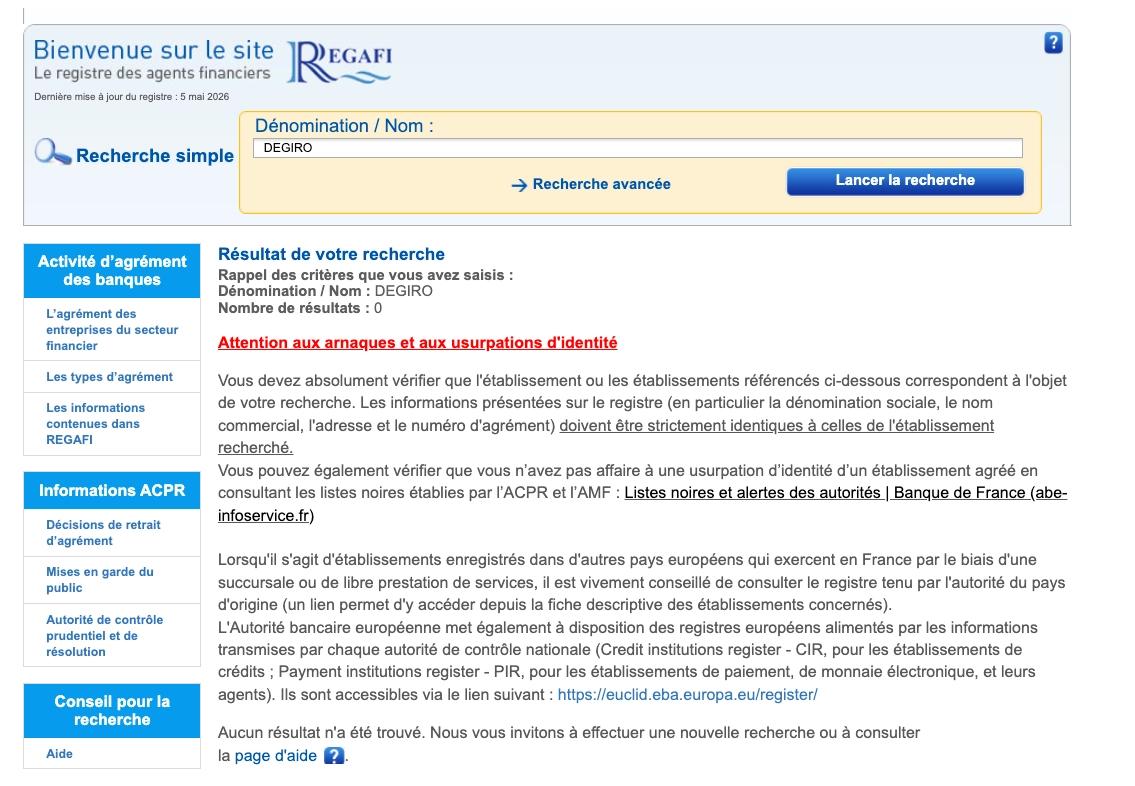
For DEGIRO, the legal name to search for is "flatexDEGIRO".
That name lets you find the authorisation in the register.
Check the broker on REGAFI
Once you've identified the legal name, search for it on REGAFI.
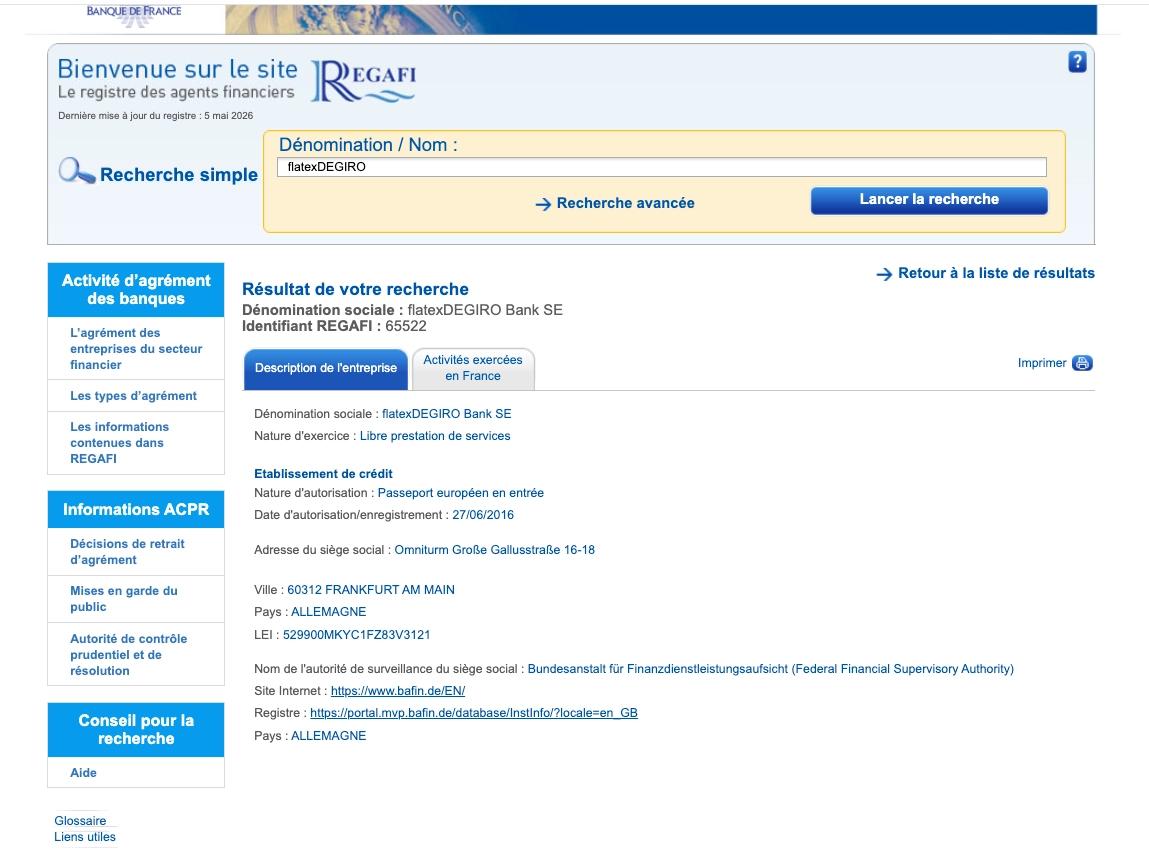
In this example, REGAFI shows that DEGIRO is authorised to operate through European passporting.
The register also identifies the country of regulation, competent authority and authorisation details.
For flatexDEGIRO, the country is Germany and the supervisor is BaFin.
Check the AMF blacklists
If your REGAFI searches return nothing, be cautious.
That doesn't automatically mean the broker is fraudulent. You may have used the wrong name, or the company may be registered under a different entity.
But when in doubt, check the AMF's blacklists and warnings.
These list websites and participants identified as unauthorised or subject to a warning.
If a broker appears on a blacklist, you're better off not opening an account or depositing money.
