
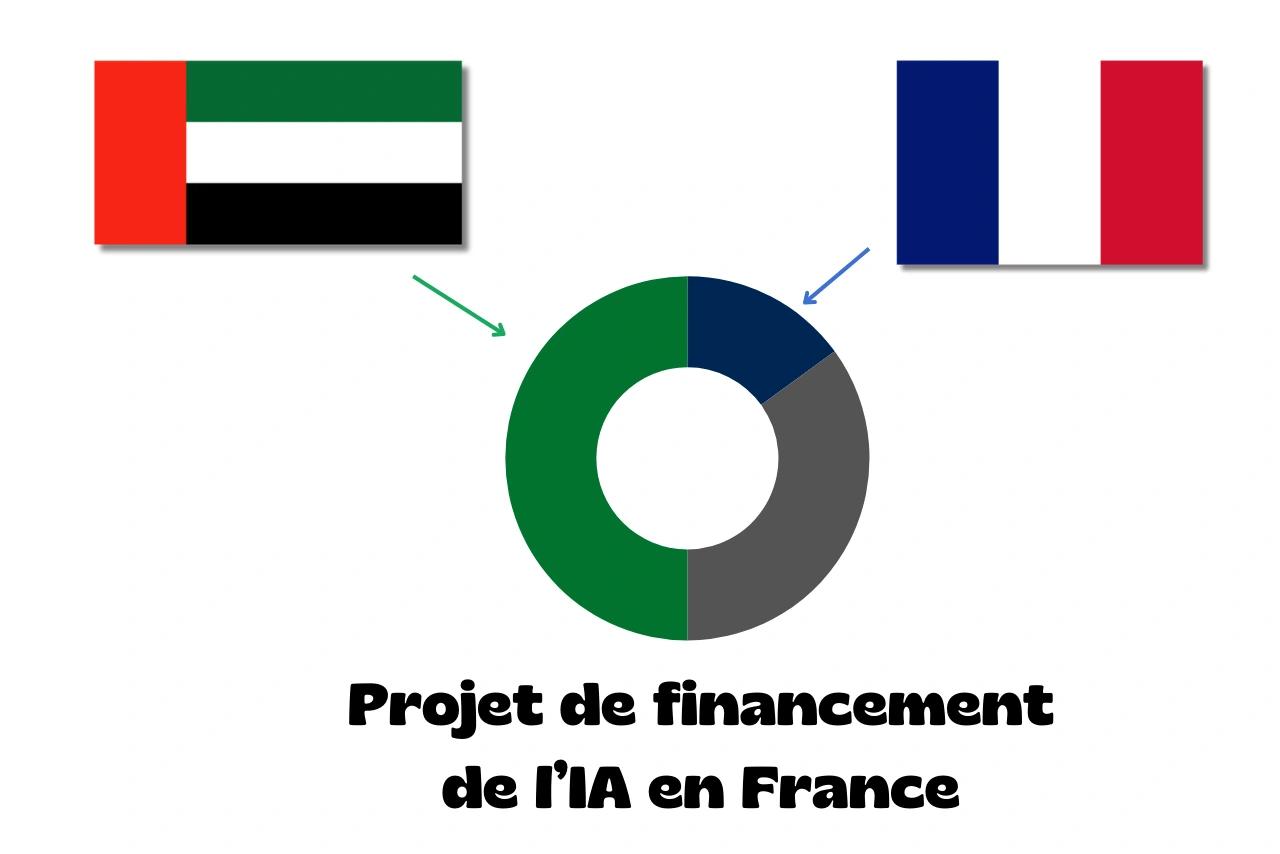
Following Donald Trump’s election and his 500-billion plan for artificial intelligence, France has announced new measures to position itself in the market.
But one detail in President Emmanuel Macron’s announcement surprised me: the United Arab Emirates will fund €50 billion of the French project, almost half the planned €109 billion total.
A few questions came to mind:
- Why isn’t France the main investor in this project?
- Why is the UAE investing in France?
- Are there risks for France, and if so, what are they?
I did some research. Here’s what I found.
Why is France accepting foreign investment?
The obvious question might be: why does France, a richer country than the UAE in GDP terms, accept foreign investment?
France’s GDP is around ten times the UAE’s.
So why not fund the project itself?
Unlike the UAE, which has accumulated large surpluses from natural resources, France doesn’t have the same readily available financial reserves. It also has other budget priorities.
To fund such an expensive project alone, it would need to increase public debt, already a controversial subject, or cut budgets such as defence, health or education.
This partnership gives France substantial funding without bearing the full cost itself, while strengthening relations with the UAE.
Why is the UAE investing in France?
The UAE has one of the world’s largest sovereign wealth funds, the Abu Dhabi Investment Authority (ADIA), which manages nearly $1 trillion in assets.
A sovereign wealth fund is a pool of money a state invests to generate returns.
The money often comes from commodities such as oil and gas, but it can also come from budget surpluses, when a country earns more than it spends.
Through ADIA, the UAE reinvests some of its oil profits in international projects.
It wants to reduce its dependence on hydrocarbons by investing in fast-growing technology sectors.
In this case, AI.
But money isn’t the only motivation.
These investments also strengthen the UAE’s influence, build strategic partnerships and develop its expertise.
How does the financial side work?
The UAE will fund nearly 50% of the French AI project. Does that automatically entitle it to 50% of the revenue?
Not necessarily.
Financial agreements like these are often complex and go beyond a simple profit split.
When a foreign country funds a project, it doesn’t always take a direct stake in the company or infrastructure involved.
The money can be provided in different ways.
Sometimes it’s venture capital.
The UAE invests in exchange for a stake, with specific conditions on its share of future revenue or profits.
It could also be a straightforward loan: provide the funds, then recover the money with interest, without necessarily taking a share of profits.
There’s another, more strategic approach too.
Instead of seeking a direct financial return, the UAE could aim for privileged access to technology, partnership opportunities or influence over project decisions.
Who actually controls the project?
Even with the UAE providing a significant share of funding, France retains control over strategic decisions and veto rights.
There are several reasons for that.
First, even a major investor doesn’t always decide a project’s direction.
Its role is often limited to financial support, without real control over strategic choices.
France also puts governance agreements in place to preserve its influence over the project’s overall direction and prevent a foreign participant taking over.
For example, France can maintain strict control over patents and the technologies developed.
That’s a common arrangement in this kind of partnership: the host country keeps the rights to the innovations it creates.
What are the risks for France?
OK, the UAE is putting €50 billion into the project.
That looks good on paper. But could it cause problems for France?
Yes, which is why the subject is being debated.
If a foreign player dominates a strategic sector, it can restrict access or impose its own conditions.
Other countries have already faced that risk after accepting too much foreign investment in their infrastructure.
The other issue is strategic independence.
Officially, France keeps control. But an investor funding half a project inevitably has weight in the decisions.
If the UAE later wants to steer it to its own advantage, it will have strong arguments for doing so.
I’m not a geopolitics expert. I’m simply trying to explain the concepts and share my understanding of the subject.