

Survive. Stay alive. Don’t go under.
As human beings, that’s our first instinct.
And it matters just as much in trading.
But while scrolling through Reddit, I came across a post that reminded me how easy it is to lose sight of it:
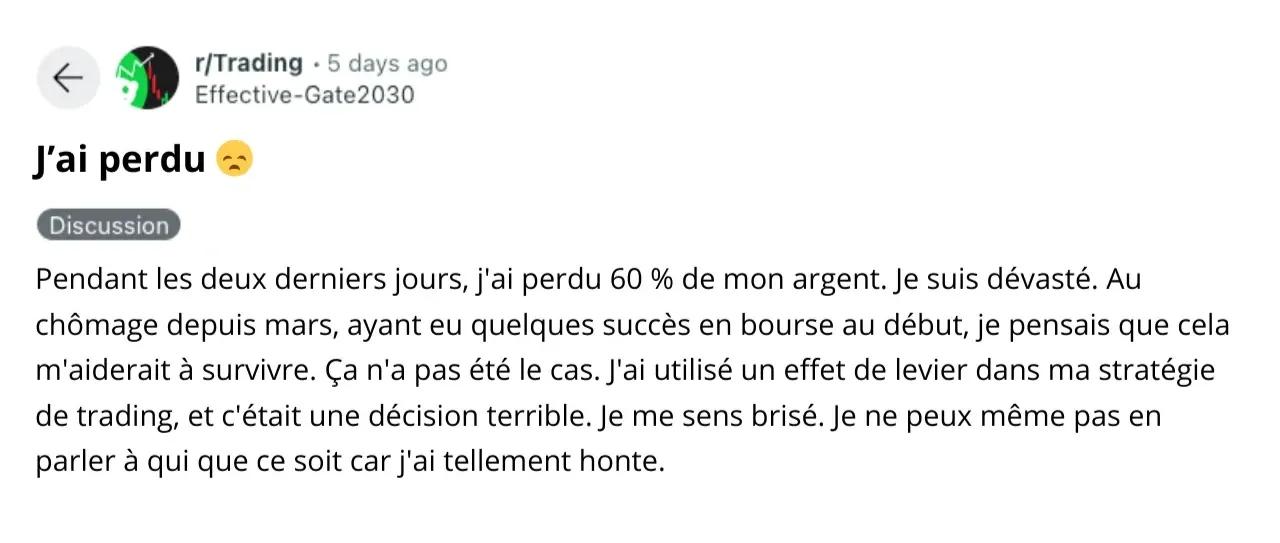
In two days, this trader lost 60% of his capital.
But he didn’t just lose money. He lost hope.
That capital wasn’t just a balance in a trading account. It was also what kept him afloat in "real life".
A trader’s first goal: survival
Let me say it again: for a trader, surviving means preserving your capital.
Losing it reduces your chances of continuing to improve.
Worse still, it puts your personal financial security at risk.
So how do we protect our capital and keep it growing?
- Manage risk properly: money management is about limiting the loss on each trade. It gives you the chance to stay in the game.
- Make decisions that pay off over the long term: the goal isn’t to win every trade, but to be profitable enough across all of them. That means accepting small losses while making the most of trades that go your way.
Those two rules are the foundations of survival in trading.
Yet beginners, blinded by the hope of getting rich quickly, ignore them far too often.
They take reckless risks without thinking about the long-term consequences.
They forget that without capital, their hopes of wealth remain out of reach.
Avoiding ruin
In trading, ruin means losing all your capital.
Nassim Taleb, a former trader and author of Antifragile, describes this reality: ruin is "game over", with no chance to start again.
It only takes one wipeout to erase everything you spent weeks earning.
And when does it happen?
When you:
- Take excessive risks without a sound strategy behind them, as most beginners and gamblers do
- Use strategies that promise quick gains while hiding the potential for catastrophic losses, such as going all-in on a memecoin
Here’s what to remember:
Surviving in trading always comes down to careful risk management and a long-term view.
Because ultimately, the goal isn’t to win everything in one go. It’s to avoid losing everything in one go.