

Every quarter, listed companies publish their financial results.
Those reports affect share prices, but not always in the way you might expect.
Here’s what you need to know.
Publishing financial reports
Listed companies are legally required to publish financial reports, also known as earnings reports.
They include several important documents:
- The income statement, showing what the company earned and spent over a given period
- The balance sheet, listing what it owns, its assets, and what it owes, its liabilities
- The cash flow statement, tracking money moving in and out of the business
- The notes, explaining certain figures and accounting choices
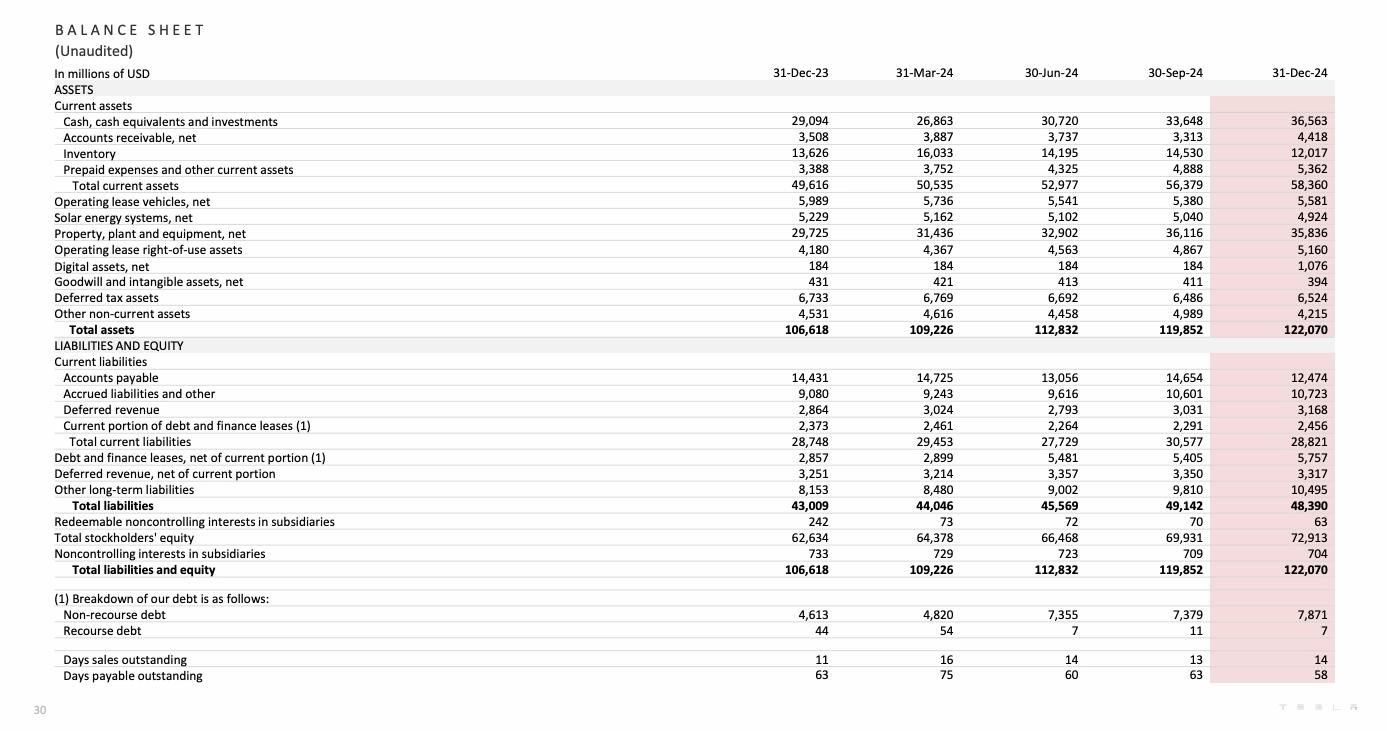
Here’s an example of a balance sheet from Tesla’s fourth-quarter 2024 results:
How often are they published?
The year is divided into four quarters, abbreviated to Q:
- Q1: January to March, published in April
- Q2: April to June, published in July
- Q3: July to September, published in October
- Q4: October to December, published in January of the following year
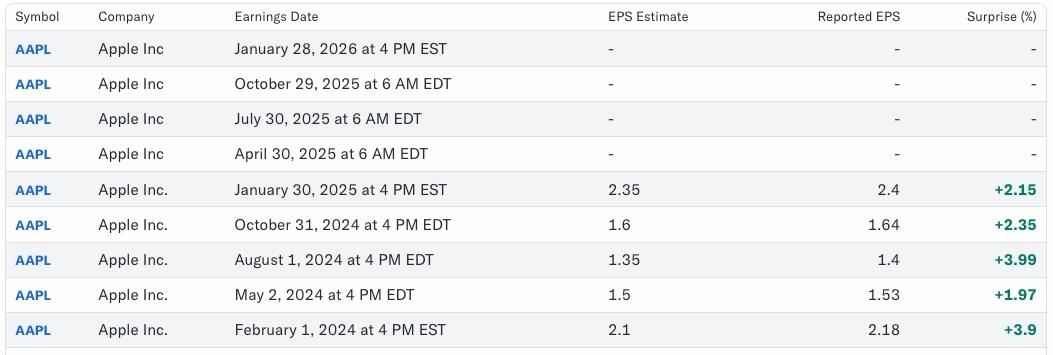
You can find release dates on sites such as Yahoo Finance.
Here’s an example of Apple’s past and upcoming release dates:
How do quarterly and annual reports differ?
Quarterly reports come out four times a year and help you follow the company’s short-term progress.
The annual report sums up the year’s performance.
It gives a broader view and often includes comments on future strategy.
What are they actually useful for?
These reports help investors understand a company’s financial health and adjust their decisions.
If you know how to interpret them, they answer questions such as:
- Is the company profitable?
- How many days pass between delivering a product and receiving payment?
- Is it investing in new machinery to increase production?
- Does it have interesting plans for the future?
Without that information, it would be hard to know whether a share is worth buying, holding or selling.
Who can analyse these reports?
Anyone can access and analyse them, but interpreting them takes some experience.
One of the most common approaches is fundamental analysis, which aims to estimate a company’s true value.
But analysis goes beyond the numbers.
Two companies in the same sector can report similar results yet be viewed very differently because of their strategy, market or growth potential.
You also need to understand the business, its competitors and the economic backdrop.
Even with identical data, two investors can reach opposite conclusions.
Can companies cheat with the numbers?
Since companies publish their own reports, you might think they can manipulate the figures.
In principle, no. The system is designed to ensure transparency.
Reporting is overseen by bodies such as the SEC in the United States and the AMF in France.
Scandals such as Enron showed that some businesses had falsified their accounts, causing major financial crises.
Since then, laws such as Sarbanes-Oxley (SOX) have imposed strict controls.
Internal and external auditors, including firms such as EY and KPMG, must validate the figures before publication.
Can companies influence their results?
Some use strategies to improve their numbers on paper.
For example, Tesla sometimes discounts its cars to boost sales towards the end of a quarter.
Sales rise just before the results are published.
But that can have an unwanted effect.
If customers start expecting regular discounts, they delay purchases, which can create sales slumps.
How do investors react to earnings reports?
Investors don’t just react after publication. They constantly try to anticipate the results.
If they expect a company to beat expectations, they buy before the release.
If they expect disappointing numbers, they sell before the announcement.
But markets don’t always follow that logic. Bad news may already be priced into the shares long before publication.
If a company reports weaker results that are still better than feared, its shares can rise.
Conversely, a positive report can trigger a fall if expectations were even higher.
That’s what happened with Nvidia’s second-quarter 2024 results.
Revenue rose 122% and net profit 168%, yet the stock lost almost 7% in a few days.
Investors had expected even stronger growth.

Markets are unpredictable
Some investors react immediately. Others take the long view.
Even a sound analysis can be undermined if the market reacts differently from what you expected.
That’s what happened to Sad, the young investor who lost a large part of his inheritance while speculating on Intel’s results.
How can you use these reports?
If you trade short term, be careful around earnings releases.
Avoid trying to predict results without relevant information.
Moves are often sharp, and good news alone may not be enough to send the stock higher.
If you invest for the long term through stock picking, choosing individual shares, these reports are a useful starting point for assessing a company before investing.
But look at the trend over several quarters. Is the company improving consistently, and do its prospects still look attractive?
Don’t stop at the numbers.
Compare it with competitors, read management’s comments and try to understand its position in the market.