

The French government faces a difficult return from the summer break, with one issue dominating the economic news...
I’m talking, of course, about the confidence vote called by François Bayrou.
But how did we get here?
Let me explain.
French public debt
What worries the government, and some of the French public, is public debt.
France currently spends more than it brings in.
To cover the gap, it borrows.
But the more debt grows, the more interest it has to pay, which means borrowing even more.
A few figures to keep in mind:
- Public debt is the sum of deficits accumulated over time. In 2025, it stands at 114% of GDP
- The public deficit is the annual gap between government revenue, including taxes and contributions, and spending. In 2025, it’s estimated at 5.4% of GDP
The more indebted a country is, the more of its budget goes towards interest.
That money has to come from somewhere.
There are two options:
- Cut spending
- Increase revenue
Neither is neutral. Every measure affects some groups more than others.
That’s where the tensions and disagreements come from.
François Bayrou’s plan
Compared with the rest of the eurozone, France is one of the most indebted countries, behind Greece at 152% and Italy at 138%.
The average is around 88%.
To change course, Prime Minister François Bayrou presented a €44 billion savings plan in July.
The aim is to bring the deficit down to 4.6% in 2026, then below 3% in 2029.
Proposals include:
- Scrapping two public holidays: Easter Monday and 8 May
- Reforming coverage for long-term illnesses
- Freezing certain social benefits
The proposals immediately drew criticism from both opposition parties and the public.
More taxes, perhaps we can live with that... but touching our public holidays? Never!
The real criticism
What’s actually wrong with the plan, according to its critics?
Bayrou’s plan avoids the biggest spending items.
It targets visible measures such as public holidays and some benefits, but not pensions or healthcare, which account for much more of the budget.
Many therefore see it as incomplete, asking households to make sacrifices without fixing structural imbalances.
And some politicians criticise for the sake of it, without offering a credible alternative.
The confidence vote
On 26 August, François Bayrou announced that he would put his plan to a confidence vote on 8 September.
He chose that route to check whether he still had majority support despite the criticism.
The vote will let MPs say whether they still support his government and its decisions.
But the plan is so contested that the result is far from certain, worrying markets and political observers alike.
If he loses, the prime minister could be forced to resign along with his government.
The market reaction
Investors haven’t waited for the result on 8 September...
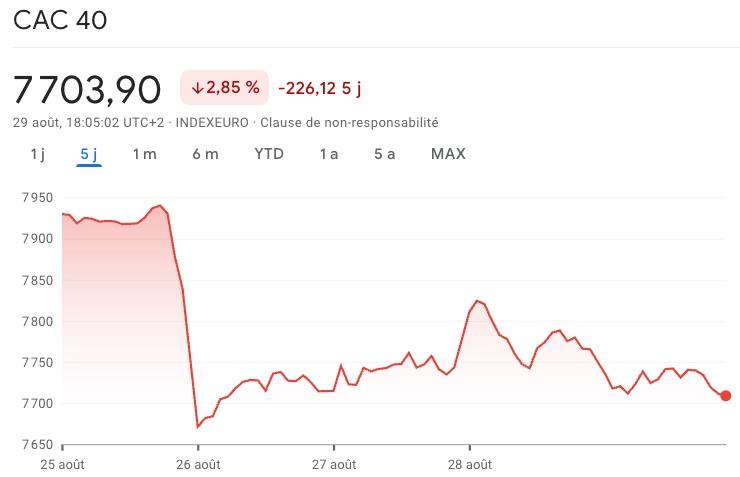
Faced with uncertainty, some would rather exit now than take a bigger risk later.
If the confidence vote fails, there will probably be a dissolution or a change in the Assembly’s composition.
That means more political instability and uncertainty for the French economy.
P.S. I’m not offering solutions, just summarising the facts. I’m not claiming to judge political or economic decisions, or cover every detail.